


Propaganda lauds Mao's China's false claims of eradicating schistosomiasis
China's anti-schistosomiasis campaign began in 1955 when Mao mounted a "socialist high tide" push to bring the socialist revolution to the Chinese countryside
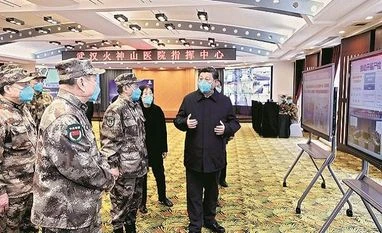 "Xi jinping, china, coronavirus")
Chinese President Xi Jinping visits Wuhan, the outbreak’s epicentre.
Several blogs also recommended that people in Wuhan, the original epicentre of COVID-19, re-read Mao Zedong’s 1958 poem Sending off the plague God, which celebrated total eradication of schistosomiasis from Yujiang, a small county along the Yangtze in central China.
But contrary to China’s official claims that it had successfully eradicated schistosomiasis, this never occurred, a cover up I’ve investigated in a new book. By focusing on this ill-fated campaign in the middle of the coronavirus pandemic, China revealed just how little the relationship between propaganda and public health has changed since the 1950s.
A ‘peasants’ disease
Also known as bilharzia or snail fever, schistosomiasis is a disease carried by a parasitic worm found in fresh water. It can stay in the body for years if not treated and be debilitating, causing organ failure leading to eventual death.
China’s anti-schistosomiasis campaign began in 1955 when Mao mounted a “socialist high tide” push to bring the socialist revolution to the Chinese countryside. The campaign was the centrepiece of the People’s Republic of China’s (PRC) focus on public health, which became the touchstone for public health innovation globally during the cold war.
The CCP leadership singled out schistosomiasis because it was a “peasants” disease which affected those working in the paddy fields and resulted from the traditional way of life of farming communities living in rice-growing regions.
The goal was to eradicate schistosomiasis within seven years, by 1962. As schistosomiasis also afflicts people in many parts of the underdeveloped world, it was thought this would bring prestige to the country if the PRC could be the first to eradicate it.
My research drew on evidence from rarely seen party archives unearthed across eight impacted Chinese provinces and freshly collected oral testimonies from experts, local cadres and villagers who had participated in or were impacted by the campaign. I found that as soon as the campaign was set in motion, the authorities quickly learned that they really had little control over it.
In 1958, at the height of Mao’s Great Leap Forward, a utopian campaign to industrialise China, the PRC became the first country in the world to declare it had successfully eradicated the disease. But it hadn’t.
A grassroots health cadre from Jingzhou in Hubei province who was involved in the local implementation of the campaign told me: