


Home / World News / Philippines spectacle of amnesia: YouTube populism rehabilitates Marcoses
Philippines spectacle of amnesia: YouTube populism rehabilitates Marcoses
Today, 35 years after the People Power Revolution, the Philippine public largely views the disgraced Marcoses not with contempt and dread but with a longing.
 "BongBong Marcos, Imelda Marcos, Philippines")
premium
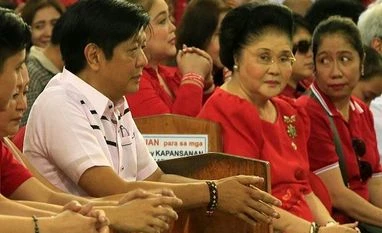
Ferdinand 'BongBong' Marcos attends a mass at a Catholic church with his mother, former first lady Imelda Marcos (2nd from R), in Paranaque city
12 min read Last Updated : Dec 15 2021 | 10:54 AM IST
In the hills of Baguio, the summer capital of the Philippines, a massive head hovers above the trees. Carved on the side of Mount Pugo, La Union, the 30-meter concrete bust overlooks the northern provinces, as if gazing over its vast domain. The head is of former president and dictator Ferdinand Marcos. Yet today, his effigy is hardly recognizable. Shortly after the 1986 People Power Revolution that deposed and exiled the Marcos family, indigenous groups displaced by the bust’s construction returned to smear pig’s blood across the leader’s face. Three years later, communist rebels bombed the same bust, leaving intact only the head’s lower half and exposing its hollow interior. The once powerful Marcos, who steered the Philippines for 21 years, had been deposed, evicted, and now defaced.
Philippine scholar Bobby Benedicto reads such destruction as the symbolic death blows to the Marcos regime, “that for revolution to put an end to the time of dictatorship it must also target the figures that render the dictator timeless and his rule without end.” In literally imprinting himself onto the mountainside, Marcos sought to make visible his legacy, a piece of himself to remember through time. In blowing it up, his detractors shattered that legacy and thereby exposed its contradictions.
Or so was the hope among Philippine democrats in 1986. Today, 35 years after the People Power Revolution, the Philippine public largely views the disgraced Marcoses not with contempt and dread but with a longing for what was, and for what could have been. Indeed, in the minds of many Filipinos, the potential return to power of the Marcos clan is a vindication of what was supposed to be.
With the late dictator’s son, former senator BongBong Marcos (BBM), declaring his candidacy for president in October—and with public support nearly overwhelming—the chance to wrest back power draws closer to reality. A September 2021 Pulse Asia survey, for instance, put Marcos in second place among declared and undeclared presidential candidates, bested only by Sara Duterte, the daughter of the current president-dictator. In October, the Social Weather Stations gave Marcos a 60 percent chance of victory, with runner-up and current vice president Leni Robredo a full 25 points behind. In mid-November, giving the campaign an even greater boost, Sara Duterte joined the late dictator’s son as his running mate.
Even if polls shift in the coming months, it is hard to ignore the vigor and commitment of BBM’s supporters, 8,000 of whom in early November held the longest motorcade in the country, which spanned 78 miles. “We did this to show Bongbong Marcos that we can sacrifice for him,” declared one of the caravan’s volunteer organizers, “There is no need to pay us.” For these Filipinos, the Marcoses did not fall from grace, much less “rape” the country through plunder and torture. These Filipinos see themselves as heirs to a Philippine “golden age,” a glorious legacy interrupted by revolution. The family’s return is thus almost messianic, with its supporters as stewards of a political rapture.
Authoritarian Nostalgia
To observers in the Western world, Filipinos seem like an overly forgiving people willing to forget the sins of the past. To scholars, liberal democracy is systemically flawed, incapable of meeting the rising demands of inequality and representation. Yet perhaps the bust in Baguio offers another kind of answer. While Marcos supporters see it as a tribute to the president’s exemplary leadership and critics consider it a display of his utter vanity, the bust, more profoundly, is a product of a national political culture that has been obsessed with spectacles.
Regardless of whether one agrees with its intent, the bust’s existence radiates a fantasy, papering over the leader’s blemishes for a timeless, unchanging image of strength. For it was Marcos’ aura of public grandeur, after all, that allowed him to literally carve his likeness onto the national landscape. Scaling the larger Baguio countryside, for example, is an eponymous highway that leads to vast bridges, the family’s mansions, and a presidential center. An hour’s drive into Manila reveals grand theaters and complexes commissioned by Marcos’ wife, Imelda. These remnants, like the bust, effectively seed the family’s immortality as physical reminders of apparent prosperity in a country scarred by ruin.
Thus the bust’s destruction, while disfiguring the surface, could not entirely upend a cultural fascination with the spectacular: another “bust” could simply reemerge in its place. Indeed, in recent years, a more powerful one already has. The capacity of social media to democratize spectacle—by flooding the public realm with nearly unlimited “truths”—has intensified the blurring of appearance and fact, performance and policy, past and present. And BongBong’s dominance on YouTube has successfully broadcast a different memory of revolution that is supplanting his family’s national injustice with their political return.
Marcosian Spectacles
You need only watch a few “BBM vlogs” before you start (almost) admiring the late dictator’s son. In one video he’s reviewing viral Filipino TikToks, in another he’s donning new looks in a makeover. Sometimes these vlogs include the whole family for various social media challenges: confronting funny truths with a lie detector, testing their mettle in a “what’s in the box,” and dissing and exposing each other in a “who’s most likely.” The skillful engineering and editing give them the feel of BuzzFeed videos. Depicting the interiority of the Marcos family and the rhythms of their daily lives, the vlogs are cheerful, humorous, affectionate, and seemingly unscripted. In three years, these ahistorical portraits have attracted nearly two million subscribers and millions more viewers. With YouTube and Facebook ranking as the most popular social media apps in the Philippines, the strength of BBM’s online support cannot be understated.
The Marcoses’ deployment of spectacle to stir and sustain mass support is hardly new to Philippine public life. Indeed, for a country that sent world champion boxer Manny Pacquio to its senate and movie star Isko Moreno to the Manila mayor’s office — and placed them third and fourth, respectively, as 2022 presidential favorites — the grand personalization of politics is routine, and almost expected. As Philippine media scholar Anna Cristina Pertierra observes, the “glitz of showbusiness and success of personal charisma evoke positive versions of [patron-client] relationships to generate followings that are easily translated between the screen and the ballot box.” The Marcoses, perhaps more astutely than anyone, recognized this link. In the 1960s, the newly wedded Ferdinand and Imelda Marcos rose to power by boasting expensive looks and offering flashy performances to generate popular appeal. Often singing together at campaign events, they “turned their lives into a private spectacle, staging a stylized version of their intimacy.” Imelda, in fact, fashioned herself as the “People’s Star,” believing that “the poor needed dreams and she fulfilled their wishes by being a star.”
Yet the sheen of the couple’s public charisma soon proved to be affectations when their obsession with aesthetics turned obscene and criminal. In full command of the Philippine economy, they amassed extravagant houses, jewels, artwork, furniture, a legendary collection of shoes, and even a private zoo with animals illegally imported from Africa. According to the Philippine Supreme Court, they drew $10 billion dollars from the nation’s treasury, which they later laundered through Swiss bank accounts. In the later Marcos years, the “conjugal dictatorship” commissioned exorbitant public works projects, a fixation Philippine historian Gerard Lico called Imelda’s “edifice complex.” Behind—and at one point, beneath—these splendid buildings are stains of human tragedy: 50 indigenous groups were forcibly relocated into reservations, and later enlisted to perform tribal rituals for tourists at the Philippine Cultural Center; rural Filipino children starved to death even as the Philippine Children’s Medical Center opened in the capital; and an entire floor of the Manila Film Center collapsed onto 169 workers during its weeks-long construction. Allegedly, the Marcoses ordered the surviving construction crew to simply build over the cement-cased bodies.
To be clear, infrastructure projects are not inherently political props, and are often needed and widely used by the general public. But nearly all of the Marcoses’ sites were built fast, recklessly, and for the pleasure of a global audience while fellow Filipinos literally fell through the cracks. Such is the kind of ruthless impunity seen now in the Marcos’ political return, which has largely been facilitated by BBM’s vlogs of historical revisionism.
Youtube Populism
Three recurring themes emerge from BongBong Marcos’ videos: injury, proximity, and exceptionalism. Each scaffolds a central populist message: you and I struggled for the past 30 years — you and I are cut from the same cloth — so let’s restore this nation’s greatness together.
In a series called “#ProtestWatch,” for instance, BBM documented his refusal to concede the 2016 vice presidential race after barely losing to Robredo, blaming her camp for voter fraud and ballot tampering. After filing legal challenges to the Supreme Court, he recounts in one video how throngs of loyalists who had camped outside the court for 100 days provided him “hundreds and thousands of friendly faces.” In another, to the backdrop of “BBM!” chants, one supporter proclaims, “We are here fighting for the truth!” These protests continued even as the Supreme Court issued a unanimous ruling confirming Robredo’s win and chastised Marcos for his anemic claims. This victim complex is, arguably, an extension of Ferdinand and Imelda’s insistence that anti-martial law activists were insurgents who, out of political avarice, exiled and convicted legitimate public servants. But in the age of social media, such indignation takes on new meaning, as these videos update supporters in real time and invite new followers through vicarious appeal.
Many BBM vlogs also show Marcos and his team carrying out “ayuda drives,” which involve hauling truckloads of food, medicine, clothes, masks, and other supplies to disaster- or COVID-affected areas, and handing them directly to locals. When the Taal Volcano erupted in 2020, engulfing surrounding villages with ash, a BBM vlog showed the former senator touring evacuation centers while taking selfies with families brandishing their new care packages. “It’s important to show that the national government is here for them, too,” Marcos said to the camera, “while the local government is evacuating them from danger.” Thus the appeal of proximity lies not only in cheeky “fast talks” with his son Sandro or an attempt at the popular video game Mobile Legends—efforts that can be read as youth voter outreach—but in being with communities in need as the national response falters. However, even as these vlogs “fatten the heart,” as Marcos puts it, they are indeed another spectacle. While Sandro Marcos chose to hand out personal protective equipment to fellow Ilocanos during his birthday, his family’s long reign over Ilocos Norte, the northwestern coast of Luzon, belies effective public service. According to a 2009 report from the Philippines’ Human Development Index—which measures regional levels of educational attainment, life expectancy, and income per capita—Ilocos ranks sixth, falling behind islands like Davao, Cebu, and Baguio. That’s hardly anything worth vlogging about.
Fading Revolution
Yet those statistics, which stem from policy decisions, will likely never enter the minds of BBM vlog viewers, who avidly believe that the Marcoses carry and share greatness. Celebrating his father’s 104th birthday, BBM reflected on the legacy of the president: “My father had a vision, a dream for our country. Let us return to that concept of service for nation building.” Such messaging urges Filipinos to recall years of national development and strength as a template for forging a nostalgic future, one BongBong inevitably hopes to claim.
But the power of the Marcosian spectacle is that it does not simply project or circulate its truth — it endears and identifies even as it ultimately distracts. For instance, in one vlog praising Filipino resiliency, BBM wipes away tears as he shows videos of people smiling, dancing, and even carrying lechon (roasted pig) as they tread through summer flood waters brimming with trash. “That’s always been the Filipino spirit,” an effusive Marcos declares, “the resiliency of our countrymen is truly out of this world.” However, as writer Jelou Galang argues, romanticizing resilience is toxic, as it normalizes suffering and abdicates government responsibility, giving people permission to forget their righteous rage.
When the singing fades and the cameras stop rolling, the Marcoses’ pockets will still be stuffed with bloodied money — money they stole, money they killed for, money from their own people circling back to create these vlogs. Today, there is no democratic revolution bursting onto the horizon. Instead, Filipinos appear to be finding recourse and recovery in an authoritarian fraud on par with that of President Duterte. Amid a steepening economic crisis, a haphazard pandemic response, numerous corruption scandals, territorial standoffs with China, environmental ruin, and tens of thousands of extrajudicial killings, the resounding popular will is continuity, not revolution. The unique power of YouTube in conditioning this consent thus gives Marcos more than votes or political clout. It gives him ownership over the spirit of People Power, over the right of a disenchanted people to redirect their nation’s future. After more than thirty years of exclusive democracy, Filipinos are doing exactly that by reinstalling the family they had proudly deposed.
What will it take to again expose the hollow core of that bust of Ferdinand Marcos? Perhaps it’s too late to say. Thanks to the combined efforts of BongBong Marcos and Sara Duterte, the bust may soon be whole again.
Patrick Peralta is a Racial Equity Fellow at the Asian Pacific American Institute for Congressional Studies and an intern with Foreign Policy In Focus.
Topics : Philippines democracy