


The heartbreaking story of the flying mathematicians of World War I
Keith Lucas and his colleagues endured freezing cockpits in aerial versions of Russian roulette
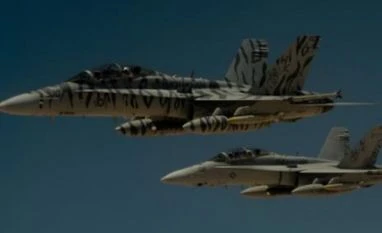 "Two U.S. Marine Corps F-18 Super Hornets depart after receiving fuel from a 908th Expeditionary Air Refueling Squadron KC-10 Extender during a flight in support of Operation Inherent Resolve. (Photo: Reuters)")
Two U.S. Marine Corps F-18 Super Hornets depart after receiving fuel from a 908th Expeditionary Air Refueling Squadron KC-10 Extender during a flight in support of Operation Inherent Resolve. (Photo: Reuters)
But Lucas wasn’t a career pilot, he was a physiologist, and a rather good one at that, having been elected a fellow of the prestigious scientific organisation the Royal Society in 1913. So what had enticed him from the relative safety of his laboratory in Cambridge into the air and, eventually, to his untimely end?
My attempt to fully understand the motivation and circumstances that conspired to put Lucas in that cockpit came as part of an ongoing study of an extraordinary set of aviation pioneers. Just over 100 years ago, a group of mathematicians and scientists were drawn to the Royal Aircraft Factory in Farnborough, Hampshire.
There, they plied their trade at the very heart of British attempts to drive forward fixed-wing, powered aeronautics during its genesis. But they soon realised that if they were to complete their mission they would need to learn how to fly themselves.
Theirs is a tale of technical achievement, flexibility and ingenuity in the context of a new field of engineering, driven apace by the necessities and incentives of conflict. It is also a story punctuated by bravery, commitment, persistence and tragedy.
In 2017, using mathematics to predict the success or failure of an aircraft structure mostly involves tapping keys on a computer while sat in a comfortable office. But 100 years ago, things were very different. Lucas and his colleagues endured freezing cockpits and engaged in aerial versions of Russian roulette in order to significantly expand our understanding. Many of them paid the ultimate price.
Tracking down Lucas
After six months on the trail of these adventurous innovators, I was finding information on Lucas to be particularly elusive. I knew he had been commandeered to work on compass design at Farnborough, but details of his exact involvement in the war effort were sketchy. After I had exhausted all conventional lines of investigation, serendipity intervened.
I happened to be watching a BBC weather forecast when I realised a potential lead was literally staring me in the face. The presenter was Sarah Keith-Lucas. I already knew from my research that the Lucas family had changed their surname to “Keith-Lucas” as a mark of respect after the tragic crash. So was there a connection?
I was thrilled when Sarah replied to my tentative e-mail enquiry and revealed that she was one of Lucas’s great grandchildren. It also transpired that her aunt, Mary Benjamin, was the family archivist and held a stash of potentially interesting material that she was willing to share with me. What’s more, Sarah’s father, Chris, was in possession of an original Lucas compass or two. The trail was suddenly hot again.
I arrived at Mary’s beautiful home to find a horde of Lucas-related treasures laid out for my perusal, from books and articles to personal photographs and letters. Chris had even arranged to have Lucas’s compasses there for me to drool over. After a few hours of reading, note making, and delightful conversation, I had learned a huge amount about Lucas. But still much of his work at Farnborough remained a mystery and only one filing box remained unopened.
Mary thought it only contained material relating to physiology so would likely be of little interest to me, but we decided to have a quick look through anyway. Sure enough, it was full of Lucas’s detailed academic musings concerning muscles and nerves. At the very bottom, however, lay a thick, unmarked brown envelope. I quickly opened it expecting more of the same but, to my delight, it was the aeronautical mother lode: reams of blueprints and associated experimental expositions that documented Lucas’s entire work at Farnborough.
The experience was a unique illustration of how an unexpected archival resource can suddenly appear and help move research forward. Before my adieu, I spent a contemplative moment with one particular item, Lucas’s flying logbook, lovingly kept by Mary, and detailing her grandfather’s fleeting adventures over Salisbury Plain. I have a number of similar books myself, each entry representing a short story in my own life as a pilot. It made me appreciate how lucky I had been. Lucas’s record was brief, so very brief in comparison to mine.
I am still absorbing this wonderful archive of material, but it is already clear that Lucas was instrumental in designing and testing a reliable aviation compass. He was also a key player in the evolution of more accurate bomb-aiming equipment.
The first generation of crude bombsights had been rather unreliable if the aircraft happened to be pitching up and down due to some disturbance in the air. To help develop a more accurate targeting device it was necessary to find a way to record the nature and duration of such pitch oscillations. Lucas’s custom invention, the “photokymograph”, was a piece of analytical equipment that fulfilled this requirement perfectly, and would certainly have made W Heath Robinson proud.
Unsung hero
Yet Lucas was following in the wake of another man, one who is perhaps most deserving of the title “unsung hero” among the mathematicians of the Royal Aircraft Factory, Edward Teshmaker Busk. Unlike those pioneering aviation industrialists of that era who became household names, such as Geoffrey de Havilland and Frederick Handley Page, few people have ever heard of Busk. But if it weren’t for him, the pilots of the Royal Flying Corps may have been obliged to enter the war in machines bereft of intrinsic stability.
After graduating from King’s College, Cambridge, Busk was handpicked to join the Royal Aircraft Factory in 1912 to address an embarrassing hole in the contemporary understanding of aircraft flight performance. Designers couldn’t work out why aircraft only sometimes returned to their original flight path after being knocked off by a disturbance.
The fundamental question was what determined the nature of the oscillations that an aircraft experienced after, for example, it was hit by a strong gust of wind. How could an aircraft be designed so that these oscillations always decayed naturally, without adjustments from the pilot to stabilise them? As fixed-wing aircraft at the time were primarily seen as reconnaissance tools, providing a stable platform for observations was considered an essential.
How solid objects rotate in space and move through a fluid such as water or air were relatively well understood principles at that time. What was missing in relation to an aircraft was a comprehensive understanding of how the lift created by its aerofoil–shaped wings modified the motion. In particular, designers needed to know how the interrelationship between aircraft roll (rotation about the longitudinal axis) and aircraft yaw (rotation about the vertical axis) affected stability following a disturbance.
The theory was laid down in 1911 by George Bryan, professor of mathematics at Bangor University in north Wales. He was able to encapsulate in a pair of equations the design features and conditions necessary to keep an aircraft stable. The problem was these equations couldn’t be solved without knowing certain parameters that depended on how initial forces acting on the aircraft’s surfaces altered its motion about its three axes.
Unfortunately, such data was only available via either rudimentary wind tunnel experiments with models, or by conducting the more dangerous but far more reliable and representative flight tests on full-scale aircraft. This is where Busk’s unique combination of talents became invaluable. He was not only a trained pilot but could also fully understand the implications and argument of Bryan’s rather protracted and exacting mathematics.
Busk designed a raft of bespoke instruments and conducted numerous flight trials to capture values needed to define the unknowns in Bryan’s equations. These so-called “resistance derivatives” that quantified the way the aircraft rolled, pitched and yawed in response to disturbances in the air were the final, vital pieces needed to complete the mathematical jigsaw. As a result, Busk was able to unravel the mysteries of stability, an endeavour that led in 1913 to the production of arguably the first inherently stable aircraft, the RE1.
Sadly, Busk would not see the significant contribution his work made to the war effort. During a test flight on November 5, 1914, a stray spark from the engine ignited a pool of fuel that had leaked into his cockpit. This caused an explosion and fireball that engulfed and completely destroyed the aircraft.
News of his death reverberated throughout the world of aviation. But it also threatened to halt the work of the Royal Aircraft Factory mathematicians before it had really begun. Unwilling to risk the lives of their talented and much-needed researchers, the factory’s superior officers suspended any further notion of allowing them to fly and conduct their own airborne experiments.
Back in the air
That could have been the end of the story had it not been for the continuing war. As the conflict dragged on, the demand for stronger, faster, more manoeuvrable and versatile aircraft grew rapidly. The moratorium designed to protect Farnborough academics, which meant experimental tasks were delegated to army test pilots, started to have serious operational ramifications. Crucial information was being missed or overlooked, resulting in frustrating delays in progress.
By the spring of 1915, one researcher had had enough. In order to circumvent the no-fly diktat, Geoffrey Ingram Taylor cunningly arranged to be sacked from his academic post, enabling him to join the Royal Flying Corps. He quickly learned to fly, only to then immediately reapply and be reappointed to his old position at Farnborough.
The erstwhile meteorologist and Trinity College, Cambridge, graduate could perhaps best be described as the cerebral odd-job man of early aerodynamic research. He investigated exactly how the pressure changes as air flows across the upper and lower surfaces of a wing in flight.
But he also formalised the maths describing the action of a parachute (having learned to use one himself). He would go on to forge a very influential career in applied science and mathematics, eventually becoming one of the Britons seconded to the US to participate in the Manhattan Project to develop the first atomic bomb.
After Taylor’s ploy, the academic rebellion against being grounded gained momentum. The unofficial shop steward of the movement was physicist Frederick Lindemann, who eventually negotiated a deal to allow him and three others (Keith Lucas, George Thomson and William Farren) to attend flight school.
He would later go on to star as Churchill’s senior scientific advisor during World War II, and eventually became a peer of the realm. But Lindemann’s immediate preoccupation after his flight training was to tackle the uncertainty surrounding a problem responsible for scores of deaths and the loss of as many airframes, that of spinning.
Aircraft were entering spins generally due to mishandling at slow speed, and the actions needed for a safe recovery were poorly understood. No one had yet determined the mathematical description of the spiral associated with an aircraft’s path through the air during a spin, or the exact state of its flying and control surfaces.
It took Lindemann’s courage in conducting the necessary flight tests, combined with the deeper insight of British mathematician Hermann Glauert, to produce the full theoretical analysis needed. The practical spin recovery actions this work inferred would subsequently save the lives of countless pilots – including my own – who have had the misfortune to be caught in a spin.
What was so remarkable about Lindemann’s willingness to expose himself to such a life-threatening manoeuvre was his complete lack of piloting experience. His mathematical calculations indicated that the way to arrest the spin was to initially stop the rotation using rudder and then counterintuitively push the nose down rather than pull it up.
The key point was that any stalled sections of wing had to be returned to normal flight. Once in a vertical dive rather than in a spin, an aircraft can be eased out of the predicament using normal control inputs –- assuming the ground doesn’t intervene first, of course. During those initial test flights, Lindemann must have been treading a very fine line between extreme bravery and complete insanity. Clearly his long career after Farnborough shows he trod it extremely well.
Further breakthroughs – and tragedy
Not all of the Farnborough set were as fortunate as Lindemann. David Hume Pinsent is perhaps more famous for his relationship with philosopher Ludwig Wittgenstein than for his academic prowess. But he was one of Cambridge’s top mathematicians among the cohort that graduated in 1913 and his work in aeronautics should not be ignored. His aspiration to become a pilot was never realised, but he spent many hours in the air as an observer conducting experiments, notably on aircraft tail loading.
He was a popular choice for this role due to his slight frame, which allowed a plethora of technical equipment to be stashed in the cockpit alongside him. He kept a diary throughout his life that offers personal insight into the nature of his school, university and professional environments and relationships.
I have also held and read the heartbreaking letters in which he reassures his concerned mother about the safety of his airborne exploits. He would die on May 8, 1918, when his DH4 aircraft suffered structural failure during a routine air test.
In August of the same year, the name of Hugh Archibald Renwick was added to the growing list of academic casualties. Renwick had survived a bullet that went clean through his chest while he was in action at the front during the early phase of the war.
The Pembroke College, Cambridge, graduate’s talents in mathematics and engineering were thought too valuable to risk losing by returning him to active duty following his recovery. How ironic that his life would end in a similar fashion to that of Pinsent, when a wing of his RE8 failed at 2,000 feet during a similar air test.
There are many other academics I could mention, all of whom contributed in some way to the advancement of British aeronautics. It was certainly an exciting field to work in, but also one fraught with danger, particularly for those who ventured skyward.
As a humble modern-day pilot and mathematician I feel nothing but respect for the contributions and sacrifices of these amazing pioneers of fixed-wing aeronautics. Though they mostly came from civilian backgrounds, the motto of the Royal Air Force applies as much to them as their battling counterparts. Per ardua ad astra – Through adversity to the stars.
Tony Royle, PhD Candidate in History of Mathematics, The Open University
This article was originally published on The Conversation. Read the original article.