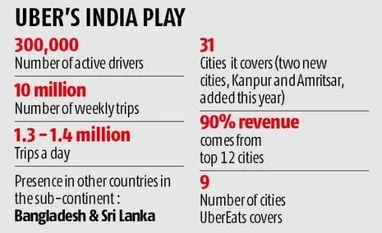
Will it do the same in India, where it competes with home-grown Ola? Sources close to the company do not think so. "For Uber, India is the last major market outside of the US. The company will hold off any talks of merger as long as it can. It is going to increase its use cases and add more services. Whatever the case might be, Uber still has deeper pockets than Ola. It can continue the price war for some more time. Also, the sale of business to Grab gives Uber enough firepower to concentrate on India. If it wins in the Indian market, the rest of its recent losses will not matter much," said a source close to the company.
Also, there has been the question of whether or not a monopoly in the cab-aggregating space will be allowed. Industry experts believe that the Competition Commission of India (CCI) might step in to prevent such a scenario. It will not allow a single player to hold all the chips and dictate terms.
During his India visit last month, Khosrowshahi had also reiterated that India was a key growth point for the company. He had indicated that he would not go by the advice of investors like SoftBank, which want the US-based firm to scale back to countries where it already has a strong market position.
Refusing to disclose how much Uber had invested in India, he had said: "It is a lot and that investment is going to continue."
Asked if SoftBank, which is also an investor in rival and India market leader Ola, had asked Uber to focus on the profitable market, Khosrowshahi had said his company's strategies were decided by the board.
"While SoftBank may have an opinion, that is not the only opinion in the room," he had said. "It is my belief that we as a company need to have a balanced profile in terms of growth and investment."


 "uber chart")