


Nifty closes above historic high of 9,500
Becomes the second-most expensive index globally
 "Nifty closes above historic high of 9,500")
premium
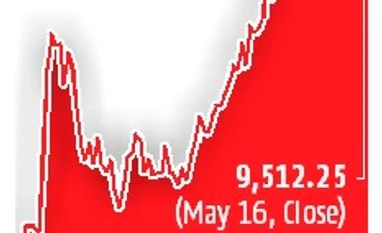
Indian equities are officially in a bull market now, with the benchmark Nifty gaining about 20 per cent since the post-demonetisation low. The Nifty crossed the psychological barrier of 9,500 points on Tuesday to close at 9,512, up 1,604 points or 20.28 per cent from the previous lows on December 26 last year.
According to experts, a 20 per cent rally from the previous low confirms the market is in a bull phase. Similarly, a 20 per cent correction from the peak is considered the beginning of a bear phase.
At the current closing, the market capitalisation of the BSE-listed companies in dollar terms is $1.99 trillion — making Indian markets just $7.3 million short of joining the elite $2 trillion club.
The rally this year has also driven up valuations of Indian equities. The one-year forward price to earnings (P/E) ratio of Nifty is 22.4 times according to Bloomberg. This makes Indian markets more expensive in terms of the P/E ration compared to other major global indices including Dow Jones, S&P 500, FTSE 100, DAX, Shanghai Composite and Nikkei.
The only other major index that is valued higher than the Nifty is the Nasdaq Composite, a gauge of 3,000 listed equities currently trading at a forward valuation of 33 times the P/E.
According to U R Bhat, managing director, Dalton Capital Advisors, although valuations are on the higher side, the markets are still not expensive. “The rise in valuations of Indian equities is on account of high demand from both domestic and foreign institutional investors (FIIs). Although in absolute terms, Indian markets are trading at high P/E multiples, considering the potential of our market and economy, our securities are not expensive. However, these valuations need to be supported by strong corporate earnings,” Bhat said.
According to experts, a 20 per cent rally from the previous low confirms the market is in a bull phase. Similarly, a 20 per cent correction from the peak is considered the beginning of a bear phase.
At the current closing, the market capitalisation of the BSE-listed companies in dollar terms is $1.99 trillion — making Indian markets just $7.3 million short of joining the elite $2 trillion club.
The rally this year has also driven up valuations of Indian equities. The one-year forward price to earnings (P/E) ratio of Nifty is 22.4 times according to Bloomberg. This makes Indian markets more expensive in terms of the P/E ration compared to other major global indices including Dow Jones, S&P 500, FTSE 100, DAX, Shanghai Composite and Nikkei.
The only other major index that is valued higher than the Nifty is the Nasdaq Composite, a gauge of 3,000 listed equities currently trading at a forward valuation of 33 times the P/E.
According to U R Bhat, managing director, Dalton Capital Advisors, although valuations are on the higher side, the markets are still not expensive. “The rise in valuations of Indian equities is on account of high demand from both domestic and foreign institutional investors (FIIs). Although in absolute terms, Indian markets are trading at high P/E multiples, considering the potential of our market and economy, our securities are not expensive. However, these valuations need to be supported by strong corporate earnings,” Bhat said.