


Arnab Goswami and the art of the interview
Goswami's interview with PM Modi failed the viewers because the interviewer remained in awe of his subject and refused to ask tough questions
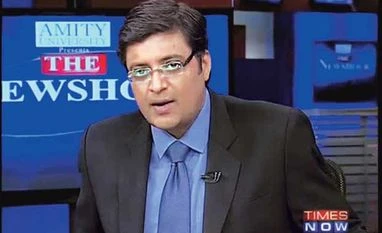 "Arnab Goswami and the art of the interview")
In the parlance of journalism, there exist various definitions of an interview.
The Columbia School of Journalism describes the purpose of an interview as where the audience gathers information about the interviewee’s character, ideology and belief. Famous BBC radio presenter Peter Allen described a good interview as one in which the interviewer challenges evasions and unfounded propaganda.
The much hyped interview of Prime Minister Narendra Modi with Arnab Goswami fails on both criteria. It fails because the interviewer remained in awe of the Prime Minister and refused to ask difficult questions.
Also Read

Now, human beings are not devoid of emotions and can hold a person in such high regard as to become hesitant to ask difficult questions. And journalists are human beings. It can be assumed that Goswami adores the Prime Minister so much that his professional duties took a backseat to his emotions.
Hence, let’s look back at the interview that the star anchor did with Modi in the polarised environment of the 2014 general elections. Modi was then the BJP candidate for the Prime Minister’s post and was equally selective about the journalists that he would speak to.
Goswami got the opportunity and the interview brought the best out of a senior primetime anchor.
With his very second question Goswami pinned Modi about his grouse against the Election Commission, asking him the reason for the tirade against the regulator when it was just doing its job. “I have not uttered a single word, where does the question of anger arise?” replied Modi. Goswami pressed back saying that the Bharatiya Janata Party is on record criticising the Commission.
Goswami then followed it up with questioning Modi on why he gave a casteist spin to an innocuous verbal duel with Priyanka Gandhi, an opposition leader and daughter of Congress president Sonia Gandhi. The reply was hostile. Modi accused the channel of protecting the Gandhi family and said it did not have the courage to speak the truth. Goswami dismissed the allegation by replying in a louder voice, “We ask questions (of) everyone equally,” and then asked him again how the casteist spin synched with his idea of a composite India. That was cross questioning – a skill whose importance during an interview is emphasised by Jacqui Banaszynski, a Pulitzer prize winning writer, in a paper where she writes “For every question ask five more.”
Goswami did not stop there and further provoked Modi on the touchy subject of ‘Hindutva’ saying that some of his statements “favoured a particular religion”. He disagreed with Modi on the idea of India being a Hindu nation. The eloquent public speaker could not manage more than an “I am ready to accept whatever you are saying.”
There were multiple other incidents of confrontation between the two which made the interview a process of dialogue rather than the monologue that transpired on Monday, where the toughest question that Modi faced was on the attacks on outgoing RBI governor Raghuram Rajan by Subramanian Swamy. The question was sugarcoated and was so verbose that the Prime Minister’s rather mild “inappropriate” comment looked like a severe reprimand on Swamy.
Modi was not cross-questioned by his illustrious interviewer on his silence as his party colleague went on a tirade of disgraceful personal attacks on the country’s central bank governor. Will action be taken against him?
While lauding the Prime Minister on his aggressive foreign policy, Goswami refrained from asking whether such an aggressive push for the NSG bid was what failed it. Or asking Modi about the extent of control on the government by the Sangh Parivar even as Modi was blaming the media for making heroes out of communal hotheads. Instead, he spent airtime on expressing his gratitude to the Prime Minister for the interview opportunity.
Oriana Fallaci, an Italian journalist famous for her interviews with heads of state including dictators and guerrilla leaders, believes that the reason they open up is because of her unwillingness to bow down because of her presumption that the public is entitled to answers. Clearly, the most watched Indian news anchor does not believe so.
Under the effective publicity mechanism of the current government, where the tap opens for journalists toeing the government line and shuts for others, Goswami has been successful in getting the interview. But in the process, he has made the history of Indian journalism poorer.
Don't miss the most important news and views of the day. Get them on our Telegram channel
First Published: Jun 28 2016 | 10:09 AM IST