Thursday, December 25, 2025 | 08:37 PM ISTहिंदी में पढें
Business Standard
Notification Icon
userprofile IconSearch

China's Taiwan tangle

More doubts on 'one-country-two systems' principle
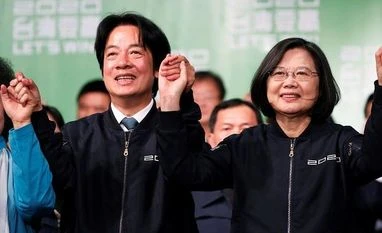
taiwan elections, Taiwan President Tsai
premium

Taiwan Vice President-elect William Lai and incumbent Taiwan President Tsai Ing-wen celebrate at a rally after their election victory, outside the Democratic Progressive Party (DPP) headquarters in Taipei, Taiwan. Photo: Reuters

Business Standard Editorial Comment
The landslide re-election of pro-independence Taiwanese President Tsai Ing-wen raises a fresh challenge for China’s “one-country-two systems” principle on its south-east and southern peripheries. Taiwan’s election results are significant because they come soon after Beijing’s unsuccessful efforts to quell pro-democracy protests in Hong Kong, which resulted in a resounding defeat for pro-Chinese candidates in local elections there. Ms Tsai, who came to power in 2016, had explicitly rejected the ambiguous 1992 consensus between the Kuomintang, then the ruling party, and China, binding the two more closely on the “One Country-Two Systems” principle, including multiple trade and economic cooperation agreements. Even in a society as efficiently repressive as China, the possibility of pro-democracy blowback on the mainland represents a danger to Xi Jinping, appointed president for life in 2018, and the seven-decade dictatorship of the Communist Party. So Beijing’s response to these geographically peripheral but politically significant threats to its authority remains the big question.

Thus far, Beijing has followed the familiar path of upping the ante in both territories. The head of the Taiwan Affairs Office has intoned the party line that China would oppose any acts for the independence of Taiwan. In Hong Kong, Beijing replaced its top representative last week, signalling a doubling down of action against protestors there. How far these muscular moves are likely to bind one de facto  independent nation and one semi-autonomous territory to the authoritarian regime in Zhongnanhai, seat of China’s party and government, is an open question. The mushrooming of anti-government posters in Hong Kong following the Taiwan election results tells its own story. 

Inconveniently for Mr Xi, the test for this notion of “one country-two systems” lies in the economy, specifically, the outcome of the debilitating trade war with the US and its heavy dependence on Hong Kong for inward investment in mainland trade and industry. China’s economy has been slowing steadily —its 6 per cent third-quarter print marked the lowest in 27 years — and the seven-month long protest saw Hong Kong’s economy shrink 3.2 per cent in the third quarter, leaving jittery global financial institutions to eye alternative locations in South-east Asia. Ironically, however, the trade war with the US saw Taiwan’s economy grow 2.6 per cent — faster than Singapore or Korea. This growth has been the result of a surge in Taiwanese firms investing at home, principally by on-shoring investments from mainland China. Intellectual property disputes have been at the heart of the US-China trade war and Taiwanese business responded by relocating their ICT platforms from China to Taiwan, despite higher costs. The result has been healthy 16 per cent growth in US-Taiwan trade (most of it in ICT).

Ms Tsai’s rise to power in 2016 — she won 56 per cent of the vote then and 57 per cent in 2020 — was an expression of young Taiwanese’ disaffection with the Kuomintang’s close economic ties with the People’s Republic of China, making China Taiwan’s largest trading partner. Going forward, the economic differentials between a slowing dictatorship and a fast-growing democracy may well undermine the legitimacy of China’s regime far more insidiously than the 1989 students’ protest in Tiananmen Square. And even if Beijing cracks down with greater viciousness on Hong Kong’s protestors, Taiwan will remain the bigger democratic thorn in Beijing’s side for some time to come.