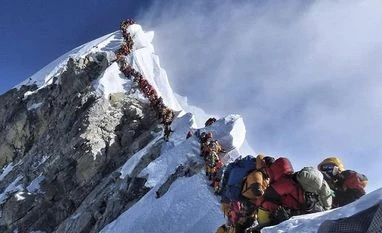
Everest may be the world’s highest mountain, at 29,035 feet, but it is by no means the hardest to climb (that honour would go to Annapurna and Nanda Devi). Thanks to technological advances in terms of oxygen and lightweight equipment, the south face route, pioneered by Tenzing Norgay and Edmund Hillary in 1953, became the favoured line up the mountain. Far fewer expeditions attempt the North Face on the China side because it is by far more technically difficult. Because of its relative simplicity, the south face route came to be known — much to Hillary’s fury — as the “milk run”, and by the nineties, western tour adventure companies were offering “guided tours” along it. As a result, the small band of seasoned mountaineers who understood and accepted the risks associated with their sport came to be outnumbered by amateurs with zero experience. Anyone of reasonable fitness and who could afford anything between $45,000 and $80,000 for a tour could be “short-roped” (literally hauled) up by teams of sherpas for the privilege of standing on the peak. Poverty and poor economic development in Nepal have fuelled this business and brought down tour costs.
The dangerous consequence of Everest’s tourist boom became evident in 1996. Six tourists who had paid $70,000 each and two famous guides died in a single night when congestion on the fixed ropes delayed their descent and trapped them in the open when one of the worst storms of the century lashed the mountain. Each year, the traffic jams caused by amateurs on the “milk run” have raised the risk levels for all, including genuine mountaineers. Each year, mountains of human waste and a mounting number of bodies are compounding the dangers posed by global warming in damaging this beautiful 60 million-year-old eco-system.
The travails of Mount Everest may represent the pinnacle, so to speak, of the ecological damage of adventure tourism, which is growing exponentially thanks to advanced equipment and falling costs. In developed countries such as Australia and Switzerland, for instance, local awareness is encouraging authorities to restrict tourism in areas such as the Great Barrier Reef in Australia (which is also threatened by global warming) and the Alps, in Switzerland. In the latter, for instance, climbing permits are restricted every season, issued only to those of proven mountaineering expertise and all mountaineers are required to follow specified waste-management norms. At the bottom of the world, tourism has added a sinister dimension to the ecological problems of human activity assailing the Antarctic, where pollution caused by visiting ships and disturbances caused by tobogganning and skiing tourists are threatening a range of local fauna and flora. Adventure tourism is but a sub-set of other deleterious human activity that is destroying our planet. Addressing it requires, to echo the Dalai Lama, overcoming the Everests of our minds.


 "Mount Everest")