As the architect of a “new” Jammu and Kashmir (“Naya Kashmir”), Union Home Minister Amit Shah’s political fortunes are linked to the successful execution of that project. Hence perhaps the unusual involvement of the most powerful man in the country in what is on the face of it a mere district level election. The decision of local political parties appears to have sufficiently disturbed Shah to describe them as the “Gupkar Gang” as if they were criminals and to allege that they want to “invite foreign forces” into J&K and take India “back into the era of terror and turmoil”.
Successive attempts by the home ministry to “create” a new political leadership for “new” Kashmir as an alternative to the so-called “dynastic leadership” of mainstream parties have failed. Ambitious bureaucrat, Shah Faesal, encouraged to form a brand new alternative in the shape of the J&K Peoples’ Movement, has quit politics in less than one and half years. Nor could the village panchayat or the urban local body elections produce viable political leadership. Delhi’s sponsorship of the J&K Apani Party under the leadership of businessman Altaf Bukhari seems stillborn. The Centre’s renewed attempt to create “grassroots” leaders for the third tier of local governance, through the DDC elections is now threatened by the collective participation of traditional J&K parties as a unified front.
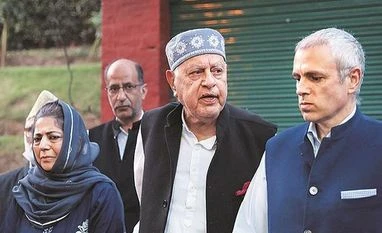
Thus far the mainstream political parties of J&K had boycotted local body elections. The Union government expected a similar free passage in the DDC polls as well. Indeed that was the impression given by the mainstream political parties of J&K when they met at former chief minister Mehbooba Mufti’s residence on October 24, 2020 under the rubric of Peoples Alliance for Gupkar Declaration (PAGD). It takes its name from Gupkar Road, on which the residence of former chief minister Farooq Abdullah is located and where the state’s parties adopted a resolution against the revocation of Articles 370 and 35A on August 4, 2019 and projected the restoration of the special status of J&K as their central political agenda. However, they have now decided not to let the DDC elections go uncontested and put up joint candidates.
Farooq Abdullah with son Omar and Mehbooba Mufti
What made the mainstream parties decide to participate in the DDC elections? They have been criticised by some who hold that by contesting the DDC elections they were in effect accepting the abrogation of Article 370 and ‘normalising’ the decisions of August 5, 2019.
The PAGD’s seven constituents are political parties that cannot push their agenda for restoration of J&K’s special constitutional status by yielding normal political space to the BJP. They must keep their local organisational structures alive by encouraging their cadre and local representatives to engage in democratic political processes such as elections.
Their refusal to be pushed to the margins of active politics has upset the Union home minister and forced him to modify his strategy. It involves projecting the PAGD as an ‘anti-national’ alliance by playing up their statements on restoration of a separate flag for J&K, and some careless statements by Farooq Abdullah as an invitation to hostile foreign forces to meddle. Although Shah’s accusations of a ‘unholy global gathbandhan’ make little sense when the election is for local bodies, his statements have put the main national Opposition party, the Congress, on the defensive and distancing itself from the PAGD.
While the BJP may not expect to do well against Alliance candidates in the Kashmir Valley, it must ensure a decisive win in Jammu. Jammu is its traditional base and it has claimed that the people there had welcomed its Kashmir policy. Should the BJP fail to sweep the elections in Jammu, it would show that the public mood has substantially changed in the region, following the enactment of unpopular land ownership laws. These laws are indispensable to the BJP’s unitarian idea of the nation and for demonstrating the “full merger” of J&K with the Union of India.
Had the Congress remained in the PAGD, the BJP’s chances of electoral victory would be diminished in areas with near even Hindu and Muslim population. There is some support for the National Conference in areas of Jammu like Doda, Kishtwar, parts of Rajouri, Poonch and Nowshera. If the National Conference and Congress put up separate candidates then a three-cornered contest would suit the BJP.
Even in the rest of Jammu where the contest is a direct one between the Congress and BJP, the BJP needs the Hindu vote to be consolidated. Were that not to happen, other factors could still lead to defeat of BJP at the hands of the Congress even in Jammu.
Assembly elections are still up in the air until constituencies can be delimited to suit the BJP. So winning the DDC elections is important to prove that the people of Jammu accept the political changes in J&K. If the land laws have indeed angered the people of Jammu then the electoral prospects for the BJP may not be very bright.
It is against these stakes that one must read the moving of non-BJP candidates into “cluster accommodation”, ostensibly for their own safety but preventing them from campaigning effectively. They are being sent in vehicles along with BJP candidates to campaign “together”.
As it is, the Kashmir policy of the BJP government is not accepted by the public in Kashmir and it is evidentially also not popular in Ladkah. If even the Jammu residents reject it, then it would be difficult for the Union Home Minister to demonstrate any local support for his Kashmir policy, underlining that it was entirely the result of his party’s ideological predilections.
Twitter:
@Bharatitis


 "Farooq Abdullah, Omar, mehbooba mufti, article 370, j&k")