


India's 'Indo-Pacific' challenges
New Delhi must synergise its maritime policies with those of other littorals of the Indo Pacific
 "naval ships, Arabian Sea")
premium
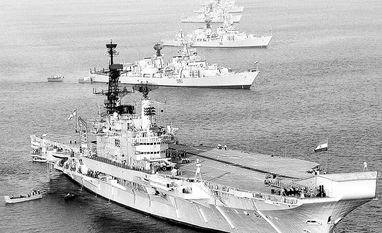
Indian naval ships in the Arabian Sea: A steady decline in maritime capability?
In recent years, the concept of Indo-Pacific, first articulated in 2009 by then US Secretary of State Hillary Clinton, has been the subject of discussion at different strategic forums. Sometimes, the theatre has also been referred to as Indo-Asia-Pacific, but shorn of the terminology used, it represents the stretch of unbroken, largely maritime domain, running from the Gulf countries on one side to the littorals of the Western Pacific on the other. Global security concerns and interests are now getting focused on this part of the world more than on any other.
Several factors have led to the shift in global strategic concerns from Europe to Asia. With the collapse of the former Soviet Union by 1990, the confrontation between the Nato alliance and the Warsaw Pact nations came to an end. The economic rise, first of Japan and then of China, further altered the equations eastwards. The increasing dependence of both on energy resources from the Gulf added to the new scenario.
Several nation-state tensions, some leading to conflict and others simmering just below the surface, were endemic to the region, to which were added the activities of non-state actors, first through piracy and then through terrorism, leave aside other crimes such as drug smuggling and human trafficking. These have created a potentially volatile environment which can have far-reaching effects on the stability of the region. As a major Indian Ocean Region (IOR) littoral state, India cannot remain unaffected.
America has serious military assets in the Western Pacific with bases in Japan, South Korea, Australia and Singapore. Even if former US President Barack Obama’s “Pivot to Asia” is no longer talked about, much of the $54 billion that President Donald Trump is earmarking for beefing up US military capabilities will, inevitably, find reflection in this region. The US cannot accept significant alteration of the status quo and this will always be a source of contestation between it and China, even as the two continue to have a sizeable trade relationship.
Several factors have led to the shift in global strategic concerns from Europe to Asia. With the collapse of the former Soviet Union by 1990, the confrontation between the Nato alliance and the Warsaw Pact nations came to an end. The economic rise, first of Japan and then of China, further altered the equations eastwards. The increasing dependence of both on energy resources from the Gulf added to the new scenario.
Several nation-state tensions, some leading to conflict and others simmering just below the surface, were endemic to the region, to which were added the activities of non-state actors, first through piracy and then through terrorism, leave aside other crimes such as drug smuggling and human trafficking. These have created a potentially volatile environment which can have far-reaching effects on the stability of the region. As a major Indian Ocean Region (IOR) littoral state, India cannot remain unaffected.
America has serious military assets in the Western Pacific with bases in Japan, South Korea, Australia and Singapore. Even if former US President Barack Obama’s “Pivot to Asia” is no longer talked about, much of the $54 billion that President Donald Trump is earmarking for beefing up US military capabilities will, inevitably, find reflection in this region. The US cannot accept significant alteration of the status quo and this will always be a source of contestation between it and China, even as the two continue to have a sizeable trade relationship.
Indian naval ships in the Arabian Sea: A steady decline in maritime capability?
Disclaimer: These are personal views of the writer. They do not necessarily reflect the opinion of www.business-standard.com or the Business Standard newspaper