


It's the incentives, stupid
The most important post-mortem required after the YES Bank crisis is about flawed incentives of bankers and officials
 "bank, regulation, crisis")
premium
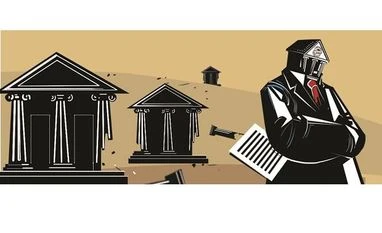
Illustration: Ajay Mohanty
Conservatives have argued that the existing policy machinery of Indian finance is broadly fine. The difficulties of YES Bank are a reminder that there are significant difficulties in the policy apparatus. It is important to not slip into personalising the failure. The personnel in the government and the Reserve Bank of India (RBI) have tried to battle with the difficulties with intelligence and determination. The failure lay in institutional capacity, in the impersonal working of incentives and information. The solutions lie in such institutional reform.
Market-based credit risk measures show that YES Bank was in a difficult zone from 2011 to 2014, and then from 2018 onwards. And yet, in the data of March 2019, it reported a nice capital adequacy ratio (CAR) of 16.5 per cent, a value that was clearly wrong. There was failure in both, the legislative function of banking regulation (i.e. the design of regulations) and the executive function of regulation (i.e. the implementation of regulations, also termed “supervision”).
The endgame may have been precipitated by an exit of deposits. The incipient stages of a bank run are extremely unpleasant; policymakers get a flurry of difficult days with little time to think and carefully design. But there was no need for the authorities to wait till this endgame. There was ample time in which the resolution could have been planned. While we recognise that India lacks the “resolution corporation” that would do a tidy resolution for some financial firms, the bespoke resolution of YES Bank and Infrastructure Leasing and Financial Services (IL&FS) looks more messy when compared with previous experiences with bespoke resolution in UTI (2001) and Global Trust Bank (2004).
How might this event change the prior of economic agents? Private persons might trust the disclosures and credit-worthiness of private banks less, and trust electronic payment systems less. If mistrust clusters around a group of stressed private firms, it could morph into contagion through reduced access for these firms to credit and deposits. The incentive implications of these changes might prove to be more important for the economy, in the long run, than the immediate disruption.
In the mainstream discourse, the collapse of a firm is seen as the failures of individuals, both in the firm and in policy institutions. We should be sceptical about the theory that the event is caused by some bad human beings. A more abstract view is more insightful, which sees the individuals as merely playing out the role for them in a vast drama, where each person is responding to incentives.
The human actions that added up to the failure of YES Bank were responses to incentives. We bemoan the willingness of people in India to go through a red light but persons of Indian origin do pretty well at respecting traffic lights, when driving in other countries. Human beings are roughly the same everywhere, the key thing that matters is the incentives that we are placed under. The most important post-mortem required after YES Bank is not the investigation and fault-finding of individuals: We should worry about the flawed incentives at work.
Market-based credit risk measures show that YES Bank was in a difficult zone from 2011 to 2014, and then from 2018 onwards. And yet, in the data of March 2019, it reported a nice capital adequacy ratio (CAR) of 16.5 per cent, a value that was clearly wrong. There was failure in both, the legislative function of banking regulation (i.e. the design of regulations) and the executive function of regulation (i.e. the implementation of regulations, also termed “supervision”).
The endgame may have been precipitated by an exit of deposits. The incipient stages of a bank run are extremely unpleasant; policymakers get a flurry of difficult days with little time to think and carefully design. But there was no need for the authorities to wait till this endgame. There was ample time in which the resolution could have been planned. While we recognise that India lacks the “resolution corporation” that would do a tidy resolution for some financial firms, the bespoke resolution of YES Bank and Infrastructure Leasing and Financial Services (IL&FS) looks more messy when compared with previous experiences with bespoke resolution in UTI (2001) and Global Trust Bank (2004).
How might this event change the prior of economic agents? Private persons might trust the disclosures and credit-worthiness of private banks less, and trust electronic payment systems less. If mistrust clusters around a group of stressed private firms, it could morph into contagion through reduced access for these firms to credit and deposits. The incentive implications of these changes might prove to be more important for the economy, in the long run, than the immediate disruption.
In the mainstream discourse, the collapse of a firm is seen as the failures of individuals, both in the firm and in policy institutions. We should be sceptical about the theory that the event is caused by some bad human beings. A more abstract view is more insightful, which sees the individuals as merely playing out the role for them in a vast drama, where each person is responding to incentives.
The human actions that added up to the failure of YES Bank were responses to incentives. We bemoan the willingness of people in India to go through a red light but persons of Indian origin do pretty well at respecting traffic lights, when driving in other countries. Human beings are roughly the same everywhere, the key thing that matters is the incentives that we are placed under. The most important post-mortem required after YES Bank is not the investigation and fault-finding of individuals: We should worry about the flawed incentives at work.
Illustration: Ajay Mohanty
Disclaimer: These are personal views of the writer. They do not necessarily reflect the opinion of www.business-standard.com or the Business Standard newspaper