Come to think of it, Gobindapur has all the water-related woes. As this district is on the coast, sea water contamination has made the water saline. Summer makes it worse when water in Bhadrak’s rivers and ponds evaporates. “We often face a water shortage as the ponds dry up,” Behera says. “During the rains every single year, our village gets flooded and we have water problems of another kind,” she adds. To make matters worse, the district is also prone to cyclones, which have recently been occurring with clockwork regularity year after year. “During floods and storms, it becomes that much harder to go to any water source to fill our buckets,” she says. Consequently, accessing safe drinking water is a problem throughout the year.
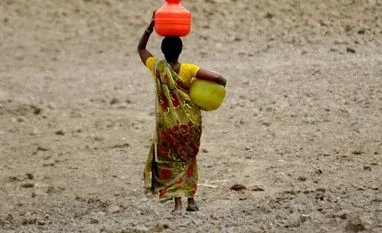
At the hand pump, groups of women wait for their turn to fill their buckets. Their children play nearby. Since her husband is too old, son works in the city and daughter-in-law is pregnant, the job of fetching water falls solely on Behera’s frail shoulders. “I worry about what will happen when I’m too old to fetch water,” says she. “I can’t lift heavy loads already so am forced to carry back only half a bucket at a time”.
It strikes me that fetching water is restrticted mostly to women. “It’s true,” says Behera. “Men go out to work, so it’s the women who break their backs carrying water.” It’s worse during floods. “We have to find higher ground and walk much longer distances to get water,” she says. Recently, the government of Odisha announced a Rs 754 crore project to ensure safe drinking water in some of Bhadrak district’s worst affected blocks. Even if the project is executed, it simply may not be enough. “Sometimes, when I’m too tired to go to the hand pump, I fill the bucket from the pond near our house,” she says. “I wonder what my life would be like if we actually had pipes delivering water to our doorsteps.”
This year’s theme for World Water Day — “Leaving no one behind” — will hopefully draw international and domestic attention to the plight of Behera and countless other women like her who spend most of their productive lives simply ferrying buckets of water for their daily needs. Unless this happens and water reaches each household in every Indian village, the United Nation’s Sustainable Development Goals to which India is a co-signatory, will remain little more than a pipe dream for much of rural India.


 "drought")