


Home / India News / Kerala political violence: BJP in search of gold in minefield
Kerala political violence: BJP in search of gold in minefield
Govt has already given Rs 40,000 cr to the state to expedite its flagship projects
 "Amit Shah, BJP")
premium
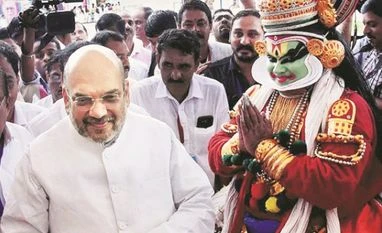
BJP President Amit Shah (left) arrives at the inauguration of the party’s National Council in Kozhikode, Kerala. (File photo: PTI)
Last Updated : Aug 13 2017 | 11:19 PM IST


On August 9, at a modest gathering of the Rashtriya Swayamsevak Sangh (RSS) faithful at this city’s protest hub, Jantar Mantar, the slogans and speeches were appropriately evocative. Called to draw “national” attention to the murders and attacks on their “swayamsevaks” (volunteers) in Kerala, allegedly by CPI(M) activists, the demonstration was occasioned by the killing of a young Dalit tempo driver, S L Rajesh, on July 29 in the latest cycle of assaults and reprisals.
India Policy Foundation, a Sangh-sponsored think tank, convened the protest. It mocked a similar but far larger rally at the same venue in June after the communal killing of Junaid on a train by a mob, to make the point that the capital’s ‘Left-Liberals’ had “double standards” on political assassinations. Parsed, it meant that for those people, minority lives were more precious than those of the Hindus. The speakers, including BJP MPs Vinay Sahasrabuddhe and Shobha Karandlaje, conjured visions of dismembered bodies, wailing mothers and wives, and a complicit Kerala police.
Among those accused at last week’s meet were chief minister Pinarayi Vijayan and his party colleague, Kodiyeri Balakrishnan. With a Bharatiya Janata Party (BJP) government at the Centre, the RSS decided it was time to situate the violence on a broader ideological canvas, target the state’s ruling Left Democratic Front, and try and paint its government in a corner, though the BJP’s political stakes presently remain rather low. It opened its account only in the 2016 Assembly election, when octogenarian O Rajagopal won a seat.
Last week, Arun Jaitley, the Union finance and defence minister, called on Rajesh’s family in Thiruvananthapuram, state governor P Sathasivam asked Vijayan to convene a ‘peace’ meet and the Sangh’s joint general secretary, Dattareya Hosabale, addressed the media in Delhi.
Although Vijayan was tetchy at the meet, the combined endeavour reportedly forced him to direct the CPM cadre to not “needlessly” provoke and clash with the RSS, lest the Centre intervened. Ironically, a central BJP leader engaged with the southern states believes that if the CPM obeyed Vijayan, the BJP would lose its campaign theme. “Many in our ‘parivar’ cannot talk on issues of economy and education. For them, CPM violence is the bread winner,” he disclosed.
How will the RSS-BJP’s high-pitched offensive transfigure into votes? V Muraleedharan, convenor of the party’s state election committee and former state president, claimed the BJP had a plan to augment its seats and vote share, first in the Lok Sabha and then the assembly election. Among the features are working on the Dalits and backward castes to discard the image of being a party of upper caste Nairs, concentrating on the “marginal” seats the BJP lost in 2014 and 2016, organising “85 per cent” of the booths (work-in-progress) and working on young voters.
Muraleedharan said Prime Minister Narendra Modi signalled his interest in Kerala from “day one”, when his government celebrated the 152th birth anniversary of Mahatma Ayankalli, a Dalit reformer from the state, in its first year. BJP’s national secretary and Kerala minder H Raja added, “Our message is Modi should return in 2019 and Kerala must help. The Centre has already given Rs 40,000 crore (to the state) to expedite its flagship projects.”
There’s scepticism, though, about the “social engineering”. A central functionary said, “Contrary to our perception, Dalits and the more backward castes hardly count. Only the backward caste Ezhavas, who are 23-24 per cent, matter. Our strategy will falter unless we bring together the Nairs, Ezhavas and a section of the Christians who look to the Centre for help in running education and business.”
Although Modi’s ratings are purportedly “high” in Kerala, the state leadership, by the BJP’s own admission, has not been “inspiring”. In June this year, a young leader, R S Vinod, was caught accepting a big bribe to help an entrepreneur secure recognition for his medical college from the Medical Council of India.
A section of the BJP is convinced the CPM might fall between two stools in trying to “safeguard” its Hindu votes and woo the Muslims by targeting the RSS. The Congress, so far a passive spectator, does not overrule the prospect of the BJP regrouping the Hindus. Its Lok Sabha member from Alappuzha, K C Venugopal, says: “Secularism is an issue and the BJP is trying to polarise Hindus and Muslims.”
Nandakumar, who declared “RSS prefers death to surrender”, says of the Congress’ perceived dilemma, “The Congress is not courageous enough to question the Communists.”
PERSONS WHO BUILT BJP IN KERALA
P P Mukundan: He was state general secretary from 1991 to 2007. Considered master strategist but came under cloud for “friendship” with the Congress. Advocates BJP shedding “pro Hindu” image.
O Rajagopal: State general secretary of Jana Sangh. Jailed during Emergency. Doggedly contested poll after poll, despite losing. Lost narrowly to Shashi Tharoor in 2014. Finally elected MLA in 2016 and broke jinx for BJP.
P Parameswaran: He started as RSS ideologue. Built Jana Sangh in Kerala. President of the Vivekananda Kendra.
Kummanam Rajasekharan: BJP state president. Was Vishva Hindu Parishad activist. Led mass movements against land encroachment and attacks on fisherfolk.
V Muraleedharan: Former state president. Arrested and jailed for ABVP association by the Nayanar govt. Vice-chairman of Nehru Yuva Kendra in Vajpayee govt. Created National Reconstruction Corps. Modi’s favourite translator from Hindi to Malayalam.