But within hours, a file sent to the LG (lieutenant governor) by the Delhi government was returned — with a note that the government had overstepped its jurisdiction by sending files to the LG.
It took Union Minister Arun Jaitley to clarify that in the constitutional scheme of things that determined the division of powers between the Delhi government and the LG, the Supreme Court order had changed nothing.
Expectations were high that relations between the Aam Aadmi Party (AAP) government and the LG would improve after Baijal was appointed to the post in 2016. He took over from Najeeb Jung, whose tumultuous relations with the AAP government led to his resignation nearly 18 months before his term was to expire. In appointing Baijal, who was home secretary when Atal Bihari Vajpayee was prime minister and was shunted out when the United Progressive Alliance came to power in 2004, the Union government thought it had in place a quiet but assertive manager who would do the Centre’s bidding.
Baijal’s career as an administrator is without blemish. A 1969 batch IAS officer of the AGMUT (Arunachal Pradesh-Goa-Mizoram and Union Territory) cadre, Baijal may have been replaced as home secretary by the Manmohan Singh government, but he retired as urban development secretary, having rolled out the ~600 billion Jawaharlal Nehru National Urban Renewal Mission.
It was generally expected he would be a fair LG. To be fair to him, Baijal lived up to that expectation. He did not oppose everything that the AAP government proposed. Take the scheme of diversion of rations from fair price or ration shops. The background is: A system for the e-point-of-sale (ePoS) delivery of rations from civil supplies shops for targeted public distribution was introduced in Delhi as well. This is a system that records biometric details of the family that is registered for ration supplies. However, there were question marks on its workability and the Delhi government raised the matter with the LG several times, flagging the misuse of the device, which was leading to diversion of foodgrain from ration shops, denying eligible beneficiaries their right to subsidised food. The AAP said the device must be withdrawn and replaced instead by doorstep delivery of ration.
The LG asked the government to weed out ineligible beneficiaries. However, possibly realising that this was an impossibly complex task, he concurred with the Delhi government that laws permitting, doorstep delivery might work better. But he asked the government to ensure that another tier of human interface, represented by vendors who would ensure doorstep delivery, did not lead to further corruption.
While this sounds reasonable, the AAP says there were several issues on which it clashed with the LG. The biggest recent issue was the installation of close circuit televisions (CCTVs). The AAP dispensation wanted to install around 146,000 CCTVs in about 1,000 schools run by the Delhi government. The LG’s office cautioned that as privacy laws were involved, a committee should frame standard operating procedures for the operation of these cameras: A move that the AAP government believes was to obstruct the initiative.
All this may sound like childish bickering. But at the centre of this was the constitutional crimp. AAP believes it has the people’s mandate to take decisions like any other state government. The Constitution (and now the Supreme Court as well) says Delhi is not like any other state and the government should be conscious of this.
In other words, nothing has changed.
As the AAP braces itself for another confrontation, it trying to decide what form this should take — another round of legal petitioning or a shutdown of Delhi.
The LG continues to tranquilly carry on with his work of administering Delhi. The net result is a legal conundrum that is like a bone stuck in the throat: It can neither be swallowed, nor spat out.


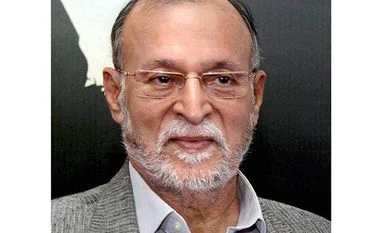 "Anil Baijal")

