Stem cells are undifferentiated cells that can grow into different types of cells and hence, ideal for their versatility. The researchers harvested stem cells from frog embryos and used an artificial intelligence (AI) to design a blueprint for organising them into a new type of organism. Unlike in cloning, where DNA from one individual is used to grow identical copies of that individual, these cells are harvested from different embryos, and used to create entirely new and dissimilar organisms that don’t resemble their parent species.
This AI uses an “evolutionary algorithm”, which starts by generating random 3D configurations of 500 to 1,000 skin and heart cells. Each design is then tested in virtual environments to see what it can do. The designs of the best performers (the fastest walkers, best swimmers, etc.) are then tweaked to create more designs, which are again, put through similar iterations before physical designs are implemented.
The AI churned out 100 virtual generations before the first physical xenobots were created in the lab by putting stem cells together.
The average xenobot is about 1 millimetre in diameter and consists of stem cells, which have mostly been grown into skin cells and heart muscle cells. The skin cells provide rigid support and shape, while the heart cells act like motors as they contract and expand to propel the xenobot around. These creatures are being used in research to understand how cells build bodies but along the way, the scientists have discovered surprising levels of versatility.
The shape, the mix and distribution of different cells can be reconfigured (again by AI programming and simulation) to perform specific tasks. Different xenobot designs can walk, swim, push pellets around, carry stuff, and swarm to work together to do things like collect litter (small pellets in the experiments).
They can survive for weeks without food, using their stored fat and proteins, and they have a self-healing ability. When a xenobot exhausts its store of fat and protein, it just “dies” and turns into dead frog cells.
Experiments have been performed to turn stem cells into cilia (filaments), which can be used for swimming, and the injection of RNA molecules can make them glow in different colours. Multiple types of designs have been experimented with — for example, they can be created with small holes, which act as pouches for carrying stuff around like microscopic marsupials.
Most interestingly, they can also be programmed to gather up loose stem cells and then turn those into new xenobots. If this can be termed reproduction, and it is reproduction by definition, it is a new method that is not found in nature, at least as far as we know.
Are these creatures alive? It’s difficult to answer that question. They have no brains or cognitive ability. But they can be pre-programmed for a range of specific activities. They do reproduce, but not by sexual means, or parthenogenesis.
The scientists who designed them describe them as living robots. The research is funded by the US Defense Advanced Research Projects Agency’s (DARPA’s) “Lifelong learning machines programme”, which looks to recreate biological learning processes in machines. While most of DARPA’s projects are classified and military in application, it also funded the research that led to the internet, to GPS, and to autonomous vehicles, to name just some famous projects.
The versatility of this concept has surprised everyone. The potential applications are wide-ranging.
For example, swarms of xenobots could be used to clean up plastic pollution, since they can collect plastics and microplastics on both sea and land. They are completely organic in nature and hence, pose no environmental issues.
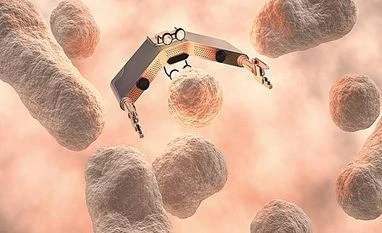
There are other possibilities. If xenobots are built with mammalian stem cells, including human stem cells, they could be organised to form lenses to restore vision, or to clean up plaque that causes heart blocks, or brain damage. They could be programmed to attack and remove cancer cells, or be used to create structures that can repair and replace damaged organs.
Of course, at some stage, ethical issues will arise as such experiments move forward, especially if xenobots are designed with nervous systems (very likely) and cognitive ability (likely only much further down the road). This is inevitable and the world will have to contemplate these ethical issues soon enough as bio-scientists acquire the ability to do things that used to be considered the province of the divine.
What xenobots could help with
-
Swarms of xenobots could be used to clean up plastic pollution, both in sea and on land
-
If built with mammalian stem cells, xenobots could be, for example,
-
organised to form lenses to restore vision
-
or to clean up plaque that causes heart blocks, or brain damage
-
programmed to attack and remove cancer cells
-
used to create structures that can repair and replace damaged organs


 "xenobot")