


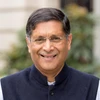
 "Arvind Subramanian")
Arvind Subramanian
Arvind Subramanian
Arvind Subramanian is former chief economic advisor to the Government of India, and is currently a senior fellow at the Watson Institute for International and Public Affairs at Brown University. He was earlier the assistant director in the research department of the International Monetary Fund, and has taught at Harvard University's Kennedy School of Government, Johns Hopkins School for Advanced International Studies, and has been a Professor of Economics at Ashoka University.
Arvind Subramanian is former chief economic advisor to the Government of India, and is currently a senior fellow at the Watson Institute for International and Public Affairs at Brown University. He was earlier the assistant director in the research department of the International Monetary Fund, and has taught at Harvard University's Kennedy School of Government, Johns Hopkins School for Advanced International Studies, and has been a Professor of Economics at Ashoka University.


Page 6 - Arvind Subramanian
Devesh Kapur & Arvind Subramanian: Rebuilding the Indian state
Both growth and inclusion need a capable Indian state


India's unique crisis: A short-term fix
A temporary across-the-board import surcharge may need to be part of crisis avoidance plans
India's unique crisis - I
Aspects of the Indian crisis have no parallels in recent history, and the crisis has consequently been misdiagnosed
Raghuram Rajan's agenda: Damage control through independence
The new RBI governor could instill a sense of calm through clarifying his objectives, and being independent while awarding banking licences
Setting some conditions
What the government needs is an IMF programme - without the IMF
 "Setting some conditions")
A no-protectionism miracle
Actual protectionist actions by the US against China have been negligible compared with the severity and scope of those taken against Japan in the 1980s
The economic consequences of Professor Amartya Sen
Redistributive policies via rights and entitlements are ultimately self-defeating
 "The economic consequences of Professor Amartya Sen")
Thank you, Mr Bernanke?
Tightening of US monetary policy might actually force India's govt to be responsible
 "Thank you, Mr Bernanke?")
Underperforming even in good times
The author compares India's boom years with East Asia's
Reinhart-Rogoff: The problem and solutions
The author on the market failure in economic theory revealed by the Reinhart-Rogoff affair
 "Reinhart-Rogoff: The problem and solutions")
Convergence with a vengeance: humanity's golden age
Remarkably, in spite of the continuing effects of the financial crisis, poorer countries are still catching up with the rich world
Alone, but correct?
The author answers five questions on the disputed Novartis ruling
 "Alone, but correct?")
US must learn to live with India's frailties
American business should adapt to India's messy regulatory and tax environment or risk losing trade deals to its competitors
A carbon-less world by 2050?
A global emissions-GDP graph shows the need to cut this ratio tenfold from the current level to meet the climate change targets
Arvind Subramanian: FM flatters, but Budget deceives
The Budget is disappointing because it refuses to fundamentally repudiate fiscal populism
Arvind Subramanian: De-democratising the WTO
The organisation suffers from too much democracy and the blocking powers of small countries are creating an existential threat
Arvind Subramanian: Is the Modi miracle overrated?
On an important governance measure, there is a Nitish Kumar effect, a Naveen Patnaik effect, but no Modi effect
Arvind Subramanian: 2013: P Chidambaram's year
Arvind Subramanian argues that the finance minister must focus on fiscal consolidation to restore the economy
Arvind Subramanian: Which nations failed?
A new book suggests that political institutions determine disparities in wealth across nations