


Can 'Make in India' help Tesla navigate increasing global roadblocks?
After prolonged speculation about Tesla's entry into the Indian market, the Elon Musk-led EV major has begun the process of setting up its manufacturing unit in India
 "Tesla")
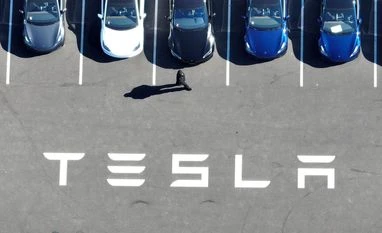
Tesla | Photo: Bloomberg


Listen to This Article
Elon Musk-led Tesla has initiated the process of identifying land for an electric vehicle (EV) manufacturing facility in India, with Maharashtra emerging as the frontrunner, according to media reports.
Tesla has also reportedly reached out to executives at Tata Motors for a possible collaboration. This development comes after prolonged speculation about Tesla’s entry into the Indian market. Musk was expected to visit India in April 2024 to announce Tesla’s investment plans but cancelled his trip at the last minute, citing “very heavy Tesla obligations”. Instead, he travelled to China, raising doubts about Tesla’s India strategy.
Why now? What changed?
India has long sought Tesla’s presence in its manufacturing sector, with Prime Minister Narendra Modi actively encouraging Musk to establish a ‘gigafactory’ in the country. However, Tesla’s primary concern was India’s high import tariffs, which made foreign-made Teslas prohibitively expensive for Indian consumers.
On March 15, 2024, the Indian government introduced a new policy aimed at attracting EV investments. The scheme offers companies investing $500 million in a new manufacturing facility (with at least 25 per cent localised components) the ability to import up to 8,000 high-end vehicles annually at a reduced 15 per cent tariff. This incentive package appeared designed to lure Tesla and other global EV manufacturers like Vietnam’s VinFast Auto Ltd into the Indian market.
However, Musk’s abrupt shift in focus towards China left India’s Tesla ambitions in limbo. While reports occasionally hinted at ongoing discussions, no substantial progress was visible – until now.
Also Read

 "Tesla, Tesla logo")
 "Tesla")
 "Tesla")
 "Modi Musk")
 "Tesla, Tesla logo")
Tesla’s mounting challenges
Tesla is grappling with multiple crises that make India an increasingly attractive option for expansion. The company was among the worst-performing stocks in the S&P 500 following US President Donald Trump’s trade war measures. Trump imposed a 25 per cent tariff on Canadian and Mexican goods, excluding Canadian oil, and a 10 per cent tariff on Chinese imports.
In retaliation, Canadian officials suggested a 100 per cent tariff on Tesla vehicles, while Ontario Premier Doug Ford terminated a contract with Musk’s satellite firm, Starlink.
Declining deliveries and production disruptions
Tesla’s first-quarter 2024 vehicle deliveries plummeted to just under 387,000 – the lowest in over a year – due to a series of disruptions. Supply chain issues, including Houthi attacks in the Red Sea, temporarily shut down Tesla’s factory in Germany, which was later hit by an alleged arson attack. These setbacks added to Tesla’s struggles amid increasing competition from Chinese EV manufacturers.
Meanwhile, in the US, the EV industry is facing policy reversals. One of Trump’s first acts upon taking office in 2025 was to revoke Biden’s 50 per cent EV sales target for 2030. While federal incentives for EVs remain intact, Trump’s executive orders have already impacted the industry, including freezing funds earmarked for EV charging infrastructure. The administration also put a $400 million US State Department procurement of armoured Tesla EVs on hold, further straining the company’s prospects.
US’ anti-China push
Tesla’s regulatory troubles in China are another major concern. The US has shifted from a ‘China plus one’ strategy to ‘Anything But China’ strategy, urging tech firms away from Chinese companies. This has led to many Chinese tech companies being banned from US trade along with tariffs on Chinese imports.
In light of this, a recent report has suggested that Tesla may face delays in securing approval for its Full Self-Driving (FSD) technology. In retaliation to Trump tariffs, Beijing may be leveraging the decision as a bargaining chip in the ongoing trade war with the US. Initially expected in the second half of 2025, the approval process is now uncertain, affecting Tesla’s plans to expand its FSD subscription model in China. Tesla is also caught between stringent data security rules from both the US and China, preventing it from transferring training data across borders.
Manufacturing in India: A potential lifeline
Beyond geopolitical risks, Tesla has faced company-specific issues, including regulatory scrutiny over its driverless software and vehicle safety. Addressing these concerns will require higher operational costs, making cost-efficient production more critical than ever.
India offers a viable solution. The country’s lower labour costs and newly announced tariff concessions could help Tesla offset rising operational expenses. A manufacturing presence in India could also mitigate the impact of supply chain disruptions, while also tapping into the world’s third-largest automobile market.
Apple supplier Foxconn’s expansion in India reportedly saw a 10 per cent drop in its operation cost. Similarly, Tesla could also achieve significant cost savings, although this may not lead to lower retail prices, as witnessed in iPhone prices. Establishing a manufacturing base in India could also reduce Tesla’s dependence on the volatile US-China relationship, providing greater stability.
Musk’s divided focus in business
Investors have long been concerned over Musk’s divided attention. While Tesla has been struggling with production and regulatory hurdles, Musk has been preoccupied with his social media platform X, making controversial decisions that have dented Tesla’s brand. Additionally, critics argue that Tesla’s product lineup has grown stale compared to emerging competitors. To add to this, Musk’s close relationship with US President Trump and his new role with the Department of Government Efficiency (DOGE) has added on to these concerns.
By prioritising India, Tesla has an opportunity to stabilise its business, expand its global footprint, and diversify away from geopolitical risks that threaten its long-term growth. The question remains: Will Musk fully commit to India this time?
More From This Section
 "Hyundai")
 "Oyo hotel")
 "ONGC")
 "Hexaware technologies")
 "Website block, ban, online ban")
Topics : Elon Musk Tesla Elon Musk Tesla Elon Musk Tesla cars Make in India BS Web Reports Electric Vehicles Electric vehicles in India
Don't miss the most important news and views of the day. Get them on our Telegram channel
First Published: Feb 19 2025 | 5:05 PM IST