


Ratan Tata: From unlikely heir to architect of Tata group's global legacy
Ratan Tata was not supposed to be the Group Chairman. But he scripted an unlikely and indelible chapter in Indian business history
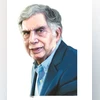 "Ratan Tata")
Illustration: Ajay Mohanty
Listen to This Article
Fate put Ratan Tata in a situation where few expected him to succeed. However, not only did he succeed but also transformed the sprawling Tata Group from an India-focused one into one of the most significant names in the world, from an old-world business into one whose software outfit became its crown jewel, and from a group that had had to part with Air India into one that got the airline back.
Just as important, Tata changed the character of his eponymous group from a federal setup to cohesive operation, and run by Tata Sons, the group holding company, which in turn is controlled by Tata Trusts.
It comes as no surprise that Tata’s journey as the helmsman of the Tata group — which started in 1991, the year India began to embrace economic reforms and liberalisation — ran in parallel to the country’s rise as an economic power as well as the unleashing of India’s managerial and technological talent around the world.
However, the thread that connects the numerous dots in this story is Tata’s personal journey.
“It’s hard being a Tata. The surname doesn’t permit failure…” Gita Piramal wrote in Business Maharajas, first published in the 1990s.
Also Read

 "Ratan Tata with his adopted dogs at Bombay House, the Tata headquarters | Photo: Ratan Tata's social media handle")
 "Ratan Tata inside the cockpit of a US military aircraft during an air show at the Yelahanka station on the outskirts of Bengaluru in 2007 | Photo: Reuters")
 "The public fallout between Ratan Tata (right) and Cyrus Mistry altered a long-standing alliance | Photo: Reuters")
 "A 2009 picture of Ratan Tata after addressing a news conference to announce the launch of Jaguar and Land Rover in India | Photo: Reuters")
 "Ratan Tata")
But that is what the wise money was betting on back when Tata took charge, that he would end up a failure. He had joined the group in 1962, armed with a bachelor’s degree in architecture from Cornell. He did a bit of this and a bit of that before starting a non-too-glorious stint at the National Radio and Electronics Company in 1971. Ten years later, he was named Chairman of Tata Industries, where he first showed glimpses of what was to come by transforming the company into a think tank and promoter of high-technology ventures.
But nobody cared much about Tata Industries at a time when Russi Mody at Tata Steel, Darbari Seth at Tata Chemicals and Tata Tea, and Ajit Kerkar at Indian Hotels were becoming legends, loosely reporting to the bigger legend: JRD Tata.
Also Read: Ratan Tata passes away at 86, leaving behind a legacy of innovation
Also Read: Ratan Tata passes away at 86, leaving behind a legacy of innovation
Few expected Ratan Tata to go far when he became the head of the group. He was not even supposed to become that. But his chief rival for the post, Mody, gave a newspaper interview that snuffed out his chances.
The eventual sacking of Mody left no one in doubt that Ratan Tata would not stick to JRD’s loose federal structure. He chose the tougher option and brought the satraps to heel. From there, he went on to systematically increase the shareholding of Tata Sons in group companies. In 1996, he started the Brand Subscription Scheme under which group companies would pay a fee for using the Tata name.
Once Tata felt secure, he embarked on the journey of realising his dreams. Unlike some of his peers such as Rahul Bajaj, who were determined to guard their sovereignty and not part with equity, Tata was open to collaborations with foreign partners. He took this several steps ahead through a string of overseas acquisitions, the most notable ones being Tetley, Corus, and Jaguar Land Rover.
What he did at home was no less significant. He dreamed of making a people’s car for India, with the comfort of the Ambassador and the frugality of a Maruti. Thus was born the Indica, which for a while held its own against the influx of international brands. But it was the more ambitious Nano that would rankle Tata.
He somehow talked himself into a corner by speaking of the ideal car for India that would cost about Rs 1 lakh. The dream car did come, defying the odds. “A promise is a promise,” Tata thundered at its launch in 2008. But the Nano belied the promise. Car buyers were loath to be identified as owners of the cheapest car.
There was also the episode of the Radia tapes. Tata and Niira Radia got to know each other in the 1990s, when the group was fighting to put its airline, a venture with Singapore International Airlines, in the air. Radia had moved base to India with her three young sons after her divorce from London-based financier Janak Radia, and was advising SIA. As Tata said ad nauseam in the aftermath of the tapes, the group, whose external communication was managed mostly by internal teams, saw a campaign against it by a coalition of rival companies and journalists and he needed someone to fight this battle for him.
For a while, the collaboration did well and Radia’s Vaishnavi became the most prominent public relations outfit in the country. But things unspooled as tapes were leaked showing Radia in questionable conversations with several people.
Nevertheless, when Tata made way for Cyrus Mistry as the chairman in 2012, he was set to leave behind a glorious legacy. But destiny had other plans. Unhappy with the direction in which the young chairman was taking the group, Tata ousted him in a boardroom battle to return as interim chairman in 2016, before ushering in a more durable succession.
That is too eventful a journey for someone who was not even supposed to be on the ride. His father, Naval, was adopted by Ratanji Tata, the son of group founder Jamsetji.
He may have remained an architect, regardless of his surname.
But his grandmother fell very ill and he kept coming back to India to see her. One thing led to another and he stayed back, scripting an unlikely but indelible chapter in India’s business history.
More From This Section
 "Suresh Narayanan, who joined Nestlé India as chairman and MD in 2015 when the FSSAI had ordered a nationwide recall of Maggi noodles due to high levels of lead, prepares to retire in July 2025")
 "Suresh Narayanan's leadership saw Nestlé India diversifying into categories like cereals and pet care")
 "Ratan Tata")
 "Prasanth Kumar, AAAI")
 "Rashmi Saluja, chairperson, Religare")
Don't miss the most important news and views of the day. Get them on our Telegram channel
First Published: Oct 10 2024 | 1:05 AM IST