


FM Nirmala Sitharaman stresses need for steady, consistent defence funding
LS clears Health Security se National Security Cess Bill
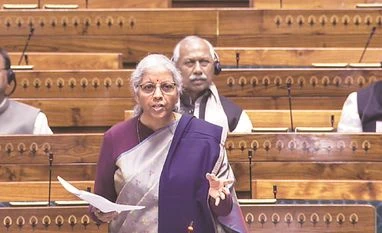 "Nirmala Sitharaman")
Sitharaman clarified that Section 7(1) of the Bill ring-fences the proceeds strictly for two purposes — strengthening national security and supporting public health.
Listen to This Article
The Lok Sabha on Friday passed the Health Security se National Security Cess Bill, 2025, with Finance Minister Nirmala Sitharaman defending the proposal as essential for both strengthening national security and supporting public health, while stressing that the levy would fall only on demerit goods, mainly pan masala.
Sitharaman clarified that Section 7(1) of the Bill ring-fences the proceeds strictly for two purposes — strengthening national security and supporting public health. The specific schemes will be prescribed through rules. Since public health is a state subject, she added, the portion earmarked for health will flow to the states.
Moving the Bill for consideration and passing, the minister drew extensively on past capability gaps in defence preparedness and said India “cannot afford” a return to those conditions.
She referred to earlier statements in Parliament where it had been acknowledged that procurement could not take place “because there was no money”, adding that retired Army generals had repeatedly flagged how budgetary constraints through the 1990s left the Army holding only 70-80 per cent of authorised weapons, ammunition, and equipment.
Citing Comptroller and Auditor General of India (CAG) reports, Sitharaman noted that as of March 2013, 125 of 170 ammunition types had fallen below 20-day war reserves, with half the ammunition types available for less than 10 days of intense warfare. “We cannot afford that situation again,” she said, arguing that the cess would create a “consistent, regular, steady flow of income” for defence needs. The minister said modern warfare demands precision weapons, autonomous systems, space assets and cyber operations, and such technologies require continuous upgrading.

 "Parliament, New Parliament, Lok sabha, Rajya sabha")
 "Finance Minister Nirmala Sitharaman")
 "Nirmala Sitharaman, Nirmala")
 "Nirmala Sitharaman, Nirmala")
 "Union Finance Minister Nirmala Sitharaman speaks during the first day of the Winter Session of Parliament, in New Delhi, Monday, Dec. 1, 2025. (Sansad TV via PTI Photo)")
Responding to concerns raised by members on the Centre’s constitutional authority to levy such a cess, the minister cited Article 270, which empowers Parliament to impose a cess for a specific purpose, and referred to the Supreme Court’s 2019 Mohit Minerals judgment reaffirming these powers.
She emphasised that all cess notifications are placed before Parliament and are fully subject to oversight by the CAG, the Public Accounts Committee, the Standing Committee on Finance, and internal audit systems.
On the cess structure, Sitharaman said the levy was based on machine capacity, including speed and grammage of each pouch. A progressive rate applies depending on the size and output of the machinery.
Small units operating manually will be treated separately. Based on a detailed study, the cess for handmade pan masala units has been fixed at ₹11 lakh per factory, roughly 10 per cent of the lowest machine-based category. “This will ensure that a unit engaged in handmade processes is not discouraged, but at the same time, they shall not be incentivised either,” she added.
The minister said the sector is “highly evasion-prone,” and goods and services tax (GST) already taxes pan masala at 40 per cent, the highest slab. Since GST cannot exceed this cap, the cess provides an additional mechanism for enforcement and revenue.
Addressing questions that the Centre has been accumulating cess collections without transferring them, Sitharaman presented detailed numbers of pre- and post-2014 cesses. She pointed out that multiple cesses existed well before 2014, including the Oil Industry Development Cess, National Calamity Contingent Duty, Road and Infrastructure Cess, and the Health and Education Cess.
She highlighted that in several cases, transfers exceeded collections. Between 2014-15 and 2025-26, the government transferred ₹11.34 trillion under the Road and Infrastructure Cess against collections of ₹11.11 trillion. Under the Health and Education Cess, ₹6.49 trillion was transferred against collections of ₹6.07 trillion.
On the Agriculture Infrastructure and Development Cess, imposed in 2021–22, transfers stood at ₹3.77 trillion against collections of ₹3.87 trillion.
She added that cesses (excluding the GST Compensation Cess, which went entirely to States) stand at 6.1 per cent of Gross Tax Revenue in 2025–26 Budget Estimates, lower than the 7 per cent level seen during 2010–14.
More From This Section
 "India Russia Trade")
 "Modi, Narendra Modi, Vladimir Putin")
 "Nuclear reactor, Nuclear plant")
 "Crude oil")
 "food prices, inflation")
Topics : Lok Sabha Health sector National Security GST cess
Don't miss the most important news and views of the day. Get them on our Telegram channel
First Published: Dec 05 2025 | 11:30 PM IST