


India can be global hub for research, learning with state-led reforms: CEA
India is uniquely placed to benefit from demographics, technology and AI adoption, but state-led reforms under NEP 2020 will determine whether the country can emerge as a global research destination
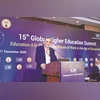 "CEA V Anantha Nageswaran addressing 15th CII Global Higher Education Summit, in New Delhi. (Photo: PTI)")
CEA V Anantha Nageswaran addressing 15th CII Global Higher Education Summit, in New Delhi. (Photo: PTI)
Listen to This Article
Chief Economic Advisor (CEA) V Anantha Nageswaran on Thursday said India can become a new global destination for learning, research and ideas in an uncertain world if the momentum gained under the National Education Policy (NEP) 2020 is followed by reforms pushed by state governments.
This comes at a time when the global higher education landscape is being reshaped as traditional academic hubs face demographic decline, fiscal pressures and tightening political curbs on international students.
“At the same time, Asia is emerging as a centre of gravity for learning, research and innovation. India has a rare opportunity to move from being primarily a source of students to becoming a destination for global learners and scholars,” Nageswaran said in his address at the 15th Confederation of Indian Industry (CII) Global Higher Education Summit in New Delhi.
The CEA cited the Union government’s 2023 reform allowing foreign higher education institutions (HEIs) to set up campuses in India, subject to quality safeguards, as an example of how internationalisation of higher education can be leveraged.
“This was not a routine regulatory change. It was a signal to the world — and to ourselves — that India is prepared to engage with global academia on its own terms,” he added.
Also Read

 "CEA V Anantha Nageswaran")
 "GDP, India GDP")
 "V Anantha Nageswaran, Nageswaran, Anantha")
 "V Anantha Nageswaran, Nageswaran, Anantha, Chief Economic Advisor")
 "fiscal deficit")
However, the CEA said that if India is to truly internationalise higher education, clarity and predictability in regulation, accreditation, degree recognition and exit norms are essential.
“There should also be ecosystem readiness in terms of student visas, housing, campus safety, research infrastructure and professional administration within universities,” he said.
He added that states should have the confidence to let Indian institutions compete, collaborate, learn from and contribute to the learning of global peers.
This, he said, could lead to both foreign universities and students seeing India not merely as a cultural experience but as a serious academic destination.
“Done well, this can raise standards, generate foreign exchange, strengthen soft power and embed Indian universities in global research networks,” Nageswaran added.
Highlighting that India is at a demographic and economic inflection point, Nageswaran said higher education would play a decisive role as millions of young people prepare to enter the workforce over the next two decades.
“Whether this demographic dividend becomes a growth accelerator or a social strain will depend, in large measure, on the quality, relevance and adaptability of our higher education system,” he said, calling on states to lead the change.
Higher education in India is largely delivered by state governments or regulated by them. “Most universities, colleges, faculty appointments and administrative decisions sit at the state level. Therefore, the success of national reform depends critically on state-level action,” Nageswaran said.
Many states have transitioned to the 5+3+3+4 school structure, and universities too are switching to new course designs, but some states continue to oppose the change.
Calling on states to shift from control to stewardship in higher education, the CEA recommended allowing independent, professionally governed university boards and urgently addressing the teacher shortage.
He also called on states to increasingly fund institutions based on roles and outcomes rather than uniform templates. “Not every institution must be a research university. Some should focus on teaching excellence, applied research and regional development,” he added.
More From This Section
 "exporters, trade, tariff")
 "sitharaman")
 "oil, crude oil,")
 "exports, imports, trade")
 "FMCG, SHOPS")
Don't miss the most important news and views of the day. Get them on our Telegram channel
First Published: Dec 17 2025 | 2:28 PM IST