


PM Modi inaugurates infra projects worth ₹31,850 crore in Maharashtra
Projects include the first phase of Navi Mumbai International Airport and the second phase of Mumbai Metro Line 3, connecting South Mumbai with key suburbs
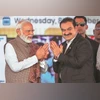 "Prime Minister Narendra Modi greets Adani group Chairman Gautam Adani during the inauguration ceremony of the Navi Mumbai International Airport on Wednesday")
Prime Minister Narendra Modi greets Adani group Chairman Gautam Adani during the inauguration ceremony of the Navi Mumbai International Airport on Wednesday. | Image: PTI
Listen to This Article
Prime Minister Narendra Modi on Wednesday launched infrastructure projects worth ₹31,850 crore during his two-day visit to Maharashtra. The highlights: the first phase of the ₹19,650 crore Navi Mumbai International Airport (NMIA) and the second phase of the ₹12,200 crore Mumbai Metro Line 3.
Navi Mumbai Airport: A digital ‘lotus’ to take flight
India’s first fully digitised airport, NMIA has been designed for multimodal connectivity and developed under a public-private partnership model between Adani Airport Holdings (74 per cent) and City & Industrial Development Corporation of Maharashtra (26 per cent). Spread over 2,866 acres, the airport will be built in four phases at a total cost of $2.4 billion and is expected to be fully operational by 2034.
The first terminal will handle 20 million passengers annually, eventually scaling to 90 million passengers and 3.2 million tonnes of cargo. Initially, NMIA will function with one runway and one terminal, later expanding to four runways, multiple terminals, and a dedicated cargo hub for perishables and express shipments.
Modi said the airport will turn the Mumbai region into “Asia’s largest connectivity hub”, helping farmers, small businesses, and exporters access global markets. Civil Aviation Minister K Ram Mohan Naidu said NMIA will ease congestion at the existing Mumbai airport, trebling passenger capacity and making Mumbai the first Indian city with two international airports.
Also Read

 "Infrastructure, project financing")
 "Acquiring SunbridgeAgro")
 "undersea tunnel (total 21 kms) of the Bullet train project between Ghansoli & Shilphata in Maharashtra")
 "(From left) Kuljit Singh, investment banking partner and leader (infrastructure), EY; Rahul Mithal, chairman & MD, Rites; and Jagan Shah, CEO, The Infravision Foundation, at the Business Standard Infrastructure Summit in New Delhi on Thursday")
 "Kuljit Singh, Rahul Mithal, Jagan Shah")
Gautam Adani described the airport as “a lotus, a gateway to India’s future”. He called it a landmark in infrastructure and nation-building, completed in under 50 months with ₹20,000 crore. Maharashtra Chief Minister (CM) Devendra Fadnavis said the project could boost the state’s GDP by 1 per cent and will be the country’s first airport connected by water taxi.
Aqua Line: South Mumbai’s new lifeline
The ₹37,270 crore Aqua Line spans 33.5 kilometres from Cuffe Parade to Aarey with 27 stations, expected to serve 1.3 million passengers daily. Phase 2B, from Acharya Atre Chowk to Cuffe Parade, is now operational. Modi called it “a major step for Mumbai’s infrastructure”. Deputy CM Ajit Pawar said the line will drastically cut travel time between South Mumbai and the suburbs, connecting key business districts like Girgaon and Kalbadevi.
Vadhvan Port, offshore airport next
Fadnavis said Maharashtra’s next push includes the ₹76,220 crore Vadhvan Port and India’s first offshore airport. The state plans to develop a “fourth Mumbai” in the region to anchor long-term growth.
Expanding aviation, unified mobility
Modi noted that India aims to become a global maintenance, repair, and operations hub by decade’s end. Since 2014, the number of airports has grown from 74 to 159, and Ude Desh ka Aam Naagrik now links 90 airports through 625 routes. He also launched the Mumbai ONE App, India’s first integrated mobility platform connecting suburban rail, Metro, monorail, and multiple bus operators across Mumbai Metropolitan Region.
More From This Section
 "Rs, Rupee, Indian Currency")
 "Finance, FDI")
 "Piyush Goyal, Piyush")
 "Pralhad Joshi")
Don't miss the most important news and views of the day. Get them on our Telegram channel
First Published: Oct 08 2025 | 7:36 PM IST