


US President Donald Trump hits India with 25% tariff, plus penalty
Move comes after two nations fail to seal interim trade deal; govt says will take steps necessary to secure national interest
 "Donald Trump, Trump")
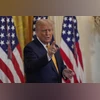
US President Donald Trump. (Photo: PTI)


Listen to This Article
US President Donald Trump on Wednesday announced a 25 per cent tariff on exports from India starting August 1, along with an unspecified penalty to be imposed for India’s defence and energy procurements from Russia. This may have a significant adverse impact on India’s shipments to its largest market that accounts for about a fifth of its exports.
President Trump’s unilateral pronouncement of the levy came early morning Washington time (5:39 pm IST) and caps the inability of India and the US to strike an interim trade deal after five rounds of intense negotiations before August 1, when the US is set to implement steep, country-specific reciprocal tariffs for trading partners.
An interim deal was intended to serve as a precursor to the first tranche of the bilateral trade agreement (BTA), which Prime Minister Narendra Modi and Trump in February had decided to finalise by September-October, and India had hoped to avoid the 26 per cent reciprocal tariff Trump had announced for its goods in April.
As it turns out, the levy on Indian exports to be effective from August 1 is only marginally lower. Currently, Indian exporters bear a 10 per cent baseline tariff, over and above the existing World Trade Organisation (WTO)-compatible duties.
“Remember, while India is our friend, we have, over the years, done relatively little business with them because their Tariffs are far too high, among the highest in the World, and they have the most strenuous and obnoxious non-monetary Trade Barriers of any Country. Also, they have always bought a vast majority of their military equipment from Russia, and are Russia’s largest buyer of energy, along with China, at a time when everyone wants Russia to stop the killing in Ukraine— all things not good!” Trump said on his social media platform Truth Social.
Also Read

 "Donald Trump, Trump")
 "US TARIFFS, RETAIL")
 "textile")
 "Apple, Apple iphone")
 "crude oil, oil, lng")
“India will therefore be paying a tariff of 25 per cent, plus a penalty for the above, starting on August first,” Trump said, further adding that the US has a “massive” trade deficit with India. India’s merchandise exports to the US stood at $86.5 billion in FY25 with a trade surplus of $40.8 billion.
“I think President Trump is frustrated with the progress we've made with India but feels that a 25 per cent tariff will address and remedy the situation in a way that's good for the American people,” White House economic adviser Kevin Hassett said.
The Ministry of Commerce & Industry said in a statement that India is committed to concluding a fair, balanced and mutually beneficial bilateral trade agreement with the US through negotiations.
“The government attaches the utmost importance to protecting and promoting the welfare of our farmers, entrepreneurs, and MSMEs [micro, small and medium enterprises]. The Government will take all steps necessary to secure our national interest, as has been the case with other trade agreements including the latest Comprehensive Economic and Trade Agreement with the UK,” it stated.
Till this week, Indian government officials maintained that virtual talks between both sides are on, the next formal round of discussion is now scheduled to take place from August 25 in New Delhi. Despite pressure from the US administration to strike a trade deal to avoid imposition of reciprocal tariffs, the pact did not materialise due to disagreements between both sides over contentious issues related to agriculture and dairy.
New Delhi-based think tank Global Trade Research Initiative noted that Trump’s tariff plus penalty on Indian goods appears harsh, but a closer look shows India is not significantly worse off than countries that did sign deals with the U.S. “The UK, EU, Japan, Indonesia, and Vietnam now face elevated tariffs, and in return, have given sweeping concessions — zero tariffs on U.S. farm goods, massive investment pledges, and purchases of U.S. oil, gas, and arms. India has made no such concessions,” it pointed out.
However, Indian businesses are not as sanguine. President of industry body FICCI, Harsha Vardhan Agarwal, expressed disappointment at the 25 per cent tariff on exports from India and the imposition of secondary sanctions. “While this move is unfortunate and will have a clear bearing on our exports, we hope that this imposition of higher tariffs will be a short-term phenomenon and that a permanent trade deal between the two sides will be finalised soon,” he said.
Garima Kapoor, executive vice president and economist at Elara Securities, said the 25 per cent tariff rate is certainly a negative development as it compares to lower rates for peers such as Vietnam, Indonesia, and the Philippines which compete with India in a similar category of labour-intensive products and electronic goods.
“On the positive side, it is pertinent to note that any hotchpotch deal that would have compelled India to give concessions to its agriculture and dairy sector may have had much deeper ramifications politically, socially, and eventually on livelihoods,” she added.
Mithileshwar Thakur, Secretary General Apparel Export Promotion Council (AEPC) said they were expecting a reciprocal tariff close to 20 per cent, with no conditionality attached which would have placed the Indian players at an advantageous situation vis-à-vis Bangladesh and China, and at par with Vietnam. “However, a 25 percent tariff with an additional clause of penalty in case of procurement of energy and arms and ammunition from Russia, has upset the equation and sent trade possibilities with the US into a zone of uncertainty,” he remarked.
Vinod Kumar, president of India SME Forum, said export-driven MSMEs across engineering goods, auto components, textiles, apparel, leather, gems and jewellery, handicrafts, and select pharmaceuticals will feel the most immediate impact in the form of reduced order volumes, compressed margins, and slower payment cycles. “The tariff makes sectors such as pharmaceuticals, electronics, auto parts, and other high-value exports especially vulnerable to intense competition,” he added.
A hit on exports is likely to weigh on India’s growth story too. "When the US had initially imposed tariffs, we had lowered our forecast of India's GDP expansion to 6.2% for FY2026, presuming a tepid rise in exports and a delay in private capex,” recalled Aditi Nayar, chief economist at rating firm ICRA. “The tariff (and penalty) now proposed by the US is higher than what we had anticipated, and is therefore likely to pose a headwind to India's GDP growth. The extent of the downside will depend on the size of the penalties imposed,” she concluded.
(Harsh Kumar and Reuters contributed to this story.)
More From This Section
 "fuel imports, crude oil price, Russia Oil production, Oil industry")
 "RBI, Reserve Bank of India")
 "US India Trade")
 "Donald Trump, Trump")
 "Donald Trump, Trump")
Don't miss the most important news and views of the day. Get them on our Telegram channel
First Published: Jul 31 2025 | 12:35 AM IST