


UP election results 2017: How the Rajya Sabha scenario will change
A three-fourth majority in UP is likely to help the BJP's candidate become India's next President
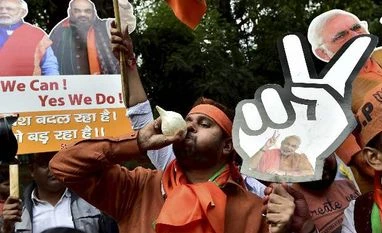 "UP, Election, BJP, Celeberation")
premium
The Bharatiya Janata Party has swept clean India's most populous state, Uttar Pradesh, by gaining a three-fourth majority in the 2017 state Assembly elections. The massive win will help the National Democratic Alliance in the presidential polls in June this year.
The BJP is keen on putting its nominee as the presidential candidate and the party is giving its best shot at putting its candidate on the big chair. The arithmetic has changed with the poll results and the BJP is in a comfortable position after today's win in Uttar Pradesh and Uttarakhand.
In the presidential elections, both MPs and MLAs vote. With a big win in the 2014 Lok Sabha polls and decent shows in assembly elections in Maharashtra, Haryana, Assam, and other states, the NDA is at an advantage. The BJP is leading in over 300 seats in Uttar Pradesh and in 58 seats in Uttarakhand.
The BJP is keen on putting its nominee as the presidential candidate and the party is giving its best shot at putting its candidate on the big chair. The arithmetic has changed with the poll results and the BJP is in a comfortable position after today's win in Uttar Pradesh and Uttarakhand.
In the presidential elections, both MPs and MLAs vote. With a big win in the 2014 Lok Sabha polls and decent shows in assembly elections in Maharashtra, Haryana, Assam, and other states, the NDA is at an advantage. The BJP is leading in over 300 seats in Uttar Pradesh and in 58 seats in Uttarakhand.
| The Rajya Sabha numbers | |
| Party | Strength |
| Indian National Congress | 59 |
| Bharatiya Janata Party (BJP) | 56 |
| Samajwadi Party | 18 |
| All India Anna Dravida Munnetra Kazagham (AIADMK) | 13 |
| Trinamool Congress (TMC) | 11 |
| Janata Dal (United) | 10 |
| Others | 78 |
| Total | 245 |
| As on March 11, 2017; Two seats are vacant, 12 members are nominated Source: rajyasabha.nic.in | |