


Need to avoid trade curbs to normalise ties: Jaishankar to Wang Yi
In Beijing, Jaishankar urges Chinese counterpart Wang Yi to resolve border friction, resume hydrological data sharing, and avoid trade curbs to restore bilateral normalcy
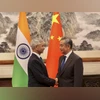 "In this image posted by @DrSJaishankar via X on July 14, 2025, External Affairs Minister S Jaishankar during a meeting with Chinese Foreign Minister Wang Yi, in Beijing, China. (@DrSJaishankar on X via PTI Photo)")
In this image posted by @DrSJaishankar via X on July 14, 2025, External Affairs Minister S Jaishankar during a meeting with Chinese Foreign Minister Wang Yi, in Beijing, China. (@DrSJaishankar on X via PTI Photo)
Listen to This Article
In his first visit to China in almost six years, External Affairs Minister (EAM) S Jaishankar on Monday told his Chinese counterpart Wang Yi that the two neighbours resolving “friction” on the India-China border had led to an easing of tensions, and they should now build on it to address other aspects related to their border, including border management and de-escalation.
Jaishankar said the two neighbours should also normalise people-to-people contacts and avoid “restrictive trade measures and roadblocks”. He underlined the need for cooperation on trans-border rivers and urged the Chinese side to resume providing hydrological data.
In his opening remarks at his meeting with the Chinese foreign minister in Beijing, Jaishankar said relations between the two countries can continue to develop on a “positive trajectory” on the foundation that differences should not become disputes and competition should not become conflict.
Alluding to China restricting the supply of critical minerals and flagging the need to foster mutually beneficial cooperation, including through people-to-people exchanges, Jaishankar said, “It is also essential in this context that restrictive trade measures and roadblocks are avoided.” He said he hoped to discuss these issues in further detail with Wang.
Jaishankar landed in Beijing on Sunday, after a day-long visit to Singapore, to attend the Meeting of the Shanghai Cooperation Organisation (SCO) Foreign Ministers Council in Tianjin, which is 135 kilometre from Beijing. China is the current president of the SCO and will host the SCO Summit in Tianjin later this year, which Prime Minister Narendra Modi is likely to attend. Jaishankar last visited China from August 11-13, 2019 — his first visit to the country after assuming office as India’s EAM in June that year.
Also Read

 "External Affairs Minister S Jaishankar Vice President of China Han Zheng")
 "han zheng, china vp, chinese vice president, dr. s jaishankar")
 "S Jaishankar, Jaishankar")
As Jaishankar noted in his remarks, India-China relations have been gradually moving in a “positive direction” after Modi and Chinese President Xi Jinping met in China’s Kazan in October 2024. “Our responsibility is to maintain that momentum,” Jaishankar said, adding that the India-China bilateral relationship requires that “we take a far-seeing approach to our ties”.
India’s EAM noted that Wang and he have met in recent months on several occasions at international events and carried out strategic communication.
“It is our expectation that this will now be regular and take place in each other’s countries,” Jaishankar said. India-China foreign ministers’ level talks had been discontinued after the Galwan clashes of June-July 2020.
Jaishankar noted that India and China mark the 75th year of the establishment of diplomatic relations between the two countries, and appreciated Chinese cooperation in the resumption of the Kailash Manasarovar Yatra after a gap of five years. He said the resolution of friction along the India-China border and the ability of the two countries to maintain peace and tranquillity there was the “fundamental basis” of the “good progress” made in the past nine months for the normalisation of bilateral relations.
Jaishankar called for “stable and constructive ties” between the two neighbours, which he said could best be achieved by handling relations on the basis of mutual respect, mutual interest, and mutual sensitivity. “We have also earlier agreed that differences should not become disputes, nor should competition ever become conflict. On this foundation, we can now continue to develop our ties along a positive trajectory,” he said. Jaishankar and Wang will also exchange views on global and regional issues.
As for the SCO meeting, scheduled for Monday, Jaishankar said India “hopes” that the grouping will “strongly” uphold its mandate of zero tolerance for terrorism. At the SCO’s meeting of defence ministers in China’s Qingdao in June, Defence Minister Rajnath Singh had refused to sign a joint communiqué as it omitted the Pahalgam terror attack and did not explicitly address India’s concerns over Pakistan-backed cross-border terrorism.
In Beijing, the EAM also called on Chinese Vice President Han Zheng, where he noted the “steadily improving” bilateral ties since the Modi-Xi meeting in Kazan last October. He said it is “very important” for India and China, as neighbouring countries and major economies, to have an open exchange of views and perspectives in the context of the complex international situation.
In Singapore on Saturday, Jaishankar met Singapore President Tharman Shanmugaratnam and other ministers, including Teo Chee Hean, who is the coordinating minister for national security and chairman-designate of Temasek Holdings. Their discussion focused on the transformation underway in India and opportunities for Temasek to expand its investments in India, the Ministry of External Affairs said.
More From This Section
 "Ishaq Dar, foreign minister of Pakistan")
 "Taiwanese President Lai Ching-te")
 "French President Emmanuel Macron, France, Macron")
 "S Jaishankar, Jaishankar")
 "Full-scale model of the Advanced Medium Combat Aircraft, which was showcased at the 15th edition of Aero India in Bengaluru, Karnataka, from February 10 to 14, 2025. Photo Credit: PIB")
Don't miss the most important news and views of the day. Get them on our Telegram channel
First Published: Jul 14 2025 | 8:09 PM IST