


Pakistan-Saudi Arabia defence pact: What does it mean for India's security?
Saudi Arabia and Pakistan have signed a defence pact pledging joint military support. India is weighing its security implications as Riyadh deepens ties with Islamabad
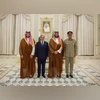 "Pakistan-Saudi Arabia sign defence pact")
(L-R) Saudi Arabia's Defence Minister Khalid bin Salman, Pakistan's PM Shehbaz Sharif, Saudi Arabia's Crown Prince Mohammed bin Salman and Pakistan's Army Chief Field Marshal Asim Munir, after signing a mutual defense pact | Photo: PTI
Pakistan and Saudi Arabia have signed a mutual defence pact that says an attack on one will be treated as an attack on both. The deal was inked in Riyadh by Crown Prince Mohammed bin Salman and Pakistan's Prime Minister Shehbaz Sharif, with the country's army chief Asim Munir in attendance.
The agreement covers "all military means", including joint training, intelligence sharing, and exercises. Saudi Arabia calls it a step toward regional peace. But for India, this may be a red flag.
What's behind Saudi-Pak defence deal?
The defence pact between Saudi Arabia and Pakistan comes at a time of heightened anxiety in the Gulf. On September 9, an Israeli strike on purported Hamas targets in Qatar killed six people, sparking outrage across the Arab world. In response, Qatar hosted an emergency summit of Arab and Islamic leaders in Doha, where the Israeli attack was condemned as “cowardly” and “treacherous".
Against this backdrop, Riyadh’s agreement with Islamabad signals a desire to broaden its security partnerships as the region reassesses reliance on US military protection. This also provides Saudi Arabia and its regional allies a nuclear cover.
However, when asked about the timing of the agreement, a Saudi official told Reuters that the agreement was a "culmination of years of discussions" and "not a response to specific countries or specific events".
Also Read

 "Shehbaz Sharif Riyadh visit")
 "Donald Trump, Trump")
 "TRF Pahalgam attack, UN Security Council report, Lashkar-e-Taiba proxy, India Pakistan terrorism, TRF UN report, UNSC TRF LeT link, India diplomatic win UN, 1267 Sanctions Committee, Pakistan terror groups, Jammu and Kashmir attack")
 "satellite rocket space")
 "White House")
What the agreement means for India
For India, the agreement comes at a sensitive moment. Pakistan is India’s main security rival, armed with nuclear weapons. A defence pact with Saudi Arabia gives Islamabad political backing, and possibly financial cover, that could embolden it.
The Ministry of External Affairs reacted cautiously but made clear it is taking the development seriously. Spokesperson Randhir Jaiswal said the government was already aware that such an agreement had been under discussion and would now “study the implications of this development for our national security as well as for regional and global stability".
Former ambassador Kanwal Sibal called the pact a “grave misstep” by Riyadh. In a post on X, he argued that Saudi Arabia risked outsourcing its security to “a nuclear-armed state hostile to India", warning that Pakistan and its affiliated groups could feel emboldened to escalate tensions.
"This pact means that funds will flow from Saudi Arabia to Pakistan to strengthen its armed forces. Saudi Arabia knows this will be construed in India as a threat to India’s security,” he wrote.
Sibal also questioned Saudi Arabia’s judgment in choosing Pakistan as a security partner, stating, “A politically unstable and economically broken Pakistan as a security provider is a dangerous proposition. A grave mis-step by Saudi Arabia."
Professor of Strategic Studies at the Center for Policy Research in New Delhi and columnist Brahma Chellaney framed the pact as part of a "troubling axis".
“Axis of terror backers: Saudi Arabia—once branded by Trump as ‘the world’s biggest funder of terrorism’—and Pakistan, the world’s most notorious state sponsor of terrorism, signed a mutual defence pact declaring that an attack on one is an attack on both,” he wrote in a series of posts on X.
“By binding a chronically dependent Pakistan closer, Riyadh locks in military manpower and nuclear ‘insurance', while signalling to New Delhi, Washington and others that it will chart its own course," he added.
The India-Middle East-Europe Economic Corridor, which passes through Saudi Arabia, could also now face uncertainty, as Riyadh’s defence pact with Pakistan risks complicating India’s efforts to deepen strategic and economic ties with the kingdom.
What the agreement means for Pakistan
For Islamabad, the deal strengthens its strategic partnership with one of its most significant Gulf allies. For Riyadh, it formalises defence ties with a nation that commands one of the largest standing armies in the Muslim world.
Javid Husain, who served as Pakistan's ambassador to Iran from 1997 to 2003, expressed surprise at the key clause that treats an attack on one country as an attack on the other. Speaking to The News, Husain said the provision “will send a loud and clear signal to countries like India or Israel and discourage them from undertaking any aggressive moves against Pakistan or Saudi Arabia".
The defence agreement also highlights Pakistan’s heavy economic dependence on Saudi Arabia. According to the Pakistan Economic Survey 2024-25, Islamabad’s external debt stands at around $87.4 billion. This fiscal year alone, Pakistan must repay more than $23 billion, of which $5 billion is owed to Saudi Arabia.
Riyadh has repeatedly rolled over deposits to keep Pakistan’s foreign reserves afloat. At the end of last year, Saudi Arabia extended a $3 billion deposit for another year, marking the third rollover since 2021. Another $2 billion deposit due in mid-June was also expected to be extended.
As US influence wanes in the Gulf, nations are seeking alternative defence support. For New Delhi, the challenge will be to balance its expanding economic and strategic partnership with Riyadh against the risks posed by the new Pakistan-Saudi Arabia alignment.
More From This Section
 "India-Maldives, India Maldives flag")
 "Parvathaneni Harish, Parvathaneni")
 "China Taiwan")
 "India, european union, EU-India, india flag")
 "Indian Army, Armed Forces")
Don't miss the most important news and views of the day. Get them on our Telegram channel
First Published: Sep 18 2025 | 5:26 PM IST