


Trump targets Harvard, 59 US colleges: How foreign students are affected
Harvard is at risk of losing $9 billion in federal grants, while Princeton University has confirmed that several dozen research grants have already been frozen
 "Harvard")
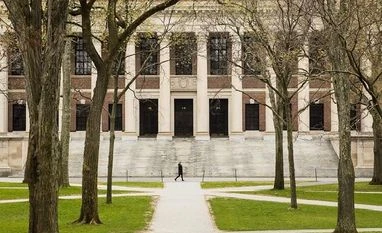
Harvard University in Cambridge, Massachusetts (Photo: Bloomberg)
Listen to This Article
After Columbia, US President Donald Trump is now targeting Harvard and Princeton, threatening them with funding cuts as part of a crackdown on what his administration claims is a failure to tackle antisemitism on campuses. The move has triggered concern over visa scrutiny and research opportunities for international students, particularly those from India. Immigration arrests and funding freezes are already affecting student life and academic roles.
Harvard is at risk of losing $9 billion in federal grants, while Princeton University has confirmed that several dozen research grants have already been frozen. Both developments follow a decision by the government last month to cancel $400 million in grants to Columbia University.
In a wider move, Trump signed an executive order in March to dismantle the Department of Education. Education Secretary Linda McMahon was instructed to “take all necessary steps to facilitate the closure” of the department, which oversees billions in federal education funds.
Possible fallout for foreign students
Legal experts and university officials say the ongoing clampdown could hit education and research programmes involving international students.
Also Read

 "Nita Ambani")
 "Harvard Business School")
 "Mark Zuckerberg")
 "Harvard University")
 "HDFC Bank")
“If this funding is stopped, it will halt life-saving research and imperil important scientific research and innovation,” said Alan Garber, president of Harvard, in an official statement.
In the 2023–24 academic year, over 331,000 Indian students were in the US. According to the Open Doors report, 42.9 per cent chose maths or computer science, and 24.5 per cent were in engineering.
Visa scrutiny adds to pressure
There has also been a rise in scrutiny of student visa applications under the Trump administration.
The increasing scrutiny and higher denial rates for international student visa applicants are already discouraging students from choosing the US.
Ajay Sharma, founder of Abhinav Immigration Services, said the order to close the Department of Education may face legal and legislative resistance.
“The decision or plan to shut down the Education Department would require approval from Congress,” Sharma discussed with Business Standard. “If a significant bill is to be introduced, it would also need a Senate majority. Like many other directives since the Trump administration took over, this may require multiple levels of approval.”
He added that while federal funding backs several key programmes, education in the US remains largely a state matter.
“If a state can afford to maintain its own programmes, the impact may be minimal,” Sharma said. “The effect is likely to be felt more at the higher education level—particularly where major scholarships or loan schemes are involved.”
“The real issue with directives like these is the uncertainty they generate. They often result in a wave of court challenges and political pushback. Short-term effects may not be immediately visible, but they do sow confusion and speculation almost instantly,” he added.
What Harvard and Princeton are facing
The move against Harvard follows the cancellation of federal grants to Columbia University, which had become the centre of anti-Israel protests after the October 7, 2023, Hamas attack and the Israeli response in Gaza.
Earlier this month, the Trump administration also suspended $175 million in funding to the University of Pennsylvania, citing its transgender sports policies.
A letter sent by the Department of Education to 60 institutions—including Harvard—warned of possible enforcement actions under Title VI of the Civil Rights Act. It referred to antisemitic “eruptions” on elite campuses that have disrupted student life over the past year.
“Harvard's failure to protect students on campus from antisemitic discrimination—all while promoting divisive ideologies over free inquiry—has put its reputation in serious jeopardy,” said Education Secretary Linda McMahon. “Harvard can right these wrongs and restore itself to a campus dedicated to academic excellence and truth-seeking, where all students feel safe on its campus.”
Princeton University said several federal agencies have frozen dozens of research grants. President Chris Eisgruber, speaking to Bloomberg News, said the university is still seeking clarity on the rationale for the suspension.
“We had notice yesterday of a suspension of some funds and are still seeking clarification of exactly why these funds were suspended,” said Eisgruber. “We have to comply with the law. If there’s an allegation that there’s some kind of unlawful behaviour, we have to change that. We have to stand steadfastly against antisemitism and all other forms of discrimination, and we will cooperate with the government to address those if that’s their concern.”
Princeton, which had a $33.4 billion endowment in 2024, received $455.8 million in government grants and contracts. The university said it has received suspension notices from agencies including the Department of Energy, NASA, and the Department of Defense.
Eisgruber said the school would also continue to “vigorously defend academic freedom and we will insist on the due process rights of the university.”
Wider crackdown and deportations
Several students and former students involved in anti-Israel protests have reportedly been detained by immigration authorities. Mahmoud Khalil, a protest leader at Columbia, and Tufts University PhD student Rumeysa Ozturk, have both been taken into custody. Ozturk, a Turkish national, was detained by plainclothes officers and transferred to a facility in Louisiana.
The Trump administration has asked colleges to provide names and nationalities of student protesters, raising concerns over potential deportations. Legal experts say this may be used to target students under visa rules.
One Indian student from Columbia, Ranjani Srinivasan, reportedly self-deported after her visa was revoked. Another, Badar Khan Suri, is facing deportation over alleged links to a senior Hamas official.
Mamta Shekhawat, founder of Gradding.com, a study-abroad platform, said interest in the US has plummeted.
“It is almost 2 months into the Trump administration in the USA, and the destination that was a top choice for overseas education is facing backlash from almost 80% of the study abroad candidates,” she told Business Standard.
“When asked why, one of them replied: ‘I have seen thousands of social media posts on X and Reddit saying that students already there are afraid to go to their home country on vacations, wondering if they will be allowed back in or not.’”
The US has revoked more than 300 F-1 student visas in recent weeks. “Every country in the world has a right to decide who comes in and who doesn’t,” said US Secretary of State Marco Rubio at a press briefing, according to Bloomberg. “We’re looking every day for these lunatics that are tearing things up.”
Rubio confirmed the number of revoked visas may already have crossed 300. “Every time I find one of these lunatics, I take away their visa,” he said.
More From This Section
 "Is the cash reserve ratio (CRR) a deadweight on banks? Of every Rs 100 raised by banks in deposits, Rs 4.50 is locked up and it earns nothing by way of interest. The CRR framework is in the spotlight because one, a good number of folks now opt to par")
 "schengen visa")
 "fund, tax")
 "spam scam phone")
 "Australia visa")
Don't miss the most important news and views of the day. Get them on our Telegram channel
First Published: Apr 02 2025 | 10:48 AM IST