


India enters humanoid robotics race with Sherpa Mecha as China surges ahead
India takes its first big step into humanoid robotics with Ati Motors' Sherpa Mecha, even as global powers ramp up investments and deployment across manufacturing, services, and defence
 "humanoid, Ati motors, Sherpa mecha, Indian humanoids")
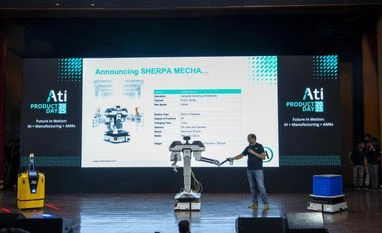
Sherpa Mecha, Mecha’, a humanoid-inspired robot, that pushes the boundaries of robotics research, doing a Handshake with Ati Motors' CEO Saurabh Chandra.
Listen to This Article
At its Product Day 2025 event, Indian robotics startup Ati Motors unveiled what could mark a pivotal moment for India’s deep-tech sector — the debut of Sherpa Mecha, a humanoid-inspired robot engineered for industrial deployment. Unlike fully human-like robots, Sherpa Mecha is function-first — designed to carry out high-precision tasks in complex factory environments, the company said in a press release.
The robot’s launch highlights a quiet but bold ambition — building world-class robotic platforms from India that are scalable, intelligent, and export-ready.
Sherpa 10K and India’s expanding industrial robot ecosystem
The company also launched Sherpa 10K, a heavy-duty autonomous mobile robot (AMR) capable of carrying loads up to five tonnes with millimetre-level accuracy. These platforms are already running over 1 million autonomous missions per year across Southeast Asia, the US, and Mexico.
Sherpa 10K, a robust autonomous tugger engineered for the most demanding Indian and global industrial environments, with a tugging capacity of up to 5 tonnes.
Also Read

 "IndiGo, IndiGo Airlines, IndiGo aircraft")
 "image")
 "Senior Citizen Health Insurance")
 "NewsClick founder Prabir Purkayastha")
 "road accidents, accidents, car crash, road safety, motor vehicle bill, motor vehicle act")
“Every Sherpa deployed is a testament to India’s capabilities in advanced engineering and AI, given that it takes an ecosystem to deliver these and not just the ingenuity of a single startup,” said Saurabh Chandra, founder and chief executive officer (CEO) of Ati Motors.
Where are humanoids being used in India today?
India’s humanoid applications are still largely in the exploratory stage. Ati’s Sherpa Mecha is tailored to industrial automation — assembly lines, material handling, and quality inspection — but remains in testing phases. Elsewhere:
Invento Robotics developed “Mitra,” a semi-humanoid used in hospitality and health care
Isro is preparing Vyommitra, a spacefaring humanoid, for Gaganyaan missions in Q4 2025
DRDO is prototyping humanoids for military and hazardous environments
Addverb Technologies, backed by Reliance, is set to launch a dual-arm humanoid in 2025
Despite this activity, India is far from mass-scale deployment in logistics, elder-care, or public services — sectors where China is already forging ahead.
What is India’s humanoid market size?
India’s humanoid-robot market is in a nascent but growing phase. Cognitive Market Research estimates the market to be worth $75.4 million in 2025 with a CAGR of 44 per cent. Other projections suggest it could grow from $42 million in 2023 to $149 million by 2030 at 20 per cent CAGR.
In contrast, China’s investment and market penetration remain significantly higher.
How is China accelerating humanoid deployment?
China has aggressively positioned humanoid robotics as a strategic industry. In 2024 alone, central government support topped $20 billion, with additional city-level robotics funds in Beijing and Shanghai. According to Reuters, state procurement of humanoid robots rose from RMB 4.7 million in 2023 to over RMB 214 million in 2024.
Chinese startups such as AgiBot, MagicLab, EngineAI, Unitree and UBTech are leading deployments into public service and manufacturing. UBTech’s Walker S2 became the world’s first humanoid to autonomously swap its own battery and operate 24/7 without human breaks.
What sectors are Chinese humanoids targeting?
Deployment is most advanced in:
Manufacturing: Robots are already assisting in automotive plants (BYD, Geely, FAW-Volkswagen)
Logistics and electronics: Pilots by MagicLab and AgiBot are underway
Elder-care and home services: Projects by Ant Lingbo (Ant Group) and Tencent’s Robotics X Lab are testing use cases for caregiving and companionship
How does the global humanoid robot market compare?
According to China Briefing, China’s humanoid market is expected to grow from $380 million in 2024 to $10.3 billion by 2029, capturing nearly a third of global market share.
Global forecasts:
Markets and Markets: From $2.03 billion in 2024 to $13.25 billion in 2029
Goldman Sachs: $38 billion market potential by 2035, shipping 1.4 million units
Morgan Stanley reports that 61 per cent of all humanoid models unveiled between 2022 and 2025 originated in China.
What’s the status of Elon Musk’s Tesla Optimus?
Tesla’s Optimus project has shown promise but faces hurdles. Despite Musk’s projection of 10,000 units by 2025, production halted after just 1,000 due to technical issues like overheating joints. Optimus leads in AI “brain” capabilities, but China dominates in physical manufacturing and cost efficiency.
Why are humanoids seen as a strategic priority?
Humanoid robots are increasingly viewed as solutions to workforce shortages, rising labour costs, and demographic decline. They are being positioned as the next big economic engine — akin to PCs, smartphones, and electric vehicles.
How are other countries responding?
South Korea: Launched the K-Humanoid Alliance in April 2025, targeting deployment by 2028
Japan: Though a pioneer in humanoid robotics, it is slower in scaling up newer models
Europe and the US: Maintain software and AI leadership but lag in hardware volume and affordability
Analysts widely believe China may reach commercial-scale humanoid deployment before its Western rivals — thanks to strong state backing and superior supply-chain integration.
More From This Section
 "Parliament, New Parliament, Lok sabha, Rajya sabha")
 "iit bombay")
 "Droupadi Murmu, Murmu, President")
 "Parliament")
 "Supreme Court, SC")
Don't miss the most important news and views of the day. Get them on our Telegram channel
First Published: Jul 23 2025 | 6:39 PM IST