


Independence Day 2025: PM Narendra Modi maps road to 'atmanirbharta'
Makes swadeshi push in face of US tariffs and announces next-gen reforms, deepwater energy hunt, defence shield project
 "Narendra Modi")
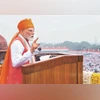
Prime Minister Narendra Modi addresses the nation from the Red Fort on the 79th Independence Day (Photo: PTI)
Listen to This Article
With economic self-interest now the global order of the day, Indians must not wallow in crisis but instead build strength and standing, Prime Minister Narendra Modi declared from the ramparts of the Red Fort in his Independence Day address on Friday.
Facing stiff US tariffs, Modi appealed to the nation to embrace “swadeshi”, and set out his government’s drive towards “atmanirbharta” -- self-reliance -- in everything from jet engines and EV batteries to fertilisers.
In a 103-minute speech, among the longest of his dozen Independence Day addresses since 2014, he spoke about the government’s efforts to slash India’s energy import bill, which runs into trillions on rupees, and announced a National Deep Water Exploration Mission to hunt for oil and gas.
A task force, he said, would be set up to recommend “next-generation reforms” to overhaul the laws, rules and procedures that govern economic life, working within a strict time-frame.
Even as he prepared the country to face economic challenges because of the 50 per cent US tariff, there was a sweetener. The government will roll out next-generation GST reforms, Modi said, to cut the tax burden on ordinary people, make daily necessities cheaper and boost growth. “It will be a double Diwali gift for you,” he promised, with micro, small, and medium enterprises (MSMEs) and small entrepreneurs set to benefit.
Also Read

 "insurers, insurance")
 "PM Modi, Narendra Modi, Independence Day, Red Fort")
 "GST")
 "The Nifty FMCG index has remained nearly flat, registering just a 0.3 per cent increase since the start of the 2024 calendar year. As of Wednesday, the FMCG index closed at 57,177.6, compared to 56,987.2 at the end of December 2023.")
While skirting direct reference to the US tariffs -- including penalty over India for its import of Russian crude, and Washington’s push for access to the country’s agriculture and dairy sectors -- Modi vowed to protect the interests of farmers, livestock rearers and fisherfolk. “Modi is standing like a wall against any harmful policy that threatens the interests of farmers, fishermen and cattle rearers of India,” he said, sporting a saffron headgear.
He hailed exports of Indian agro-products worth ₹4 trillion.
Calling on every trader and shopkeeper to display “Swadeshi goods sold here” signs, he urged pride in local products: “Not out of compulsion but for our own strength -- and if needed, even to compel others to use it. This should be our guiding mantra.”
From his “25 years of administrative experience”, he insisted: “If we choose this path, and if everyone chooses it, then no selfish interest will ever be able to entrap us.” Just as millions’ sacrifices brought “swatantra Bharat” 79 years ago, so too could hard work, vocal for local and swadeshi bring “samruddha Bharat”, a prosperous India.
The prime minister unveiled a ₹1 trillion employment scheme: Newly-employed private sector youth will receive ₹15,000 a month, benefiting 30 million. He warned of “demographic imbalance” from infiltration and illegal migration in border areas, launching a high-powered Demography Mission to protect unity, integrity and citizens’ rights.
The leitmotif of the celebrations was Operation Sindoor -- a military success he credited to indigenous defence investment. By 2035, India would erect a national security shield, the Sudarshan Chakra, to protect both defence and civilian assets.
Made-in-India semiconductor chips will hit markets by year’s end, Modi said.
The prime minister highlighted India’s push towards self-reliance in critical minerals with exploration at over 1,200 sites.
Attempts to set up chip factories “50–60 years ago were killed at birth while other nations prospered”, but now India was in “mission mode”, he said. Nuclear capacity, the prime minister said, would increase tenfold by 2047, with work on 10 new reactors already under way.
Pakistan was mentioned three times, along with a warning against “nuclear blackmail” and further misadventure. The Indus Waters Treaty, put in abeyance after the Pahalgam terror attack, was “unjust and one-sided”, Modi said: “Blood and water will not flow together.”
Explaining the impact of Operation Sindoor, Modi said Pakistan is still “sleepless” and that the devastation in that country has been so huge that every day brings new revelations and fresh information.
Stressing that dependence on imports was “unfortunate”, he asked entrepreneurs to strive for quality manufacturing at lower costs. “Daam kam, dum zyada,” he said.
“We should not waste our energy in belittling others, our focus should be on strengthening ourselves. For a nation, the greatest criteria for self-dignity is its self-reliance,” the prime minister said, while addressing the crowd that included school students and sportspersons wearing white hats printed with the slogan “New India.”
He insisted India’s macroeconomic fundamentals were strong -- inflation under control, foreign reserves robust -- and the country must “focus on even greater goals now”.
Modi, once an RSS pracharak, hailed the Sangh’s centenary as “a very proud and glorious” journey for the “world’s biggest NGO”. From the Red Fort, he saluted all swayamsevaks whose century of service “will continue to inspire us”.
Taking aim at Opposition charges of Hindi imposition, he pointed to classical language status for Marathi, Assamese, Bengali, Pali, and Prakrit.
The Constitution had been a “lighthouse” for 75 years, he said, invoking Syama Prasad Mookerjee’s sacrifice for it, and recalling how the Emergency “strangled” it 50 years ago, turning India into “a prison”. His government, he said, would mark the 200th birth anniversary of reformer Mahatma Jyotiba Phule, whose “priority to the backward” guided policy still.
He also condoled the loss of lives in recent natural calamities, including flash floods in Uttarakhand.
More From This Section
 "President Droupadi Murmu")

 "La Ganesan")
 "PM Modi, Narendra Modi, Independence Day, Red Fort")
 "accident")
Don't miss the most important news and views of the day. Get them on our Telegram channel
First Published: Aug 15 2025 | 10:34 PM IST