


Did Maharashtra reduce budget for 'Ladki Bahin' scheme? All we know
While the government's manifesto had promised an increase in the monthly stipend from Rs 1,500 to Rs 2,100, the budget has yet to give it a formal nod
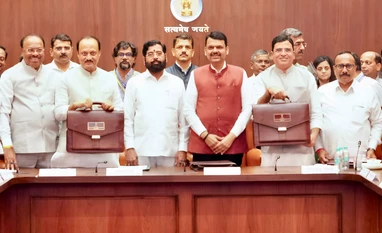 "Maharashtra Budget 2025, Ajit Pawa, Maharashtra Cabinet, Devendra Fadnavis")
Maharashtra Cabinet before Ajit Pawar presents state budget for 2025-26 | Photo: X/@Dev_Fadnavis
Listen to This Article
The Mahayuti government presented its first budget after a landslide victory in the Maharashtra Assembly elections, revealing that the state is grappling with its highest-ever debt projection of Rs 9.3 trillion and a steep revenue deficit of Rs 45,891 crore for the financial year 2025-26.
With limited financial resources, the budget refrained from announcing any major new schemes, instead focusing on continuing existing programmes while maintaining fiscal discipline.
A key point of contention has been the allocation for the Mukhya Mantri Majhi Ladki Bahin Yojana. While the government's manifesto had promised an increase in the monthly stipend from Rs 1,500 to Rs 2,100, the budget has yet to give it a formal nod. Additionally, the estimated outlay for the scheme has been reduced by Rs 10,000 crore compared to last year, bringing the total allocation to Rs 36,000 crore for the financial year 2025-26.
However, Maharashtra Chief Minister Devendra Fadnavis debunked reports of budget cuts for the scheme, assuring that all beneficiaries would receive their entitled funds.
"We have not decreased the money for 'Ladki Bahin'. Everyone will get their money. The budget has been structured as per the need, and if additional funds are required, we will make provisions for it. We will fulfill our promise of providing Rs 2,100 per month to our sisters," CM Fadnavis said.
ALSO READ: Maharashtra Budget 2025: New airport, job generation, road development
Also Read

 "EV, ELECTRIC VEHICLE")
 "Maharashtra Budget 2025, Ajit Pawa, Maharashtra Cabinet, Devendra Fadnavis")
 "crop insurance")
 "Mumbai skyline, Market, Peak XV, firms, buildings, real estate, companies, Sequoia Capital")
 "Accident, road accident")
In addition to reaffirming support for the 'Ladki Bahin' scheme, the chief minister announced plans to provide 300 units of free electricity per month and leverage Artificial Intelligence (AI) to boost agricultural productivity.
Speaking at a joint press conference with Deputy Chief Minister and Finance Minister Ajit Pawar, he also highlighted Maharashtra's strong performance in revenue collection.
“The fiscal deficit of Maharashtra is contained at 2.9 per cent, and for the next year, it is estimated to be 2.7 per cent. While our loan burden has increased, our borrowing capacity has also expanded. We remain well within fiscal limits, with debt at 18.7 per cent of GSDP, far below the prescribed 25 per cent limit. Maharashtra is leading in Goods and Services Tax (GST) collection and Foreign Direct Investment (FDI), contributing 15.4 per cent to the country's GDP," Fadnavis stated.
Ajit Pawar, presenting his 11th state budget, reinforced Maharashtra's commitment to economic growth, announcing that 56 companies signed MoUs at Davos, bringing investments worth Rs 15.72 trillion and generating 1.6 million jobs. "Maharashtra is set to play a leading role in realising the Prime Minister’s vision of a developed India by 2047. The Mumbai Metropolitan Region Development Authority (MMRDA) will be transformed into a growth hub with seven new business centres planned across the region," he added.
To address local body elections, the budget has increased the district annual plan by 11 per cent, raising it from Rs 18,165 crore to Rs 20,165 crore. The scheduled caste component of the annual plan has been hiked by 42 per cent, while the tribal component sees an estimated 40 per cent increase.
The budget also proposes new revenue streams, including taxes on motor vehicles expected to generate Rs 1,125 crore and a hike in stamp duty on certain transactions. Maharashtra’s debt burden is now Rs 2 trillion higher than the 2024-25 figure of Rs 7.1 trillion, nearly tripling over the past decade. The revenue deficit has also doubled compared to last year’s estimate of Rs 20,051 crore.
Despite the financial strain, infrastructure projects will continue, albeit without new outlays. The government is also pushing for women's empowerment through credit societies and self-help groups, inspired by a successful initiative in Nagpur under the 'Ladki Bahin' scheme. "We are working towards the 'Lakhpati Didi' model, where women can earn up to Rs 8,000 per month," Fadnavis said.
(With agency inputs)
More From This Section
 "Parliament, New Parliament")
 "United Nations")
 "Sanjay Singh, WFI")
 "Holi special train 2025")
 "Siddaramaiah, Karnataka CM")
Topics : Maharashtra welfare schemes BS Web Reports
Don't miss the most important news and views of the day. Get them on our Telegram channel
First Published: Mar 11 2025 | 12:24 PM IST