


Analysts see big boom in battery storage; RIL, Waaree among key gainers
With 100GWh, 20GWh and 12GWh of planned capacities respectively, these players are set to benefit from what Nuvama calls an imminent J-curve demand breakout, reaffirming its 'Buy' rating on the theme.
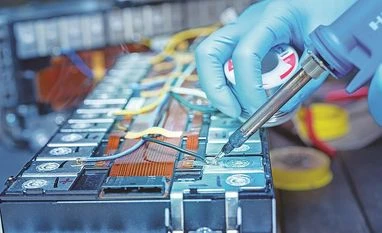 "battery")
According to analysts, technological shifts offer a potential opening. While Li-ion still commands ~98 per cent of the BESS market, emerging chemistries such as sodium-ion are gaining momentum due to better cost economics and safety.
Listen to This Article
Domestic brokerage Nuvama Institutional Equities (Nuvama) sees a multi-decadal opportunity unfolding in India’s Battery Energy Storage Systems (BESS) market, placing Reliance Industries (RIL), Waaree and Premier Energies at the forefront as each prepares to commission large-scale capacities.
With 100GWh, 20GWh and 12GWh of planned capacities respectively, these players are set to benefit from what Nuvama calls an imminent J-curve demand breakout, reaffirming its ‘Buy’ rating on the theme.
The brokerage recently hosted CEEW experts Arushi Relan and Shruti Gauba in its New Energy/ESG Series to decode India’s path to energy resilience through storage.
Their core message was India’s BESS story is at a turning point. Installed BESS capacity, currently a modest 0.5GWh, is projected to soar to 236GWh by 2032, a blistering 141 per cent CAGR, and reach 1,840GWh by 2047, implying a 45 per cent CAGR over the next 22 years. ALSO READ | Nuvama bets on HDFC AMC, KFin as SIPs hold firm, lump-sum flows rebound
A confluence of structural drivers underpins this surge, Jal Irani, Tanay Kotecha and Akshay Mane of Nuvama said. Battery pack prices have already fallen 84 per cent over the past decade, and costs are expected to decline by another one-third by 2030, improving affordability across grid-scale, renewable integration and commercial & industrial (C&I) applications. Rising demand for round-the-clock clean power, the need to stabilise an increasingly renewable-heavy grid, and the economic advantage of BESS over fossil fuel-based peakers are expected to accelerate adoption. Nuvama notes that setting up 1GWh of BESS requires around ₹1,000 crore in capex, with execution timelines of six to 12 months and asset life of about 16 years.
Also Read

 "Stock Market LIVE, December 12, 2025")
 "Stock Market LIVE Updates")
 "Lloyds Engineering Works share")
 "Tata Steel, Tata")
 "AMC stocks, SIP flows")
The brokerage, however, flags raw material dependency as a strategic bottleneck. Cathodes remain the costliest component given their reliance on precious metals, making vertical integration essential for cost control. This challenge is amplified by China’s overwhelming dominance, it accounts for over 75 per cent of global battery and component manufacturing and exports more than $60 billion worth of Li-ion batteries annually. Concerns around supply concentration, dumping risks and cybersecurity further sharpen the need for domestic capacity. ALSO READ | Outlook bright for auto financiers, but valuations may cap upside: Analysts
According to analysts, technological shifts offer a potential opening. While Li-ion still commands ~98 per cent of the BESS market, emerging chemistries such as sodium-ion are gaining momentum due to better cost economics and safety. With limited lithium reserves, India can leverage the ‘China +1’ shift by focusing on value-chain segments where competitiveness can be achieved faster, supported by targeted R&D, policy reforms and financing for cell manufacturing.
That said, Nuvama believes India’s energy storage cycle is entering its steepest growth phase yet, and the companies scaling capacity early stands to gain the most.
Disclaimer: The view/outlook has been suggested by Nuvama. Views expressed are their own
More From This Section
 "Asian stocks, Asian stock market")
 "BSE, Markets insights, stock market")
 "stock market, BSE")
 "equity mutual fund")
 "housing, housing finance")
Topics : Share Market Today Industry Report Waaree Energies RIL stock Reliance Industries RIL Lithium battery battery technology Battery makers Electric car battery Markets Sensex Nifty S&P BSE Sensex Nifty50 Indian equities Share price
Don't miss the most important news and views of the day. Get them on our Telegram channel
First Published: Dec 12 2025 | 9:01 AM IST