


Best of BS Opinion: Growth's next chapter is written in innovation
Here are the best of Business Standard's opinion pieces for today
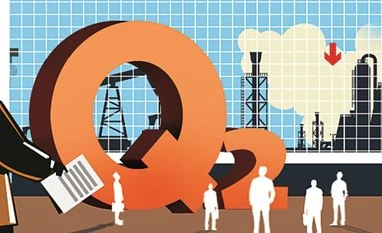 "Q2 result")
Illustration: Ajay Mohanty
Listen to This Article
The past year in markets has tested investors’ patience. Since last Diwali, the Sensex and Nifty have gained only around 5-6 per cent, with small-caps slipping into losses and equity returns barely keeping pace with inflation, highlights our first editorial. Government securities have done better, helped by global uncertainty and geopolitical tensions.Gold has emerged as the standout performer, delivering returns of over 50 per cent. Mutual fund inflows remain robust, with assets rising to Rs 75.4 trillion, and IPO fundraising has nearly doubled year-on-year. Yet foreign investors have pulled out Rs 1.5 trillion from equities, wary of uneven growth and global headwinds.
Inflation, meanwhile, has fallen to its lowest level in more than eight years. September’s retail inflation dropped to 1.54 per cent, largely on the back of cheaper food prices. This has stoked expectations that the Reserve Bank of India could cut rates at its December meeting, notes our second editorial. The central bank has lowered its inflation forecast for FY25 to 2.6 per cent and raised growth expectations to 6.8 per cent, though it foresees price pressures reviving later. However, economists caution that any rate cut from the current 5.5 per cent would depend on fresh data and the RBI’s updated projections for FY26 and FY27.
Beyond markets, the year’s Nobel Prize in Economic Sciences has turned attention to the roots of growth itself. As Mihir S Sharma writes, Joel Mokyr, Philippe Aghion, and Peter Howitt were recognised for showing how innovation and knowledge creation power economies through what they call “creative destruction.” Their work underscores that progress depends not just on capital and labour, but on societies’ willingness to embrace new ideas.
That theme resonates in India’s own challenge as well. Debashis Basu argues that the country must view growth as a knowledge ecosystem. With only 0.7 per cent of GDP spent on research and development and weak links between academia and industry, India risks stagnating without stronger research universities, technology partnerships, and incentives for private R&D. Building networks that connect laboratories, factories, and markets could unlock the next wave of innovation-led growth.
Finally, David Greenberg reviews Devils’ Advocates by Kenneth P Vogel’s, to round off the week’s reading with a gripping account of Washington’s $5-billion foreign lobbying industry. Through figures like Hunter Biden, Rudy Giuliani, and Paul Manafort, Vogel exposes how foreign powers cultivate access and influence, revealing a system less about ideology and more about the mechanics of money and persuasion.
Stay tuned!
More From This Section

 "festival travel, air travel")
 "Illustration: Ajaya Mohanty")
 "Nifty, Sensex, record highs, markets, investing strategy, gold prices, commodity surge, silver prices")
 "flexicap funds, mutual fund inflows, AUM, Rs 5 trillion, equity mutual funds, investor trends, Parag Parikh, HDFC Flexicap Fund, sectoral funds, thematic funds, SIP inflows, investment strategy, largecap bias, midcap funds, smallcap funds")
 "Modi, Narendra Modi, Keir Starmer")
Topics : BS Opinion BS Special Curated Content
Don't miss the most important news and views of the day. Get them on our Telegram channel
First Published: Oct 20 2025 | 6:15 AM IST