


CPI(M) aiming to recover WB base, unite Left forces against TMC, BJP: Karat
He added that no discussions had been held on whether the Left Front and the Congress would contest the assembly polls, due in 2026, in an alliance
 "Prakash Karat")
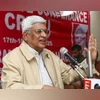
CPI(M) interim coordinator stressed that the party losing ground in West Bengal was a major reason behind its declining electoral strength. | File Photo: PTI
Listen to This Article
The CPI(M) is aiming to recover its base in West Bengal and will try to bring together "Left and democratic forces" against both the TMC and the BJP, party leader Prakash Karat has said.
He added that no discussions had been held on whether the Left Front and the Congress would contest the assembly polls, due in 2026, in an alliance.
In an interview with PTI, the CPI(M) interim coordinator stressed that the party losing ground in West Bengal was a major reason behind its declining electoral strength.
The CPI(M) is focusing on working among the rural poor to regain its traditional support base, Karat said.
Asked about the party's standing in West Bengal, which the CPI(M)-led Left Front governed for 34 years between 1977 and 2011 before losing to the TMC, the veteran leader highlighted the recent mobilisations of youngsters, including during the protests against the RG Kar rape and murder incident.
Also Read

 "CPI(M) MP K Radhakrishnan")
 "Delhi Assembly elections: Congress, AAP, BJP")
 "CPI (M), CPI (M) logo")
 "National Investigation Agency NIA")
 "Kerala chief, K Sudhakaran")
"I am not talking only about our party but all Left and progressive forces (that) came out in large numbers, mobilising the youth also in a big way," Karat told PTI.
"So, we are trying to regain our influence among sections whose support we had lost. We have now realised that we must work very hard among the rural poor. That was our main base. So, we have made those plans. Some progress is there," he said.
Karat claimed the CPI(M) had organisationally regrouped and reoriented even though it had not converted it to electoral success yet.
Asked if the Left Front-Congress alliance would continue in the assembly polls, he said, "Last time, we had some understanding with the Congress. I don't know whether that will materialise this time. It may also. We have not entered that stage of having any discussions on that yet." "But we will be making a serious effort in the assembly election against the TMC and the BJP. We are going to oppose both. And we hope to rally all other Left and democratic forces as an alternative," he said.
The CPI(M) and the Congress, as well as the TMC, are constituents of the Indian National Developmental Inclusive Alliance (INDIA) of opposition parties that came together ahead of the Lok Sabha elections to counter the BJP-led National Democratic Alliance at the Centre.
The CPI(M)-led Left Front and the Congress had formed an alliance in West Bengal for the 2016 and the 2021 assembly polls, and the 2024 Lok Sabha elections.
Asked about Kerala, which also goes to the polls in 2026, Karat said the CPI(M)-led Left Democratic Front (LDF) government winning a second consecutive term was unprecedented and the focus now was on long-term development goals.
Noting that the LDF was in its second term, Karat highlighted that that itself set a new precedent, pointing to Kerala's history of alternative governments.
That pattern was broken for the first time in 2021, he said.
"This itself opened up new possibilities and also new challenges. Because everybody is used to this pattern of being in the seat of power for five years and then in the opposition -- whether it's the Congress or us. We are entering the ninth year of the Pinarayi Vijayan government, we (have) realised that let us have a more long-term perspective. That is why we have been talking about a new Kerala, a Nava Kerala, which will be as per international standards of a medium-developed country," Karat said.
"We are hoping that this will pay off, that people will understand that this government has seriously engaged in a path of development which is suitable for Kerala and, on that basis, give us another vote of confidence," he added. 'Centre 'insensitive' towards southern states' apprehensions over three-language formula'
More From This Section
 "Modi, Narendra Modi, Sharad Pawar")
 "Ravi Shankar Prasad, BJP leader")
 "Supriya Sule, Supriya, Sule")
 "Bhupesh Baghel")
 "Pinarayi Vijayan, Pinarayi, Vijayan, Kerala CM")
Don't miss the most important news and views of the day. Get them on our Telegram channel
First Published: Mar 15 2025 | 5:36 PM IST