


The economics and art of giving: TN elections may revive freebie debate
With elections in Tamil Nadu approaching, the 'investment or freebie' debate, as part of the overall development question, is likely to resume
 "MK Stalin, Stalin")
premium
Supporters of the DMK and AIADMK alike hotly contest the charge that in Tamil Nadu freebie power wins elections
6 min read Last Updated : Dec 28 2025 | 11:45 PM IST


Listen to This Article
Microwave ovens? Induction cookers? Air fryers? MacBooks?
As Assembly elections in Tamil Nadu approach (likely April-May 2026), speculation has begun in the state, which is known for distributing election freebies: What will it be this time? The answer could well be: None of the above.
Government officials are measured in their responses. “Old-age pension might be doubled,” said a member of the Indian Administrative Service (Tamil Nadu cadre), posted in Delhi. “It is ₹1,200 a month now and it is a social-security measure.” He acknowledged the “complicated logistics” in distributing pressure cookers, mixies, colour TVs, and the like.
Tamil Nadu might have decided to opt for cash in the bank, using direct benefit transfer (DBT) for the 2026 Assembly elections. But in the past, almost every Assembly election had led to a deluge of freebies for voters, beginning with 1991, when J Jayalalithaa promised colour TVs in all panchayats (she ran into trouble later due to corruption charges in the procurement of 40,000 TV sets and was investigated for it). But picking up where she left off, her successor, M Karunanidhi, in 2006 offered colour TVs to all households holding the ration card. Among other promises were free gas stoves with a gas connection. In 2011, Karunanidhi offered either a free mixie or grinder to ration card holders. Jayalalithaa did one better, offering both, plus a fan, to each woman in the state, laptops to Class 11 and 12 students, four free sets of uniforms, and a pair of shoes for school children. Free houses of 300 square feet for 300,000 families below the poverty line, 60,000 cows for 6,000 families, and ₹50,000 as wedding assistance for women with diplomas were included in the manifesto of the All India Anna Dravida Munnetra Kazhagam (AIADMK).
Four sheep and goats for every family below the poverty line were also part of the 2011 AIADMK manifesto. The rollout of this scheme began, strategically, around the 2014 Lok Sabha election.
The manifesto of the Dravida Munnetra Kazhagam (DMK) also promised free laptops — but to every student in the first year of their graduate professional courses in government-run and government-aided colleges and to students of backward, most backward, and Scheduled-Caste communities when they joined a professional course. The party threw in free rice to families below the poverty line and enhanced marriage allowance to women from ₹25,000 to 30,000.
All this excludes the monetary income support the state government offered to a variety of low-income groups, and other free services like free bus travel for women on buses run by the state government or free breakfast or mid-day meals for schoolchildren, which was pioneered by Tamil Nadu when a Congress-led government headed by Kamaraj was in power (1957).
Supporters of the DMK and AIADMK alike hotly contest the charge that in Tamil Nadu freebie power wins elections. “How can you say which is a freebie and subsidy, and which is an investment? If I give free schooling, is that an investment or a subsidy? This whole debate is a waste of time,” P Thiaga Rajan, former state finance minister, had told Business Standard in an earlier interview.
A S Panneerselvan, who has written a bestselling biography of M Karunanidhi, former chief minister, said: “Tamil Nadu’s gross enrolment ratio (GER) in higher education is upwards of 47 per cent, much higher than the all-India average of 29 per cent. Child and adolescent health levels are much better, and there are no dropouts, especially among girls. This is a result of sustained investment in education, starting from the days of Kamaraj.”
The so-called freebies like mixers and grinders, he said, help take the drudgery out of the unpaid work of women. He cites the Kalaignar Magalir Urimai Thogai scheme, rolled out in 2023. This scheme promises women (satisfying certain criteria) an unconditional cash transfer of ₹1,000 per month in recognition of their unpaid domestic and care work.
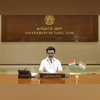
Chief Minister M K Stalin rolled out a second phase of this scheme earlier this month.
“When you add the free bus-pass scheme to this, it is a big step in the inclusion of women in the workforce. Now, not only do women get paid for unpaid work but can also travel to find higher-paying work. And if they do, they don’t have to relocate — they can commute at no cost,” he said.
Karti Chidambaram, Lok Sabha MP from Tamil Nadu (Sivaganga), says direct cash transfers seed the local economy.
Similarly, Panneerselvan is of the view that “our social sector policies saved us”. “There are no farmer suicides in Tamil Nadu. This is the reason why Tamil Nadu is not like Odisha in absolute poverty levels”.
The major difference between Tamil Nadu and other states is that all parties have recognised the competitive nature of welfare politics, according to him. “If one party rolls out a free noon-meal scheme, the other makes it more attractive by adding bananas to the meals. The next government adds eggs. The following government gives breakfast to schoolchildren. Governments don’t scrap their predecessor’s initiatives. They improve them.”
Other institutions have taken a dim view of these schemes. In July 2022, after Prime Minister Narendra Modi first criticised the “revadi culture” — handing out freebies — in a speech in Uttar Pradesh, the Supreme Court made oral observations criticising pre-election announcements of “free money”.
“Unfortunately, because of these freebies ... the people are not willing to work. They are getting free rations. They are getting amount without doing any work,” said Justice B G Gavai in the course of a February 2025 hearing on the right of homeless people to accommodation.
In Tamil Nadu, they don’t agree. “If foreign direct investment in Tamil Nadu is among the highest in India, it is because the state has taken sustained efforts to improve skill development on the back of general education. The skilled workforce comes because of state government intervention,” Panneerselvan said.
The upcoming polls will likely see a continuation of the debate between development and dole.