


Nothing changes in terms of trade deal with India: Donald Trump
Trump's remarks came after the US Supreme Court ruled that he could not rely on the International Emergency Economic Powers Act to impose sweeping tariffs on imports
 "Donald Trump")
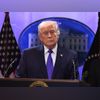
US President Donald Trump addressed a press conference on Friday. (Photo: YouTube/@WhiteHouse)
Listen to This Article
US President Donald Trump on Friday said "nothing changes" with Washington's deal with India. Trump called the US-India trade deal a "fair deal" as he said the Supreme Court's ruling was "deeply disappointing" and "ridiculous".
Addressing a press conference after the Supreme Court's verdict, he said he was very proud of his work and had "powerful alternatives" to impose tariffs. He said he would sign an executive order to impose a 10 per cent global tariff over and above the existing tariffs, which would come into effect in three days.
Responding to a question on the status of the trade deal with India, Trump said, "I think PM Modi is a great gentleman. It is a fair deal. We are not paying tariffs, but they are. We did a little flip there." Trump’s remarks came after the US Supreme Court ruled that he could not rely on the International Emergency Economic Powers Act (IEEPA) to impose sweeping tariffs on imports.
It is to be noted that India was subject to some of the highest tariffs imposed under IEEPA, totalling 50 per cent from August until just two weeks ago, when Indian and American officials agreed to a bilateral trade agreement.
The verdict, which came 6-3 against President Trump, triggered the move of 10 per cent global tariffs. The court held that IEEPA allowed the president to regulate certain economic transactions during a national emergency but did not authorise the imposition of tariffs. It said Congress retained primary authority over duties and trade taxes and found no clear statutory basis for using emergency powers to introduce broad import tariffs.
Also Read

 "Donald Trump")
 "Donald Trump, Trump")
 "Donald Trump, Trump")
 "Donald Trump, Trump")
 "The US Supreme Court in Washington, DC")
In the press conference, he said, “Certain justices are afraid. This was important for me. We have never done so well before,” Trump said.
“Their decisions are incorrect, but that does not matter. We are very proud of our work. I can do anything, but I cannot charge them a dollar. I do not have the right. This is what the court has said,” he said, adding, “How crazy is that?”
“I disagree with the court’s decision. I can charge much more than I am charging. I have alternatives,” Trump said, referring to other trade laws. “The Trade Expansion Act of 1962, Section 232, the Trade Act, the Tariff Act.”
The justices said tariffs carried major economic consequences and required explicit congressional approval. The ruling set limits on the use of emergency economic powers for trade measures and invalidated the tariff framework introduced under that law.
“As a president, I can do anything, but I cannot charge a dollar under IEEPA. It grants me a lot of power, but does not authorise me to charge,” Trump said when asked about the judgment. He also alleged that the court had been influenced in its decision, without providing evidence.
He criticised some members of the court and said he would pursue tariffs through other legal routes that required additional procedural steps. “Now I am going in a different direction,” Trump said, adding that other authorities existed to impose duties but involved longer processes, including investigations.
Trump also praised justices who dissented from the ruling, particularly Justice Brett M. Kavanaugh. He said he was proud of having nominated him and described the dissent as setting out possible paths for future tariff action.
At the same time, Trump said he had previously taken a cautious approach to avoid provoking legal challenges. “I wanted to be a good boy,” he said.
Trump said he would sign an order to impose a 10 per cent global tariff under Section 122, in addition to existing duties. He said national-security tariffs under Section 232 and measures under Section 301 would remain in force and that further investigations into trade practices would begin.
As he spoke at the press conference, a series of posts from his Truth Social account said the court’s decision had clarified presidential authority over trade rather than eliminating tariffs. The posts said the ruling addressed only the use of IEEPA for tariffs and that other trade statutes remained available.
“In actuality, while I am sure they did not mean to do so, the Supreme Court’s decision today made a President’s ability to both regulate Trade, and impose TARIFFS, more powerful and crystal clear, rather than less. There will no longer be any doubt, and the Income coming in, and the protection of our Companies and Country, will actually increase because of this decision,” his post read.
“Based on longstanding Law and Hundreds of Victories to the contrary, the Supreme Court did not overrule tariffs, they merely overruled a particular use of IEEPA tariffs. The ability to block, embargo, restrict, license, or impose any other condition on a Foreign Country’s ability to conduct Trade with the United States under IEEPA, has been fully confirmed by this decision. In order to protect our Country, a President can actually charge more tariffs than I was charging in the past under the various other TARIFF authorities, which have also been confirmed, and fully allowed,” his post read further.
The Supreme Court decision marked a legal setback for tariffs imposed under emergency powers and reaffirmed that broad tariff measures required clear authorisation from Congress.
More From This Section
 "Statue of Liberty, US-France, US France, France US, US flag, America Franch")
 "Indonesian Flag")
Topics : Donald Trump Trump tariffs US Supreme Court
Don't miss the most important news and views of the day. Get them on our Telegram channel
First Published: Feb 20 2026 | 11:53 PM IST