


Protests spread across Iran with demands to overthrow the govt: Here's why
A sharp fall in the rial, soaring prices and economic uncertainty have sparked protests across Iran, with demonstrators in several cities calling for regime change
 "Iran")
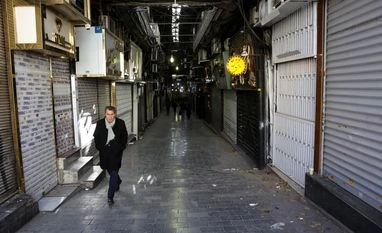
People walk past closed shops following protests over a plunge in the currency's value, in the Tehran Grand Bazaar, Tehran, Iran, December 30, 2025. Photo: Majid Asgaripour/WANA via Reuters
Listen to This Article
Thousands of Iranians have come out on the streets voicing their anger over the country’s worsening economic situation, with some chanting slogans like "death to the dictator," The Telegraph reported. The unrest, which began on Sunday, follows a dramatic decline in the Iranian rial to record lows of 1.42 million to the United States (US) dollar. By Monday evening, the currency had recovered slightly to 1.38 million, the report added.
The protests
Many mobile phone and electronics shopkeepers in Tehran shut their stores on Sunday and urged others to join them in response to the rial’s rapid depreciation. The protests continued on Monday with security forces in Tehran firing tear gas to disperse them. Similarly, in Malard, 28 miles east of the capital, residents faced armed security on motorcycles.
In several cities, demonstrators climbed onto rooftops to chant slogans against the Islamic Republic and its Supreme Leader, Ali Khamenei, the report added.
The demonstrations have also spread across universities, prompting increased security presence around the campuses. "They have closed the gates, and special forces on motorcycles are circling us. We are determined – some of us may be arrested, things could get worse – but we will not back down," one of the protestors inside Tehran University said, as quoted by The Telegraph.
Also Read

 "plastics in arteries")
 "paper cups health risk")
 "Health Insurance")
 "US President Donald Trump")
 "Supporters of Yemen's southern separatists stand on a billboard during a rally to show support to the United Arab Emirates. (Photo: Reuters)")
The regime's response to protests
Iran's President Masoud Pezeshkian addressed the protests on social media, saying he has asked the government to hear the legitimate demands of the protesters.
"The livelihood of the people is my daily concern. We have fundamental actions on the agenda to reform the monetary and banking system and preserve the purchasing power of the people," Pezeshkian said in a post on X.
"I have tasked the Minister of the Interior to hear the legitimate demands of the protesters through dialogue with their representatives, so that the government can act with all its might to resolve problems and respond responsibly," he added.
Troubles mounting for Iran
The economic crisis comes as Iran remains under sanctions and diplomatic pressure from the United States and its allies over its nuclear programme. It is further exacerbated by fears of renewed conflict following June’s 12-day war involving Iran and Israel, with concerns that any escalation could further unsettle markets.
Iran's currency traded at around 32,000 rials to the dollar at the time of the 2015 nuclear accord that eased international sanctions in exchange for strict limits on Tehran’s nuclear programme. The agreement collapsed after Donald Trump withdrew the US from the pact in 2018.
Earlier this year, Trump also claimed that Tehran's nuclear capabilities were completely and fully obliterated by US strikes on key nuclear enrichment sites in June.
Trump on Monday warned Tehran of military action if it attempts to rebuild its nuclear or missile programmes. “Now I hear that Iran is trying to build up again. And if they are, we're going to have to knock them down. We'll knock them down. We'll knock the hell out of them. But hopefully that's not happening,” Trump said, as quoted by the Associated Press.
The World Bank has projected that Iran’s gross domestic product (GDP) could shrink by 1.7 per cent in 2025 and 2.8 per cent in 2026, Reuters reported. Data from the Iranian Statistics Centre show that currency depreciation has fuelled inflation, which rose to 42.2 per cent in December, with food prices up 72 per cent and health and medical items increasing 50 per cent year-on-year, the Associated Press reported.
More From This Section
 "Russia Ukraine flag, Russia-Ukraine flag")
 "Ranjit Gill, Ranjit 'Ricky' Singh Gill")
 "Vladimir Putin, Putin")
 "china Flag, China")
 "Global business newsmakers of 2025")
Don't miss the most important news and views of the day. Get them on our Telegram channel
First Published: Dec 30 2025 | 6:49 PM IST