


A boy in love, a girl's 'no', and how it led to the making of Pope Francis
A story of heartbreak that led Jorge Mario Bergoglio to become Pope Francis - the first non-European leader of the Catholic Church in over 1,300 years
 "Pope Francis")
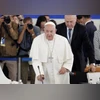
Pope Francis arrives to attend a session on Artificial Intelligence (AI), Energy, Africa and Mediterranean on the second day of the G7 summit in Borgo Egnazia, Italy, June 14, 2024. Photo: REUTERS


Listen to This Article
When Jorge Mario Bergoglio was 12, he fell in love with a girl named Amalia. He asked her to marry him. But her answer set him on a different path.
“He said that if I didn’t say yes, he would have to become a priest. Luckily for him, I said no,” Amalia recalled years later.
That moment of rejection would shape history. Jorge Mario Bergoglio would go on to become Pope Francis — the first non-European leader of the Catholic Church in over 1,300 years.
A papacy that ends
On Easter Monday, Pope Francis passed away at the age of 88, ending a papacy that transformed the image of the Roman Catholic Church. The announcement came from Cardinal Kevin Farrell, the Vatican camerlengo, who now oversees the Church during the interregnum—the period between papacies.
Standing before the Casa Santa Marta, Cardinal Farrell delivered the news.
Also Read

 "Pope Francis")
 "Pope Francis")
 "Kevin Farrell")
 "Australia Flag")
 "Donald Trump, Melania Trump")
“Brothers and sisters, I must announce the death of our Father Francis. At 7.35 this morning, the Bishop of Rome, Francis, returned to the house of the Father. His life was dedicated to the service of the Lord and of His Church. He taught us to live the values of the Gospel with fidelity, courage, and love, especially in favour of the poor and marginalised. With gratitude for his example as a disciple of the Lord Jesus, we commend the soul of Pope Francis to the love of the One and Triune God.”
A Pope of firsts, and a Pope of the people
Pope Francis was a man of many firsts—first Jesuit Pope, first from Latin America, and the first to take the name ‘Francis’, inspired by Saint Francis of Assisi, the patron saint of the poor.
Born in Buenos Aires, Argentina, he brought humility to the Vatican. He shunned papal apartments, choosing instead to live in a guesthouse. He often rode in a car, personally called parishioners, and carried his luggage—gestures that earned him a reputation as the ‘people’s Pope’.
Yet his papacy was not without controversy. His views on climate change, migration, same-sex unions, and capitalism made him both a beloved as well as polarising figure. His role during Argentina’s military dictatorship, and his pace in addressing Church scandals, remained aspects of his legacy.
Despite health issues in recent years — including hospitalisations and a case of double pneumonia earlier this year — Pope Francis remained resilient. He continued to speak about death, urging the faithful to embrace it not with fear, but with preparation and peace.
More From This Section
 "Jews, Israel, Israel-Gaza, Hamas")
 "US President Donald Trump, Pete Hegseth")
 "Kash Patel")
 "Taiwan flag, Taiwan")
 "Pope Francis")
Topics : Pope Francis BS Web Reports
Don't miss the most important news and views of the day. Get them on our Telegram channel
First Published: Apr 22 2025 | 12:48 PM IST