


Why Russia is likely to reject the US-backed peace plan on Ukraine
The new blueprint includes the security guarantees Kyiv wants to prevent future Russian aggression, as well as plans to rebuild the war-ravaged nation
 "Vladimir Putin, Putin")
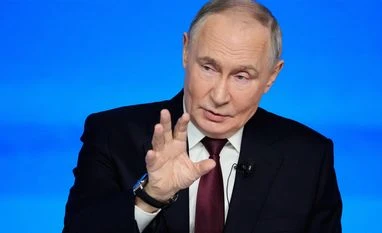
Russian President Vladimir Putin. (Photo: PTI)
Listen to This Article
By Ivan Nechepurenko Ukraine President Volodymyr Zelensky has presented a 20-point peace plan formulated by Ukrainian and American officials, which is a significant departure from a plan drawn up in October. The previous plan would have forced Ukraine to cede territory and rule out NATO membership.
Zelensky presented the new proposal as a reasonable compromise to the plan drawn up by Kirill Dmitriev, the special envoy of President Vladimir Putin of Russia, and Steve Witkoff, President Trump’s special envoy, and unveiled in November.
The new blueprint includes the security guarantees Kyiv wants to prevent future Russian aggression, as well as plans to rebuild the war-ravaged nation. But a Kremlin emboldened by Moscow’s advances on the battlefield and restrained by the difficulty of selling the new plan to the Russian public as a victory is unlikely to accept it.
“This is an absolute mockery,” Aleksei Naumov, an analyst of international affairs based in Moscow, said of the new Ukrainian plan in a post on the Telegram messaging app.
“The idea is clear: Pitch this to the Americans as a ‘compromise,’ and then blame Russia for its failure.”
Also Read

 "United Spirits, USL")
 "China's Foreign Ministry spokesperson Lin Jian")
 "Jeffrey Epstein")
 "Volodymyr Zelenskyy, Zelenskyy")
 "Volodymyr Zelenskyy, Zelenskyy")
What Are Russia’s main sticking points?
Over the past two years, Mr. Putin has consistently insisted on two main points: Ukraine must withdraw its forces from the rest of the Donetsk and Luhansk regions and NATO membership must be ruled out.
Putin confirmed this position on Friday at his annual news conference. He said that Russia was willing to make some “accommodations” — widely believed to involve giving up some Russian-occupied land in Ukraine’s Kharkiv and Zaporizhzhia regions. But he stressed that Moscow remained willing to continue fighting to fully occupy the Donetsk region.
The Ukrainian peace plan stipulates that Russia must withdraw its forces from the Dnipropetrovsk, Mykolaiv, Sumy and Kharkiv regions.
The proposal also states that Ukraine would pull its troops back from areas of the Donetsk region that would be turned into a demilitarized zone — but only if Russia withdrew its forces from an equivalent stretch of land.
“The plan offers no compromise regarding the territories or the Zaporizhzhia Nuclear Power Plant,” Georgi Bovt, a Russian analyst, said of the plant that is currently occupied by Russian forces but that Ukraine would prefer to operate jointly with the United States.
“Failing to resolve the territorial issue renders this a nonstarter.”
Why can Russia afford to reject the plan?
Even though Russia’s full-scale invasion of Ukraine has been costly for both the Russian economy and Moscow’s army, the Kremlin appears to still believe it can gain more by fighting.
The Russian economy is at its weakest point since 2022, with interest rates at record highs and growth rates dipping toward recession.
But despite sanctions imposed by the West because of the war, analysts say the country is still far removed from the kind of economic crisis that would force the Kremlin to change course.
Russia occupies about three-quarters of the Donetsk region. At the current pace of their advance, Moscow’s forces would take about 18 months to capture the entire region.
Dmitri A. Medvedev, Russia’s hawkish security official and a former president, said on Wednesday that about 417,000 recruits signed new contracts to join the Russian Army in 2025, a figure largely consistent with estimates by independent researchers. The continued flow of new recruits means that Russia can afford to continue the war despite suffering heavy losses.
Why Is Russia still negotiating?
Russia is interested in negotiating a possible peace deal to maintain a working relationship with Washington and to avoid taking the full blame for the ongoing conflict, experts say. Moscow is also interested in delaying any additional sanctions or other economic restrictions from Washington. Sanctions imposed in October by Trump on Russia’s two oil giants, Rosneft and Lukoil, have forced the country to sell its oil at significantly steeper discounts.
The tug of war over potential peace terms also deepens the cracks between Ukraine and its Western allies as details are discussed across various capitals in grinding negotiations.
More From This Section
 "United States Department of Justice")
 "Tarique Rahman")
 "Algeria")
 "Bangladesh Nationalist Party (BNP) Acting Chairman, Tarique Rahman, waves to supporters at Hazrat Shahjalal International Airport in Dhaka | AP/PTI")
Don't miss the most important news and views of the day. Get them on our Telegram channel
First Published: Dec 25 2025 | 10:37 PM IST