


Russia sets land concession as condition to continue talks with Ukraine
Russia is ready to sign a draft memorandum for a peace accord if Ukraine agrees to withdraw from its eastern Donetsk region
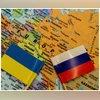 "Russia Ukraine flag, Russia-Ukraine flag")
Russia Ukraine flag (Photo: Shutterstock)


Listen to This Article
Russian officials increasingly consider there’s no point to continue US-led peace talks with Ukraine unless Kyiv is willing to cede territory to reach a deal, according to people familiar with the negotiations.
Talks planned for next week will be decisive in whether or not the sides can agree on terms to end the war, two people close to the Kremlin said. Russia will likely walk away if Ukrainian President Volodymyr Zelenskiy fails to make the concession, they said, asking not to be identified because the matter is sensitive.
Russia is ready to sign a draft memorandum for a peace accord if Ukraine agrees to withdraw from its eastern Donetsk region, one of the people said. That would be followed quickly by a presidential summit between Vladimir Putin, Donald Trump and Zelenskiy to confirm the deal, triggering a mutual pullback of the Russian and Ukrainian armies, the person said.
To be sure, the territorial issue is the most difficult to resolve in the efforts to end the Russian full-scale invasion that entered its fifth year this week. Zelenskiy insists that the fortified area of Donetsk still under Ukraine’s control is vital for defending the country against any future Russian attack, and that Kyiv won’t recognize Moscow’s illegal occupation of any Ukrainian territory.
Trump and Zelenskiy spoke by phone on Wednesday, and the Ukrainian president said they agreed the next round of negotiations with Russia should “create an opportunity to move talks to the leaders’ level.” The talks may take place around March 4-5.
Also Read

 "Bill Clinton, Bill, Clinton")
 "Ukraine Air pollution, Kyiv, Russia-Ukraine")
 "Mark Carney, Canada")
 "AI chatbots")
 "Syria airstrikes, US President Donald Trump, Syrian President Bashar al-Assad ,Bashar al-Assad,Winston Churchill ,Britain, France, Syria chemical attack, Mike Pence , John Bolton,Pentagon,, russia ,President George W. Bush")
Kremlin spokesman Dmitry Peskov didn’t respond to a request for comment. He told reporters Friday that preparations for the next round of talks were taking place, though Russia saw no “substantial change” in Ukraine’s position.
Zelenskiy has proposed a ceasefire along existing frontlines and a commitment to seek the restoration of Ukraine’s territories by diplomatic means only, alongside US and European security guarantees against Russian attack. He has repeatedly rejected Russian demands to withdraw troops from areas Moscow has failed to capture in fighting since 2014.
The US has suggested the creation of a free economic zone in the area, though Ukraine says it must remain under Kyiv’s flag. Russia wants its national guard police to be present on the ground.
Russia is ready to withdraw troops from Ukraine’s north-eastern Sumy and Kharkiv regions as well as the Dnipropetrovsk region as part of the accord, and wouldn’t press demands for more territory in the southern regions of Kherson and Zaporizhzhia, one person said.
Russia would agree to US-led monitoring of the truce, though it wouldn’t accept any foreign troops in Ukraine, and would also drop a demand to limit the size of the Ukrainian army, the person said.
The future of Ukraine’s Russian-occupied Zaporizhzhia nuclear power plant is also still being negotiated. Russia backs a three-way split of power generation at the plant with the US and Ukraine, while Kyiv supports a 50-50 split with the US, which would be free to share electricity supply with Moscow.
US, Ukrainian and Russian negotiating teams have met twice this year in Abu Dhabi and again last week in Geneva to try to hammer out an agreement. Kremlin envoys told US officials after the Geneva meeting that further negotiations would be meaningless without a Ukrainian concession on territory, as practically all other issues had been resolved, according to the people familiar.
US envoy Steve Witkoff and Jared Kushner, Trump’s son-in-law, met Ukrainian officials in Geneva on Thursday to discuss a “prosperity” package of post-war reconstruction and investment.
“We’re at a make or break moment,” said Thomas Graham, a former US National Security Council senior director for Russia, who is now at the Council on Foreign Relations. “So it’s a deal or we’re no deal and no serious negotiations for quite some time.”
The deal favored by Russia resembles proposals first put forward by Witkoff when he traveled to Moscow shortly before Putin’s August summit with Trump in Alaska, according to four people in Moscow familiar with the matter.
Witkoff told Putin the US would push for Ukraine to relinquish the Donbas region consisting of Donetsk and neighboring Luhansk provinces, if Russia agreed to freeze the conflict along existing lines and drop claims to Ukrainian-controlled parts of Zaporizhzhia and Kherson regions, the people said, asking not to be identified discussing internal issues.
The White House didn’t respond to a request for comment.
A day before Putin traveled to Anchorage, he assembled top officials in the Catherine Hall of the Kremlin to seek their views. It was the same room where he’d staged a televised meeting with officials days before the invasion to demand their support for recognizing Donetsk and Luhansk as “independent.”
“How do you see this plan?” Putin asked the officials seated in a semicircle before him, according to people familiar with the meeting. Initially silent, officials rose one by one to speak and the majority backed the proposal, arguing that the war should end, according to the people.
Expectations of an agreement between the US and Russia at the summit fell through, though Trump abandoned previous demands that Putin accept a ceasefire in order to create space for peace talks.
“In Anchorage, we accepted the US’s offer,” Russian Foreign Minister Sergei Lavrov said in a Feb. 9 interview with BRICS TV. “They suggested, we agreed, the problem should be solved.”
Witkoff claimed the two leaders agreed at the summit that the US would offer “Article 5-like language to Ukraine” in security guarantees, a reference to NATO’s mutual-defense clause. Russia hasn’t confirmed that.
Trump returned to the White House in January last year pledging to bring a rapid end to Europe’s worst conflict since World War II. More than 13 months of diplomacy have failed to reach a breakthrough, however.
With the battlefield largely at a stalemate, waves of Russian air strikes have battered Ukraine’s energy infrastructure throughout the coldest winter in years, cutting power and heating for millions of people across the country.
Russia’s economy is also under deepening strain, with growth slowing and the government wrestling with a widening budget deficit.
A truce may be in the interests of both Ukraine and Russia, according to Celeste Wallander, a former top Pentagon official during President Joe Biden’s administration, who worked on bolstering Kyiv’s defense capabilities in the first three years of the war.
Still, Putin’s strategic goal remains a “Ukrainian political leadership that is not independent,” she said. “That is not the end of the conflict with Ukraine, from the Kremlin’s point of view, that is just a step.”
More From This Section
 "Iran-Israel, Iran Israel flag")
 "Iran's former Crown Prince Reza Pahlavi")
 "Israeli military on the Israeli side of the border with Gaza, on Wednesday")
 "US flag, US, united states")
 "Bahrain, Bahrain flag")
Don't miss the most important news and views of the day. Get them on our Telegram channel
First Published: Feb 28 2026 | 3:33 PM IST