


Russians ignore Putin's call for more babies as population declines
Russia recorded the lowest number of births last year in a quarter of a century, while the number of deaths increased for the first time since the height of the pandemic in 2021
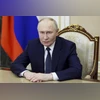 "Vladimir Putin, Putin")
Russia estimated its population in 2024 was 146 million, a figure that includes about 2 million people in Ukraine’s Crimea, which was annexed in 2014
Listen to This Article
By Bloomberg News
Russia’s population is declining at its quickest pace since the Covid-19 pandemic, even after President Vladimir Putin declared that a demographic turnaround is the country’s most important priority.
Russia recorded the lowest number of births last year in a quarter of a century, while the number of deaths increased for the first time since the height of the pandemic in 2021.
In 2024, 1.22 million people, or 3.4 per cent fewer than in 2023, were born — the lowest level since 1999 — while deaths increased by 3.3 per cent to 1.82 million, according to the Federal Statistics Service, known as Rosstat. The pace of the population decline accelerated by roughly 20 per cent compared to 2023, due in part to the Kremlin’s three-year-old war on Ukraine.
“Several factors have come together in Russia at the same time,” said independent demographer Igor Efremov from Moscow. While tens of thousands of men have died in the war, there are also fewer women of childbearing age because the group born in the 1990s amid the hardship that followed the Soviet Union’s collapse is smaller and at the same time the postwar baby-boomer cohort is beginning to pass away.
Also Read

 "Donald Trump, Trump")
 "Vikram Misri")
 "US-Russia, US Russia flag")
 "moscow")
 "Modi, Narendra Modi")
The population decline will bring consequences for Russia. Its economy is already starved of labor, which will grow worse, threatening the country’s future development and prosperity. A shrinking population also makes it harder for the world’s largest country to retain its territory if the land is emptying, putting at risk its security and the opportunity to exploit vast natural resources. A greying population will also be harder to support economically as the workforce shrinks, reducing the tax base and the ability to pay for essential services.
Russia estimated its population in 2024 was 146 million, a figure that includes about 2 million people in Ukraine’s Crimea, which was annexed in 2014.
Russia has been grappling with its population crisis since the 1990s collapse in the birth rate that created a so-called “demographic pit.” While generational challenges are the primary driver of the current contraction, Putin’s invasion of Ukraine is worsening the situation and undermining his repeatedly stated priority of reversing the population decline.
“Let me say that the most important goal is to preserve the population,” Putin said last year at a meeting with leaders of parliamentary groups at the Kremlin. He’s overseen policies aimed at increasing the birthrate that have ranged from lump-sum payments for new mothers to mortgage relief for families.
Dmitry Zakotyansky, an independent demographer and sociologist from Moscow, has estimated that the number of dead could be as high as 200,000. That’s based on indirect data and takes into account all deaths, including those who died after they returned from what Russia calls the “special military operation” in Ukraine, as well as people mobilized in Donbas and other occupied areas, according to Zakotyansky.
Yet, even during major wars, the majority of those who die in a country will be the elderly, Efremov said. “If there had been no war, the natural decline would still have been very large,” he said.
According to Efremov’s estimates, without the war, the natural population decline would be around 500,000 people a year instead of around 600,000 as it is now. “This is important, but doesn’t fundamentally change the demographic situation,” Efremov said.
The actual impact of the February 2022 full-scale invasion could be greater than what is currently reflected in demographic data.
Those killed in the war are included in statistics with great delay, said Alexey Raksha, an independent demographer from Moscow. That’s true “especially if they are missing in action, and there are many of those.”
Detailed statistics on mortality have been classified since 2023, according to Raksha. “If the information has been closed, it means that they are either going to change it a lot, or they are closing bad data.”
Data Distortions
Russian data is compiled and published under “colossal political pressure,” Ilya Kashnitsky, a demographer from the University of Southern Denmark, said.
Demographers already have noticed distortions in statistics.
According to Rosstat, overall population decline is at its slowest in five years, whereas natural population decline, specifically the difference in birth- and death-rates, remained at a high level. That’s because Rosstat’s data includes a record influx of migrants into Russia, after the statistics agency changed its methodology last year.
“Suddenly, 120,000 began to appear monthly,” Raksha said. “If this data is extrapolated to a year, it turns out that 1.4 million people appear in Russia per year,” a higher rate than even in the US, he said.
When asked for comment, Rosstat pointed to a statement explaining that since August it has transitioned to an electronic format that may allow migration data to appear faster in official statistics.
What Economics Says...
The decline is likely to accelerate toward around 700,000 per year over the next decade before peaking in 2035. Russia’s rate of demographic drag is in line with regional peers in Eastern and Central Europe — Germany, Romania, Hungary or Finland experience broadly similar rates of natural population decline.
For Russia’s economy, natural population decline provides a headwind of around 0.1-0.2 ppt a year, but among the government’s worries, it lags far behind other issues.
-Alex Isakov, Russia economist
To be sure, many developed countries are facing natural population declines, Zakotyansky said.
“Not many countries can boast that they have it better,” he said. “But Russia shouldn’t allow the current situation of low birth rates to drag on for long.”
More From This Section
 "WHO, World Health Organization")
 "dollar, rupee, trade")
 "Donald Trump, Trump")
 "Pakistan Flag, Pakistan")
 "White House")
Topics : Vladimir Putin Russia Russia Ukraine Conflict
Don't miss the most important news and views of the day. Get them on our Telegram channel
First Published: Mar 08 2025 | 2:55 PM IST