


Spain denies cooperating with US in West Asia, contradicting White House
Moments after a White House spokesperson said that the Spanish government in Madrid had agreed to help the US, Spanish Foreign Minister Jose Manuel Albares came out and flatly denied the claim
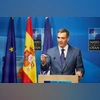 "President of Spain Pedro Sanchez speaks to the press during the NATO summit in The Hague on June 25")
Spanish Prime Minister Pedro Sanchez again criticised the US and Israel's military actions in Iran early on Wednesday, standing firm against trade threats from Washington


Listen to This Article
A diplomatic tussle between the United States and Spain over the war in Iran intensified on Wednesday when the governments exchanged contradictory statements over the possible use of Spanish military bases by American armed forces for operations in the West Asia.
Moments after a White House spokesperson said that the Spanish government in Madrid had agreed to help the US, Spanish Foreign Minister Jose Manuel Albares came out and flatly denied that the European government had changed its position.
"I can refute (the White House spokesperson)," Albares told Spanish radio station Cadena Ser. "The position of the Spanish government regarding the war in the West Asia, the bombing of Iran and the use of our bases has not changed one iota." The disagreement broke out on Tuesday when US President Donald Trump had threatened to cut off trade with Madrid, hours after the Spanish prime minister said that his government wouldn't "be complicit in something that is bad for the world." Albares spoke on Wednesday evening in Madrid shortly after White House press secretary Karoline Leavitt had said, "with respect to Spain, I think they heard the president's message yesterday loud and clear.
"And it's my understanding over the past several hours, they've agreed to cooperate with the US military," Leavitt had said. "And so I know that the US military is coordinating with their counterparts in Spain." Spanish criticism of military action in Iran Trump on Tuesday said that he was going to "cut off all trade with Spain," a day after Albares said that his government wouldn't allow the US to use jointly operated bases in southern Spain in any strikes not covered by the UN charter.
Spanish Prime Minister Pedro Sanchez again criticised the US and Israel's military actions in Iran early on Wednesday, standing firm against trade threats from Washington and warning that the war in the West Asia risked "playing Russian roulette" with millions of lives.
Also Read

 "Trade, tariffs")
 "Aviation IndiGo, Airports in India, Airline IndiGo")
 "donald trump, trump, crypto")
 "US Capitol, Senate, washington, us govt")
 "Scott Bessent, US Treasury Secretary")
"We are not going to be complicit in something that is bad for the world and is also contrary to our values and interests, just out of fear of reprisals from someone," Sanchez said in a nationally televised address.
Sanchez, widely regarded as Europe's last major progressive leader, has called the US and Israeli attacks on Iran an "unjustifiable" and "dangerous" military intervention.
US chastises Spain It wasn't clear how Trump would have cut off trade with Spain, which is a member of the European Union. The EU negotiates trade on behalf of all its 27 member states.
When asked in an interview with CNBC whether a trade embargo with Spain would be possible, US Treasury Secretary Scott Bessent said on Wednesday that "it would be a combination effort." He didn't explain further, but said Spain's refusal to allow the US to use its bases in the weekend attack on Iran endangered American lives.
"Anything that slows down our ability to engage and prosecute this war in the fastest, most effective manner puts American lives at risk," Bessent said. "The Spanish put American lives at risk." On Wednesday, Sanchez expressed concern that the attacks on Iran could lead to another costly military quagmire in the West Asia, similar to the past American interventions in Iraq and Afghanistan.
"In short, the position of the government of Spain can be summarised in four words," Sanchez said. "No to the war." The EU said that it would protect its interests and work to stabilise its trade relationship with the US, with which it struck a trade deal last year after months of economic uncertainty over Trump's tariff blitz.
"We stand in full solidarity with all member states, and all its citizens, and, through our common trade policy, stand ready to act if necessary to safeguard EU interests," European Commission spokesperson Olof Gill said.
After Spain denied US use of its bases, Trump on Tuesday said "we could use their base if we want," referencing the Rota and Moron installations in southern Spain that the US and Spain share, but which remain under Spanish command.
"We could just fly in and use it," Trump said. "Nobody's going to tell us not to use it, but we don't have to." Trade threats Tuesday's threats from Washington were just the latest instance of the US president wielding the threat of tariffs or trade embargoes as punishment. Last month, the US Supreme Court struck down Trump's far-reaching global tariffs, saying emergency powers don't allow the president to unilaterally impose sweeping tariffs.
However, Trump maintains that the court allows him to instead impose full-scale embargoes on other nations of his choosing.
Spain's main business groups expressed concerns over the trade threat, calling the US a "key partner from an economic and political standpoint." "We trust that our trade relations will ultimately not be affected in any way," the Spanish business chambers CEOE, CEPYME and ATA said Tuesday.
Last year, Spain's central bank issued a report that concluded Europe's fourth-largest economy was relatively cushioned compared with the EU average when it came to exposure to tariffs by Trump.
Spain's exports and imports with the US accounted for 4.4 per cent of gross domestic product, the Bank of Spain said, while trade with the U.S. for the EU as a whole was 10.1 per cent.
Exports of Spanish goods to the US accounted for 1 per cent of Spain's GDP, or 16 billion euros (USD 18.6 billion), the bank said, making it Spain's sixth largest export market for goods. Pharmaceutical products, olive oil, refined gas and electrical transformers are among Spain's main exports to the US, according to the Observatory of Economic Complexity.
Spain's position on the Iran conflict is the latest flare-up in its relationship with the Trump administration.
Sanchez was an outspoken critic of the Israel-Hamas war in Gaza and attracted Trump's ire last year when Spain backed out of NATO's pledge to increase defence spending by members to 5 per cent of GDP. At the time, the Spanish government said it could meet its estimated defence needs by spending less - just 2.1 per cent of GDP - a move that Trump roundly criticised and also threatened with tariffs in response.
(Only the headline and picture of this report may have been reworked by the Business Standard staff; the rest of the content is auto-generated from a syndicated feed.)
More From This Section
 "Balendra Shah, Nepal")
 "US Israel strike Iran")
 "Mark Zuckerberg")
 "US Israel strike Iran")
 "US Israel strike Iran")
Don't miss the most important news and views of the day. Get them on our Telegram channel
First Published: Mar 05 2026 | 7:48 AM IST