


Surya Grahan 2026: Timings, areas of visibility and occurrence in India
The Surya Grahan, or Solar Eclipse, is taking place today, on Feb 17, marking the first solar eclipse of the year. The Eclipse 2026 is likely to end at 7:57 pm (IST)
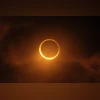 "Annular Solar Eclipse")
Annular Solar Eclipse.(Photo: PTI)
Listen to This Article
The first solar eclipse of the year is set to take place today, February 17, offering skywatchers a striking celestial display. During the rare annular eclipse, the Moon will pass directly across the centre of the Sun, creating the dramatic “Ring of Fire” effect. According to NASA, the phenomenon will be visible from parts of Antarctica.
A partial eclipse will be visible throughout Africa, South America, the Pacific Ocean, the Atlantic Ocean, and the Indian Ocean, the agency said. The whole annular phase will only be visible in Antarctica. Since the eclipse is taking place over some of the most isolated places on Earth, it cannot be seen outside of these zones.
Can India be able to witness today's Solar Eclipse?
No, India will not be able to witness the annular eclipse. However, NASA's transmission will still allow viewers to watch it live. In addition to NASA, the event will be live-streamed by other space organisations and colleges.
The ring effect will last for up to two minutes and twenty seconds at its height, covering up to 96% of the Sun's centre. On February 17, the eclipse is predicted to start at 0956 GMT (3:26 PM IST) and end at 1427 GMT (7:57 PM IST).
What are the effects of the first annual solar eclipse on Earth today?
· Changes in Ionisation: Ionisation is the process by which an atom or molecule acquires or loses electrons, resulting in a charge. One of the main causes of ionisation in the ionosphere is solar radiation.
Also Read

 "solar eclipse myths")
 "Annual Solar Eclipse")
 "Solar eclipse in September 2025")
 "Bill Gates")
 "University of Glasgow")
The ionosphere's electron density briefly drops during a solar eclipse as a result of a decrease in ionisation brought on by the fall in solar radiation.
· Temperature Changes: As solar energy decreases during an eclipse, the upper atmosphere may cool, which could alter ionospheric concentrations and altitudes. The ionosphere, the Earth's upper atmosphere, may be impacted by solar eclipses.
· Impact on radio waves: Shortwave, radio communications, GPS navigation systems, and satellite communication systems may all be impacted by the changing ionospheric conditions that occur during an eclipse.
Also Read: First solar eclipse of 2026: Debunking myths on radiation, eyes, pregnancy
When is the next solar eclipse? Where will it be visible?
The next solar eclipse will occur on August 12, 2026. A total solar eclipse will occur there. NASA reports that Greenland, Iceland, Spain, Russia, and portions of Portugal will be able to see the astronomical spectacle.
The Atlantic, Arctic, and Pacific oceans, as well as other regions of Europe, Africa, and North America, will be able to witness a partial eclipse.
More From This Section
 "Tarique Rahman")
 "oil shipment, crude oil, oil export")
 "Jesse Jackson")
 "russia, ukraine, drone attack, airstrike")
 "Frederick Wiseman")
Don't miss the most important news and views of the day. Get them on our Telegram channel
First Published: Feb 17 2026 | 5:17 PM IST