


US President Trump hosts iftar dinner at White House, thanks Muslim voters
Civil rights groups staged protests outside the White House for the exclusion of American Muslim leaders, claiming only foreign dignitaries were invited
 "President Donald Trump, Trump, iftar, ramzan, white house")
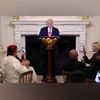
US President Donald Trump participates in the White House Iftar dinner at the State Dining Room of the White House in Washington, DC, US, March 27, 2025. Photo: Reuters
Listen to This Article
US President Donald Trump hosted an iftar dinner at the White House, marking the Islamic holy month of Ramzan and expressing appreciation for the Muslim American community’s support in the 2024 election.
“Ramzan Mubarak to my Muslim friends,” Trump said in his opening remarks. “Ramzan is a season of spiritual reflection, fasting, and devotion, and we recognise its deep significance.”
Trump also used the occasion to reaffirm his administration’s diplomatic efforts in West Asia, referencing the Abraham Accords, the normalisation agreements between Israel and Arab nations brokered during his previous presidency.
“We’re keeping our promises to the Muslim community. My administration is engaged in relentless diplomacy to forge lasting peace in the Middle East, building on the historic Abraham Accords,” he said.
The remarks came amid ongoing conflict between Israel and Hamas in Gaza, following the collapse of a ceasefire brokered by the US, Qatar, and Egypt.
Also Read

 "Iftar party, Roza Iftar")
 "Zydus Lifesciences, Zydus")
 "SaGa Frontier 2 Remastered")
 "PBKS vs GT in IPL 2025")
 "share market stock market trading")
Trump highlighted what he called “record numbers” of Muslim American support in his return to the White House. “We started a little slow with you, but we came along. The Muslim community was there for us in November, and while I’m president, I will be there for you.”
ALSO READ: Will 1 million children die? Trump's vaccine cuts could spark crisis in US
Protests over exclusion of Muslim American leaders
However, outside the White House, several American Muslim civil rights groups staged a protest over the guest list, alleging that prominent Muslim American leaders and lawmakers were not invited. Instead, the White House extended invitations primarily to foreign Muslim diplomats.
The protest, organised by civil rights groups, saw activists chanting slogans and holding signs condemning Trump’s policies, including his past attempts to ban immigrants from several Muslim-majority countries.
“You cannot celebrate Ramadan while excluding the very people who make up the Muslim American community,” said a protester outside the White House, the US media reported.
Last year, many Muslim leaders in the US chose to skip the White House iftar dinner to protest the Biden administration’s support for Israel in the Gaza war.
White House iftar dinner
Hosting an iftar at the White House is a tradition dating back to President Bill Clinton and continued by Presidents George W Bush and Barack Obama. Trump faced criticism in 2017 for skipping the event, however, he reinstated it in 2018.
More From This Section
 "Donald Trump, Trump")
 "Earthquake")
 "Pete Hegseth")
 "Lakshmi Mittal")
 "Donald Trump, Trump")
Don't miss the most important news and views of the day. Get them on our Telegram channel
First Published: Mar 28 2025 | 2:15 PM IST