


Decoded: Trump calls Japan security deal unfair, but US made the rules
Trump questioned why the US must defend Japan while Japan has no such duty. But history shows the US itself designed the post-war security pact to serve its own strategic goals
 "Donald Trump")
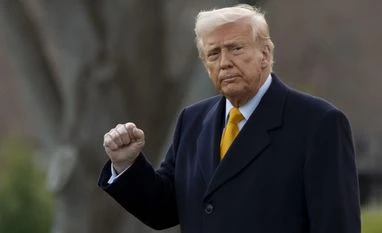
President Donald Trump Trump questioned the terms of the US-Japan defence pact. (Photo: PTI)
Listen to This Article
US President Donald Trump has once again turned his attention to America’s security alliances, this time singling out Japan. In a recent media address from his Oval Office, Trump questioned the terms of the US-Japan defence pact, saying, “We have an interesting deal with Japan, that we have to protect them, but they don’t have to protect us… Who makes these deals?”
At first glance, Trump’s frustration may appear justified—why should the United States pledge to defend a country that is under no obligation to do the same? However, asking this question without considering history ignores the very foundations of the US-Japan security alliance.
Especially when it is the United States itself that shaped this agreement, a legacy dating back to the end of World War II, when the US dropped atomic bombs on Hiroshima and Nagasaki, killing over 200,000 people (conservative estimates) and subsequently dismantling Japan’s military apparatus. What Trump characterises as an unfair deal is, in fact, an American creation—one that has served both nations for decades.
A US-designed peace for Japan after World War II
The roots of Japan’s security arrangement with the United States can be traced back to August 1945, when Japan surrendered following the atomic bombings. The US led a seven-year occupation under General Douglas MacArthur, with the twin goals of demilitarising and democratising the country. During this period, Japan’s wartime military was completely dismantled. The country’s constitution was drafted under the supervision of the Supreme Commander for the Allied Powers (SCAP), primarily led by MacArthur.
Also Read

 "Muttiah Muralitharan")
 "mutual fund")
 "Cognizant, Cognizant Technologies")
 "Ranya Rao")
 "It is termed the most talked-about “frenemyship” in Asia or a not-so-successful “Hindi Chini Bhai Bhai” bonhomie. In the age of the China Plus One, the Economic Survey aims to redraw the relationship with the neighbouring superpower to India's adva")
By 1947, the US had imposed a new constitution on Japan, which remains in force today. Its most defining feature was Article 9, which explicitly renounced war and prohibited Japan from maintaining a military capable of offensive action. The clause, written under American oversight, was meant to ensure that Japan could never again become a military aggressor.
This decision was not imposed on Japan alone—it aligned with broader US objectives. In the wake of World War II, America sought to establish a global order where it held military supremacy, allowing its allies to focus on economic recovery rather than defence. Japan’s disarmament was not just a policy imposed on a defeated enemy—it was part of a larger American vision.
From demilitarising Japan to turning it into a strategic ally
In the years immediately following Japan’s surrender, the United States focused on dismantling Japan’s military and war industries. However, the onset of the Cold War led to a shift in priorities. The US soon realised that a stable Japan was crucial in countering the spread of communism, particularly after China fell to communist rule in 1949 and the Korean War erupted in 1950.
During the Korean War, Japan became a key logistics hub for US-led United Nations forces. This reinforced Japan’s strategic importance, leading Washington to reconsider Japan’s total demilitarisation. By 1954, with US encouragement, Japan established the Self-Defence Forces (SDF)—a military in all but name. However, due to Article 9, the SDF remains limited in its scope, constrained from engaging in offensive warfare.
The US-Japan Security Treaty: A deliberate American choice
Trump’s suggestion that Japan benefits without reciprocating is inaccurate, as the US-Japan security arrangement was designed to function this way by the US itself. The first US-Japan Security Treaty was signed in 1951, alongside the Treaty of San Francisco, which formally ended the US occupation of Japan. The agreement allowed US military bases to remain in Japan, cementing the country as a cornerstone of America’s strategic presence in South-east Asia.
By 1960, a revised Treaty of Mutual Cooperation and Security committed the US to defend Japan in case of an attack. However, Japan did not reciprocate the same obligation—a design choice made by Washington, not Tokyo. The US preferred a permanent forward base in the Pacific rather than requiring Japan to maintain its own military.
Today, approximately 54,000 US military personnel are stationed in Japan across multiple bases, making it the largest American overseas military presence. These bases provide a critical foothold in the Indo-Pacific, allowing the US to project power across Asia, monitor China’s military expansion, and respond swiftly to regional conflicts. In return, Japan covers a significant portion of the costs—roughly $2 billion annually—for hosting these forces.
How does Japan contribute to US security?
Trump’s argument that Japan offers no protection in return is misleading. While Japan does not send troops to defend the US mainland, it plays a crucial role in maintaining regional security.
• Financial and logistical support: Japan’s hosting of US military bases allows America to operate in the Indo-Pacific with speed and efficiency.
• Military cooperation: In 2015, Japan reinterpreted Article 9, allowing its Self-Defence Forces to engage in collective self-defence, meaning Japan can support US forces under attack.
• Technological and strategic contributions: Japan is a major partner in US missile defence systems and provides crucial intelligence-sharing through the Quad alliance with India and Australia.
• Regional stability: Japan’s naval and air forces, while defensive, patrol the East China Sea and provide intelligence benefiting US military operations.
Trump is ignoring history
Trump’s suggestion that the US-Japan security alliance is a bad deal ignores the reality that it was the United States itself that structured it this way.
The US chose to disarm Japan. The US chose to maintain military bases in Japan.
And the US chose to design a security agreement that commits it to defending Japan without requiring Japan to do the same.
If Trump wants to argue that America should renegotiate its military alliances, that is a legitimate policy debate. But to suggest that Japan is exploiting the US is an argument that collapses under the weight of history.
To answer Trump’s question, “Who makes these deals?”—the US did.
More From This Section
 "Mark Carney, Donald Trump")
 "Donald Trump, Volodymyr Zelenskyy")
 "Syria, civil war")
 "Foxconn")
 "Nissan")
Topics : Donald Trump Decoded BS Web Reports Japan
Don't miss the most important news and views of the day. Get them on our Telegram channel
First Published: Mar 10 2025 | 2:30 PM IST