


Trump tariffs on Canada, Mexico, China take effect: How did they retaliate?
US trade wars: Tariff hikes have sparked volatility in financial markets, with North American stocks plunging on Monday in anticipation of trade disruptions
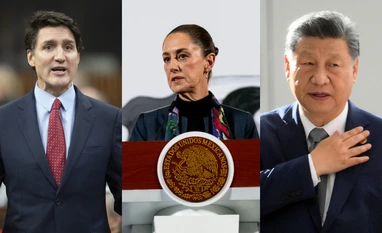 "Prime Minister of Canada Justin Trudeau; President of Mexico Claudia Sheinbaum; and President of China Xi Jinping")
(L-R) Prime Minister of Canada Justin Trudeau; President of Mexico Claudia Sheinbaum; and President of China Xi Jinping | File photo
Listen to This Article
The United States' new tariffs under President Donald Trump are set to take effect at 12:01 am EST on March 4, increasing tariffs on imports from Canada, Mexico, and China, escalating trade tensions. In response, Canada, Mexico, and China are now preparing their own retaliatory measures against what they deemed "unfair" Trump tariffs.
Canada and Mexico face a 25 per cent tariff on goods, while China faces a combined 20 per cent tariff on its exports to the US, following an extra 10 per cent increase.
Canada imposes immediate retaliatory tariff
Canada has vowed immediate retaliatory tariffs on C$30 billion ($20.75 billion) worth of US goods. The first stage involves 25 per cent tariffs on these goods as soon as the Trump tariffs go into effect, with plans to impose an additional C$125 billion ($86.4 billion) in tariffs in the coming weeks.
Canadian Prime Minister Justin Trudeau confirmed the measures on Monday, while Foreign Minister Melanie Joly described the tariffs as an “existential threat” to the country’s economy, warning of potential job losses.
Also Read

 "Exports, Export")
 "US India Trade")
 "Gold")
 "Markets, Stock market, sensex, stock market indices")
 "European Union flag")
China targets US food products
China revealed new tariffs on US food and agricultural goods, just after Trump tariff took effect. The new measures include a 15 per cent tariff on US chicken, wheat, corn, and cotton, as well as a 10 per cent tariff on sorghum, soybeans, pork, beef, seafood, fruits, vegetables, and dairy products. These tariffs are set to take effect on March 10.
China reacted strongly, with its foreign ministry denouncing the US move as an act of “unilateralism and trade protectionism.”
The Chinese Embassy in Washington also condemned the tariffs, arguing that they violate World Trade Organization (WTO) regulations. The embassy urged the US to address its domestic drug demand instead of blaming external factors.
Mexico holds back on retaliation, for now
Unlike Canada and China, Mexico has yet to announce specific countermeasures. President Claudia Sheinbaum stated that her administration would wait until her regular morning press briefing on Tuesday before issuing an official response. However, she signalled that Mexico has prepared contingency plans in case of further escalation.
Mexico had previously managed to avoid earlier US tariffs by tightening security at its northern border and stepping up efforts to combat drug trafficking. This time, Sheinbaum assured that Mexico remains unified and ready to act, stating, “We have a plan B, C, D.”
Wall street crashes ahead of Trump tariffs
The tariff hikes have sparked volatility in financial markets, with North American stocks plunging on Monday in anticipation of trade disruptions. The Dow Jones Industrial Average dropped 649.67 points (1.48 per cent) to 43,191.24, while the S&P 500 fell 104.78 points (1.76 per cent) to 5,849.72. The Nasdaq Composite saw the steepest decline, losing 497.09 points (2.64 per cent) to 18,350.19.
The Mexican peso and Canadian dollar also weakened following the announcement, as investors braced for potential economic consequences.
Shares of major Chinese firms listed in the US were not spared either, with electric vehicle manufacturer Nio plummeting 8.6 per cent and e-commerce giant JD.com falling nearly 4 per cent.
Fentanyl at centre of China-US trade conflict
Adding to the economic strain, President Trump is set to increase tariffs on fentanyl-related Chinese imports to 20 per cent from 10 per cent, unless Beijing takes stronger action against fentanyl trafficking.
According to the US Centers for Disease Control and Prevention (CDC), synthetic opioids, primarily fentanyl, caused 72,776 deaths in the US in 2023. The US has repeatedly accused China of enabling the flow of illicit fentanyl into its borders, a charge Beijing has vehemently denied.
Chinese Foreign Ministry spokesperson Lin Jian criticised Washington for using the fentanyl crisis as a political tool to pressure Beijing, warning that such actions could strain cooperation on drug control.
With Canada already enforcing retaliatory tariffs, China preparing countermeasures, and Mexico assessing its next move, fears of a full-scale trade war are mounting. Analysts warn that higher tariffs could disrupt supply chains, push up inflation, and dampen economic growth.
More From This Section
 "Justin Trudeau")
 "China Taiwan")
 "US President Donald Trump")
 "Justin Trudeau, Donald Trump")
 "Wall Street")
Topics : Donald Trump US trade war US China US China trade war US-Canada US mexico Trump tariffs BS Web Reports US President Trump
Don't miss the most important news and views of the day. Get them on our Telegram channel
First Published: Mar 04 2025 | 11:37 AM IST