


Explained: Why Warren Buffett prefers balance sheets over income statements
Warren Buffett offered fresh insights into his investing philosophy, particularly his long-standing preference for studying balance sheets over income statements when evaluating a business
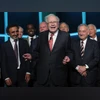 "Warren Buffett")
Warren Buffett. (Photo: Bloomberg)
Listen to This Article
Legendary investor Warren Buffett on Saturday announced that he would step down as the CEO of Berkshire Hathaway by the end of 2025. At the company’s annual shareholder meeting, Buffett offered fresh insights into his investing philosophy, particularly his long-standing preference for studying balance sheets over income statements when evaluating a business.
“I spend more time looking at balance sheets than I do income statements,” Buffett told shareholders, reported the Associated Press. “Wall Street really doesn’t pay much attention to balance sheets, but I like to look at the balance sheets over an eight- or 10-year period before I even look at the income account because there are certain things that are harder to hide or play games with on the balance sheet.”
This has been the hallmark of Buffett’s investment strategy — with focus on long-term financial fundamentals rather than short-term profitability. While income statements can be dressed up to show impressive quarterly results, Buffett believes that the balance sheet reveals the true health and durability of a business.
What Buffett looks for in a balance sheet
In their book 'Warren Buffett and the Interpretation of Financial Statements', Mary Buffett and David Clark decode his criteria and reveal how he uses balance sheets to identify what he calls companies with a "durable competitive advantage".
One of the key aspects Buffett focuses on is low or no long-term debt. As stated in the book, “Buffett loves a balance sheet with little or no long-term debt.”
Also Read

 "Greg Abel, Warren buffet")
 "Warren Buffett")
 "Elon Musk")
 "Warren Buffet, Berkshire Hathaway,")
According to Buffett, excessive debt exposes businesses to financial distress, particularly in economic downturns. Companies with strong balance sheets and minimal debt have the flexibility to withstand headwinds and seize opportunities without relying on external funding.
Another key measure for Buffett is consistently rising retained earnings, a reflection of a company reinvesting its profits to generate long-term value. “Retained earnings that are consistently increasing is a sign that the company is growing internally—a trait Buffett likes to see,” the book notes.
Buffett has a strong preference for companies that are flush with cash or short-term investments. A robust cash position, he believes, provides optionality and acts as a buffer during lean periods. “Buffett loves lots of cash. A big cash hoard gives the company flexibility and a cushion during hard times,” the book explains.
But Buffett is equally concerned about red flags on the balance sheet. These include overstated goodwill from overpriced acquisitions and unfunded pension liabilities, which may indicate poor capital discipline or hidden financial risks.
Why Warren Buffett is sitting on a $347 billion cash pile
Buffett’s emphasis on balance sheets is not just theoretical. It is reflected in how he runs Berkshire Hathaway. The conglomerate is holding a record $347.7 billion in cash and short-term Treasury bills as per the first quarter of 2025, according to its latest earnings report cited by Reuters. That’s nearly a third of the company’s total assets and the highest cash level in its history.
At the 2025 shareholder meeting on Saturday, Buffett explained that this massive cash stock is the result of both discipline and a lack of attractively priced investments. “We’d love to spend it,” he said, “but we won’t do it unless we think we’re going to make money and there’s very little risk.”
Buffett further said that Berkshire recently walked away from a potential $10 billion deal because it didn’t meet the company’s standards. His approach echoes his core investing principle: never compromise on quality, even when capital is abundant.
Greg Abel, Buffett’s successor and vice chairman of Berkshire Hathaway, described the cash reserve as a “strategic asset” that ensures the company remains financially independent and ready to act when genuine opportunities arise.
Market conditions also play a role in the strategy. With US stock valuations running high and the S&P 500 trading at elevated multiples, Buffett has found fewer bargains that meet his strict criteria. As a result, Berkshire has been a net seller of stocks for several consecutive quarters and even paused its own share repurchase program.
Why Warren Buffett's conservative mindset matters now
Buffett’s preference for balance sheets over income statements reflects his cautious optimism and long-term orientation. Where Wall Street often reacts to quarterly earnings and revenue growth, Buffett is more interested in whether a company has the financial strength and internal discipline to thrive over decades.
“Neither one gives you the total answer,” Buffett told shareholders, referring to financial statements. “But the balance sheet tells you things the income statement might not.”
As he prepares to hand over the reins of Berkshire Hathaway, Buffett’s message remains unchanged: solid fundamentals, clean balance sheets, and patient capital allocation will always outlast market hype.
Buffett's strategy has made Berkshire one of the most financially stable companies in the world. And his successor Abel is not too keen to change it.
“It’s really the investment philosophy and how Warren and the team have allocated capital for the past 60 years,” Abel said at the shareholder meeting. “Really, it will not change. And it’s the approach we’ll take as we go forward.” (With inputs from agencies)
More From This Section
 "Pope Francis")
 "US flag, US, united states")
 "china Flag, China")
 "Warren Buffett")
 "US China flag, US-China flag")
Topics : Warren Buffett BS Decoded Warren Buffett's Berkshire Hathaway Berkshire Hathaway balance sheet BS Web Reports
Don't miss the most important news and views of the day. Get them on our Telegram channel
First Published: May 04 2025 | 1:14 PM IST