Wednesday, December 31, 2025 | 08:55 PM ISTहिंदी में पढें
Business Standard
Notification Icon
userprofile IconSearch

Record yield has pulses prices slide below MSP

Trade wants stock limits lifted as prices of most varieties trading below MSP
Pulses, graph
premium

graph

Rajesh Bhayani Mumbai
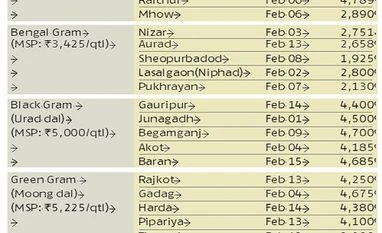
After seeing a crisis in pulses last year, when prices skyrocketed, Indian farmers have produced record high crop of 22.14 million tonnes this season but all at their own peril. Prices of moong, tur, arhar, lentils are trading below their minimum support prices (MSP) in many producing centers in the country, according to data from Agmark.

Market intervention agencies are also not able to buy at MSP and those who can buy are facing storage issues. The government had set a target to build a buffer of 2 million tonnes of which not even half has been achieved. The crop is higher by 35 per cent or 5.79 million tonnes than last year when imports also were around 6 million tonnes, much higher than usual 3-4 million tonnes. Traders and importers are clamouring for removing stock limits and allowing exports.

Ajay Vir Jakhar, chairman, Bharat Krishak Samaj said: "While the crop is at a record high, farmers are not getting the minimum support price promised by the government. The government should meet its promise of ensuring farmers get the promised MSP." 

He suggested an action plan for the government. Firstly, to follow Niti Ayog's proposal of price deficiency system where Ramesh Chand, member agriculture of the Ayog has said that wherever government could not reach for logistical issues for procuring commodity at MSP, the government should pay farmers the loss they incur by selling at prevailing lower prices if farmers can produce proof of loss. 

Secondly, he said to increase price stabilisation fund size from Rs 500 crore to Rs 5,000 crore. 

"Thirdly, when prices rise and farmers get better realisation, the government promotes imports and later doesn't procure at MSP from farmers when prices fall. This amounts to subsidizing farmers in other countries and hence government should give up promoting imports of agriculture production."

Problem arises when the government machinery is neither able to buy pulses at MSP nor allows traders with funds to store more and hence farmers who grew record pulses are suffering. 

However, importers say pulses import contracted in past continues but many importers are losing money and there are cases of defaults in imports also, according to trade sources. Compared to last year's around 6 million tonnes, importers estimate 4-5 million tonnes of imports in the current year.

According to the second advance estimate of the ministry of agriculture released yesterday, total production of pulses during 2016-17 is estimated at 22.14 million tonnes which is higher by 5.79 million tonnes from the previous year's production of 16.35 million tonnes. Chana prices at present are at comfortable levels from farmers' point of view but with the arrivals rising, farmers returns will only fall.

Bimal Kothari, vice-chairman of India Pulses and Grain Merchants Association (IPGA), an apex trade body, and managing director of importing firm Pancham International said, "We have written to the government that this is the right time to lift stock limits on pulses and allow its exports." 

The suggestion makes sense as the government is not able to ensure MSP to farmers', thus not allowing trade to store more which helps farmers get a better price. He also proposed that government must make efforts to help farmers increase productivity of pulses which is lowest among major producers. India on an average produces 800 kg pulses in one-hectare land while the world average is 3 tonnes.

Kothari said that "government must be finding it difficult to buy pulses at MSP from all mandis and hence when traders are not allowed to stock more, next season farmers will again reduce sowing and the cycle of deficiency will be repeated."
 

graph