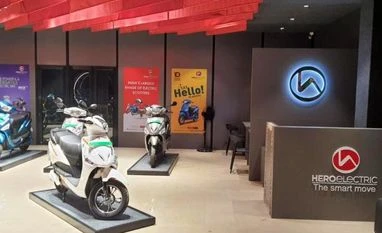
Hero Electric has decided to invest Rs 2,500 crore to build additional capacity of about 4 million electric two-wheelers by 2026. The first stage of investment will roll out this year for a new factory in Rajasthan, where vendor units will invest another Rs 400 crore.
In the second stage, it is scouting for a location of a plant in South India. Both factories will be of equal size and investment. The company has the capacity to manufacture 500,000 vehicles.
Its projected capacity of 4.5 million units per annum that it is building is half of Ola Electric’s. The latter is building a factory with a capacity to make 10 million electric vehicles (including two-wheelers) in phases.
Hero plans to finance the expansion by raising over Rs 1,000 crore and is in advanced-stage talks with private equity (PE) funds. This is the second time the company is resorting to raising money from PE players.
Speaking about its ambitious electric scooter expansion plan, Naveen Munjal, managing director of the country’s largest electric scooter company, says: “We expect the industry to hit 1 million units by 2023-24 (FY24). According to research, it will reach 9 million units by 2026-27. We want to produce about 4 million electric two-wheelers by 2026. The market for electric is charged up and the conversion from internal combustion engine (ICE) to electric is clearly moving fast.”
This explains why Munjal is aiming at expanding sales more than threefold — from the projected 160,000 in 2022-23 to a staggering 500,000 in FY24.
He says the investments it plans to make do not include the massive increase in research and development spending it is undertaking at present.
Munjal points out that Hero’s plans have already taken into consideration that subsidies from the central government will not always be there. Based on sales, he expects the Rs 10,000 crore earmarked as subsidy for 1 million vehicles under the Faster Adoption and Manufacturing of (Hybrid and) Electric Vehicles II (FAME II) to get over by June/July next year, following which the government has to decide if there will be a FAME III.
Munjal says the ‘sweet spot’ in the market for electric scooters is priced between Rs 85,000 and Rs 95,000 range (also known as the city scooter segment). This alone accounts for 70-80 per cent of industry sales. The rest is premium in the over Rs 1 lakh category (where Ola, Ather Energy, and Hero MotoCorp will be operating in).
He points out that the revenue realised from one electric scooter in the premium end is about 1.5x of what it sells in the city scooter segment.
Ola Electric has claimed it has 50 per cent share of total revenue.
The company admits it faced serious chip shortage as a result of which its sales this year have fluctuated in the past few months. The company was buying chips from Toshiba. But with the Japanese conglomerate’s overall quota of supplies to India reducing, it is in talks with Qualcomm and Texas Instruments for supply of chips to diversify its sourcing.
Hero’s strategy is, however, different from Ola Electric’s. Munjal says the company will not invest in cell technology. Ola is doing so by manufacturing lithium-ion batteries.
“The battery technology is evolving. The Japanese are now working on solid state technology. We do not want to be tied down to any one technology,” he adds.
Unlike Ola, which sells directly to consumers online, Munjal believes in the hybrid distribution model. While about 20 per cent of its sales are from online, it is again supplied by dealers. It has over 200 dealers and plans to diversify.
Hero is also not rushing into electric motorcycles, although it has built a test model. Munjal says motorcycles need more power and torque because the battery is much bigger. As a result, the differential price of an electric motorcycle of similar specification in relation to an ICE product will be that much higher.
“Unlike ICE, where the scooters are 40 per cent of the market — the rest being motorcycles — the equation will be reversed with more share of scooters than motorcycles in electric,” he observes.