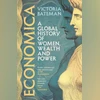
Economica: How women shaped the economy long before history sidelined them

The book is interested in not just the stories of the women who amassed immense wealth and wielded great power, but those whose quiet labour laid the building blocks of history

Economica: A Global History of Women, Wealth and Power
Neha Bhatt
5 min read Last Updated : Jan 01 2026 | 10:02 PM IST
Economica: A Global History of Women, Wealth and Power
by Victoria Bateman 
Published by Hachette
418 pages  ₹899
  We often assume economic history is made by men, while women are passive beneficiaries of the wealth created by their fathers, husbands and brothers.
 
In Economica: A Global History of Women, Wealth and Power, economic historian Victoria Bateman pushes back against this idea and tells the story of how women made the world rich.

Also Read

 
It’s a wide and expansive list: There’s Phryne, the richest woman in ancient Athens, Khadija, the uber wealthy businesswoman and first wife of Muhammad, Priscilla Wakefield, the writer who founded the first English bank for women and children, Madam Lagos, the most influential trader in Lagos, Ching Shih, a sex worker turned pirate who owned a fleet of ships and controlled trade in the South China Sea.
 
The book is interested in not just the stories of the women who amassed immense wealth and wielded great power, but those whose quiet labour laid the building blocks of history.
 
When Ms Bateman set out to write this book, she wondered if she would find enough material to fill its pages. As it turns out, she could have written many volumes and they still would not have covered it all.
 
“Women have never been missing from economic life, they have simply been hidden from view by those writing the history books,” she notes. Although the disparity between men and women’s work remains considerable even today, Ms Bateman demonstrates how “the pendulum has swung between periods in which women’s involvement in the economy has been welcomed and rewarded, and periods when it has been obstructed and rendered invisible.”
 
In doing so, the book is both surprising and illuminating. It brings together seemingly unconnected threads of history and micro stories from across the world and weaves them into a coherent, powerful narrative that offers a fine arc, from the beginning of human existence to contemporary times. It makes for an engrossing, if at times dense, read for anyone interested in global history, trade, economy and power through a gender perspective.
 
Spread across 12 chapters that focus on women’s economic contribution through the lenses of different periods and occupations in history, the book draws an extensive map to make that work visible. It also charts key economic moments and women’s role in them: from the birth of farming, the invention of bronze and iron, to the shift from feudalism to capitalism, the rise of empires and global trade, major wars, the Great Depression, and the coming of the technological age, among other pivotal developments.
 
In “Hunters, Farmers and Clothiers” we meet the women of the Stone Age, where women hunted alongside men, grinding and planting seeds that turned foragers into farmers. It was this economic revolution, and the move to a more settled life, where patriarchy and sexism first began to take root.
 
In “Doctors, Scribes and Innkeepers”, the women of the Bronze Age come into focus. Ancient Egypt, Mesopotamia, the Indus Valley, China, Peru — 5,000 years ago, women were busy building the world’s first civilisations. In some, they were enslaved, in others, free to do their trade. With time, divisions in gender and class began to widen. As Ms Bateman notes, growing warfare, the state’s desire for more people, and the increasing inequality were factors that pushed society in a more patriarchal direction.
 
The women of Ancient Greece — courtesans, poets, potters — fared worse. This distaste for women mirrored the anti-business culture in ancient Athens. In the time of merchants, property developers and moneylenders of Ancient Rome, women were pushed towards “extra baby-making”. As we move through history, we see what women experienced was a rollercoaster ride. Stories of women who held their own in business abound in “The Women of Pax Islamica”, although their paid labour was not actively encouraged by Islam.
 
“The Women of  China’s Golden Age — Inventors, Weavers, Spinners”, is particularly chilling in how it details a system that developed to shackle women, as state and family conspired to extract the value they created, even as the lives of women in parts of Europe were about to take a turn for the better. It’s a divergence that the author notes would sow the seeds of a major reversal in fortunes and spur the rise of the Western world. Also thoroughly fascinating are the sections that focus on “Women of the Creative Age” (scientist, bankers, writers) and those who lived and worked in the “Age of Colonisation” (Arms dealers, pirates, sex workers).
 
Economica  is an invaluable book that shows the intricate nature of how global wealth was built over centuries, but how, at various junctures, women’s work and contributions were erased, systematically chipping away at their collective power. The book restores women to the centre of economic history.
 
 
The reviewer is an independent journalist and author who writes on development, policy, public health and gender for global publications

One subscription. Two world-class reads.

Already subscribed? Log in

Subscribe to read the full story →
*Subscribe to Business Standard digital and get complimentary access to The New York Times

Smart Quarterly

₹900

3 Months

₹300/Month

SAVE 25%

Smart Essential

₹2,700

1 Year

₹225/Month

SAVE 46%
*Complimentary New York Times access for the 2nd year will be given after 12 months

Super Saver

₹3,900

2 Years

₹162/Month

Subscribe

Renews automatically, cancel anytime

Here’s what’s included in our digital subscription plans

Exclusive premium stories online

  • Over 30 premium stories daily, handpicked by our editors

Complimentary Access to The New York Times

  • News, Games, Cooking, Audio, Wirecutter & The Athletic

Business Standard Epaper

  • Digital replica of our daily newspaper — with options to read, save, and share

Curated Newsletters

  • Insights on markets, finance, politics, tech, and more delivered to your inbox

Market Analysis & Investment Insights

  • In-depth market analysis & insights with access to The Smart Investor

Archives

  • Repository of articles and publications dating back to 1997

Ad-free Reading

  • Uninterrupted reading experience with no advertisements

Seamless Access Across All Devices

  • Access Business Standard across devices — mobile, tablet, or PC, via web or app

Topics :BS ReadsBook readingBOOK REVIEWbooksReading

Next Story