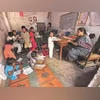
Less than three out of five higher secondary students attended government schools in rural areas in the current academic year, indicating a worrying trend of school children opting out of state-run schools and choosing private institutions for better education, according to the Comprehensive Modular Survey: Education (CMS: E), 2025 released on Tuesday.
Even as the share of students attending government schools increases with their schooling level in urban areas, it has come down in both the rural and urban areas in the past seven years, reveals a comparison of the latest data with the results of the 75th national sample survey (NSS) results released in 2019, which was the last government survey on education.
Data showed that 58.9 per cent higher secondary students attended government schools in rural areas in April to June 2025 period, as compared to 68 per cent from July 2017- June 2018.
Meanwhile, in the urban areas, the share of students attending government schools at higher secondary level came down to 36.4 per cent in April to June 2025 period, as compared to 38.9 per cent during the 2017-18 period.
This drive away of students from government schools is also witnessed at other levels of schooling as well.
In rural areas, the share of students attending government schools at primary, middle and secondary level stood at 66.5 per cent, 69.3 per cent and 65 per cent, respectively in April to June 2025 period, in comparison to 73.7 per cent, 76.1 per cent and 68 per cent, respectively during the 2017-18 period.
In urban areas, the share of students attending government schools at primary, middle and secondary level stood at 27.2 per cent, 29.8 per cent and 35.8 per cent, respectively in April to June 2025 period, in comparison to 30.9 per cent, 38 per cent and 38.9 per cent, respectively during the 2017-18 period.
However, driven by the changed methodology of the current survey, which includes anganwadi centres under pre-primary education, the share of students attending the government schools at pre-primary level increased in both the rural and urban areas to 65.6 per cent and 24.1 per cent, respectively in April to June 2025 period from 44.2 per cent and 13.9 per cent, respectively during the 2017-18 period.
This implies that despite government efforts to boost enrolment at lower levels, students drift away from government schools as they progress through their schooling years.
Among other findings, the latest survey also found that the average expenditure by a student on school education during the current academic year was estimated at ₹2,639 in government schools and ₹19,554 in non-government schools in rural areas. In urban areas, the same was estimated at ₹4,128 for government schools and ₹31,782 for non-government schools.
Nearly a third of all students (27 per cent) were taking or had taken private coaching during the current academic year. This trend was more common in urban areas (30.7 per cent) than in rural areas (25.5 per cent). The average expenditure by a student on private coaching during the current academic year was estimated at ₹1,793 in rural areas, with higher secondary students spending as much as ₹4,548. In urban areas, the same was estimated at ₹3,988, with higher secondary students spending as much as ₹9,950.
CMS: E was undertaken as part of the 80th round of the NSS during April-June 2025 and it focuses only on school education, as compared to the previous NSS survey where information on education was collected for all levels of education.
As part of the NSO’s strategy of implementing short-duration, focused surveys, CMS: E was undertaken at the behest of the Department of School Education and Literacy (DoSEL) during April -June 2025 and it focused only on school education, as compared to the previous NSS survey where information on education was collected for all levels of education.
The CMS: E was conducted in 2,384 villages and 1,982 urban blocks, covering 52,085 households (28,401 in rural areas and 23,684 in urban areas) and 221,617 students (126,079 in rural areas and 95,538 in urban areas). Education-related detailed information was collected for 57,742 students currently enrolled in schools.

 "Govt schools' share shrinks further: NSO's Comprehensive Modular Survey")



