As India confronts a fresh surge in Covid-19 cases, doctors suggest that the virus is disproportionately affecting younger age groups, with the 18-45 age bracket bearing the brunt of the infection.
According to data available on the Union health ministry’s Covid dashboard, India has 5,976 active cases from 29 states and Union Territories (UTs) as of June 19. Of these, Kerala has the highest caseload at 1,309, followed by Gujarat and Delhi at 1,046 and 632 cases, respectively.
While the government does not give an age- or gender-wise breakup of cases, doctors are seeing a noticeable increase in Covid-19 cases among young adults, specifically those aged between 18 and 45.
Tushar Tayal, consultant-internal medicine at CK Birla Hospital, Gurugram, said that on average, 10-12 patients per day were coming to him with flu-like symptoms and a small but steady percentage of them were testing positive for Covid-19.
“This may be indicative of a silent surge that is frequently overlooked because other viral infections overlap and (there’s) an overall reduction in the rate of testing,” he added.
Aakashneel Bhattacharya, consultant-infectious diseases at Paras Heath in Gurugram said that 80-85 per cent of Covid patients coming to him fell into the same 18-45 age bracket.
Young adults previously considered to be at relatively low risk of severe illness are now showing heightened susceptibility, particularly those with a poor follow-up history of vaccination or waning immunity.
Divya K S, an infectious disease specialist at Apollo Hospitals in Sheshadripuram, Bengaluru, said that waning immunity over the years, in addition to the emergence of immune-evading strains, made the younger population more vulnerable.
Tayal said that in the 18-25 age group, most came with high-grade fever, throat pain, tiredness, body pain, and sometimes gastrointestinal symptoms of nausea or diarrhoea. Some also complained of a dry cough lasting for days and mild difficulty in breathing.
In individuals over 30, symptoms persisted longer, and there were more instances of prolonged fatigue or post-viral cough, he added.
Commenting on the reasons, Bhattacharya said younger people were at high risk of contracting the infection as they were the ones who mostly went out and mixed up with other people in the community.
“Till now, we are not seeing patients developing serious pneumonia or having low oxygen saturation. While a few patients may have had minor pneumonia, they are not requiring oxygen,” he added.
Tayal, however, said that although most cases of Covid in younger patients were not serious, there should be caution against complacency. “Reinfections are being observed even in persons who have been vaccinated or infected before, pointing to changing viral strains,” he added.
Another reason was that many younger patients were delaying getting tested, assuming the infection to be a seasonal flu or viral fever, he further said.
Nidhin Mohan, consultant-internal medicine, Narayana Health City, Bengaluru, said that there was a spike among individuals who had recently travelled, especially for work or weddings, without taking adequate precautions.
“Infectious strains that spread faster within a group that is in close contact with each other can result in more case numbers among younger populations, who tend to be at the centre of workplace and social interactions,” said Deepesh G Aggarwal, consultant physician and head of department for critical care medicine at Saifee Hospital, Mumbai.

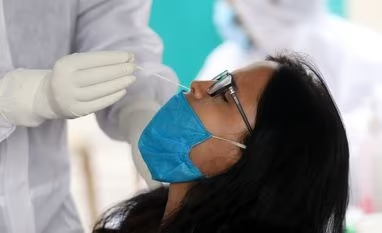 "Younger population seeing high rates of infection amid Covid surge: Experts")


 Connect with us on WhatsApp